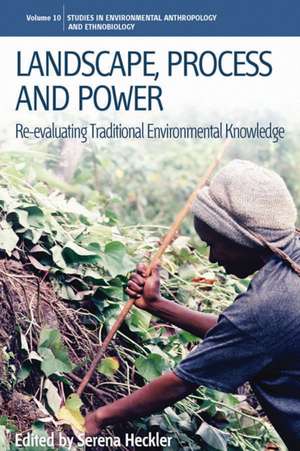
Landscape, Process and Power: Studies in Environmental Anthropology & Ethnobiology
Editat de Serena Heckleren Limba Engleză Paperback – 31 ian 2012
Remarcăm în Landscape, Process and Power o schimbare de paradigmă necesară în antropologia mediului: autorii propun un model analitic care respinge ideea că sistemele de cunoștințe tradiționale (TEK) sunt seturi de date statice ce pot fi extrase și aplicate mecanic în proiecte de dezvoltare. În schimb, volumul demonstrează că aceste cunoștințe sunt procese fluide, modelate continuu de forțe istorice și politice. Merită menționat că succesul acestui model rezidă în capacitatea de a ancora teoria în realități etnografice dure, unde angajamentul zilnic al oamenilor cu peisajul prevalează asupra definițiilor academice rigide.
Pe linia practică a lucrării Indigenous Enviromental Knowledge and its Transformations, dar cu un focus specific pe dinamica puterii și pe modul în care globalizarea economică reconfigurează identitățile locale, acest volum coordonat de Serena Heckler oferă o perspectivă critică asupra modului în care reprezentările științifice pot distorsiona realitatea indigenă. Notăm cu interes organizarea riguroasă a materialului: prima parte stabilește o genealogie a reprezentărilor științifice, urmată de o analiză a modului în care cunoașterea coexistă sau intră în conflict cu industriile globale și politicile de conservare, culminând cu studii despre managementul resurselor și etnobotanică.
Progresia argumentelor indică o acoperire exhaustivă, de la impactul economiei de piață asupra comunităților Wõthihã, până la gestionarea biodiversității în Papua Noua Guinee. Stilul este unul academic, dar extrem de aplicat, oferind instrumente metodologice pentru cei care doresc să înțeleagă de ce integrarea TEK în politicile de stat eșuează adesea atunci când ignoră contextul politic al comunităților respective.
Preț: 218.54 lei
Carte tipărită la comandă
Livrare economică 02-16 noiembrie
Specificații
ISBN-10: 085745613X
Pagini: 304
Dimensiuni: 152 x 229 x 16 mm
Greutate: 0.41 kg
Editura: BERGHAHN BOOKS INC
Seria Studies in Environmental Anthropology & Ethnobiology
V-ar putea interesa
-
 Preț: 305.74 lei
 -
 A Crisis of Waste?: Understanding the Rubbish SocietyMartin O'BrienPreț: 474.91 lei
 -
 -15%Preț: 458.10 lei538.94 lei
 -
 -18%Preț: 1254.12 lei1529.41 lei
 -
 -15%Preț: 467.90 lei550.47 lei
 -
 -18%Preț: 761.63 lei928.81 lei
 -
 Culture and Conservation: Beyond AnthropocentrismEleanor Shoreman-Ouimet-18%Preț: 1252.80 lei1527.80 lei
 -
 Anthropology and RiskAsa BoholmPreț: 457.15 lei
 -
 Infrastructural Lives: Urban Infrastructure in ContextStephen Graham-15%Preț: 516.51 lei607.66 lei
 -
 Environmental Anthropology TodayHelen KopninaPreț: 476.75 lei
 -
 Preț: 343.38 lei
 -
 -18%Preț: 1310.81 lei1598.56 lei
 -
 -15%Preț: 424.09 lei498.92 lei
 -
 The Social Life of Climate Change Models: Anticipating NatureKirsten Hastrup-15%Preț: 458.46 lei539.37 lei
 -
 -18%Preț: 1253.77 lei1528.98 lei
 -
 -18%Preț: 1251.35 lei1526.04 lei
 -
 The Consequences of Global DisastersEric L. HsuPreț: 472.93 lei
 -
 Climate Action Upsurge: The Ethnography of Climate Movement PoliticsStuart RosewarnePreț: 459.46 lei
 -
 Environmental Anthropology: Future DirectionsHelen KopninaPreț: 410.87 lei
 -
 Anthropology and NatureKirsten HastrupPreț: 380.41 lei
 -
 Preț: 436.39 lei
 -
 Preț: 112.71 lei
De ce să citești această carte
Această carte se adresează cercetătorilor în antropologie, economie socială și practicienilor din domeniul dezvoltării durabile. Cititorul câștigă o înțelegere critică a motivelor pentru care metodele științifice convenționale eșuează adesea în descrierea cunoștințelor indigene. Este o resursă esențială pentru a învăța cum să navighezi între cerințele economiei globale și dreptul popoarelor locale de a-și gestiona propriul mediu și patrimoniu cultural.
Despre autor
Serena Heckler este un cercetător recunoscut, cu un doctorat în etnobotanică, antropologie de mediu și dezvoltare durabilă obținut la Universitatea Cornell. Activitatea sa academică este dublată de o vastă experiență de teren, trăind și lucrând alături de comunitățile Wõthihã din Amazonul venezuelean. În prezent, este cercetător asociat la Universitatea Durham și colaborează cu Universitatea Interculturală Amawtay Wasi din Ecuador. Expertiza sa se concentrează pe modul în care economia de piață și schimbările demografice transformă sistemele de cunoștințe tradiționale, oferind o perspectivă autentică și documentată asupra regiunilor studiate.
Descriere
...presents an excellent overview of the study of traditional environmental knowledge (TEK) and the directions in which it has evolved in recent years...Individually but especially together, the contributors of this volume do a fine job at providing a contextualized and fluid understanding of TEK...I have no hesitation in recommending this volume not only to anyone wishing to catch up on recent developments in TEK research, but also as a useful teaching resource in a range of anthropology courses. JRAIThis volume succeeds in its purpose to dislodge enduring western notions of TEK [traditional environmental knowledge] as static and to firmly center it within an analytical framework of landscape, process, and power...The critical perspectives of the authors of this book would prompt lively discussion in the classroom, and the books grounding in ethnographic detail and applications are of interest to both research academics and practitioners. Ethnobiology Letters
In recent years, the field of study variously called local, indigenous or traditional environmental knowledge (TEK) has experienced a crisis brought about by the questioning of some of its basic assumptions. This has included reassessing notions that scientific methods can accurately elicit and describe TEK or that incorporating it into development projects will improve the physical, social or economic well-being of marginalized peoples. The contributors to this volume argue that to accurately and appropriately describe TEK, the historical and political forces that have shaped it, as well as people's day-to-day engagement with the landscape around them must be taken into account. TEK thus emerges, not as an easily translatable tool for development experts, but as a rich and complex element of contemporary lives that should be defined and managed by indigenous and local peoples themselves.
Serena Heckler received her Ph.D. in ethnobotany, environmental anthropology and sustainable development from Cornell University and is a research fellow at Durham University. She has lived and worked with the Wõthihã of the Venezuelan Amazon, studying the ways in which the market economy and demographic change have affected their environmental knowledge. She is currently undertaking participatory research on similar themes with the Shuar of Ecuador, in collaboration with the Intercultural University of Indigenous Peoples and Nations-Amawtay Wasi based in Quito, Ecuador.