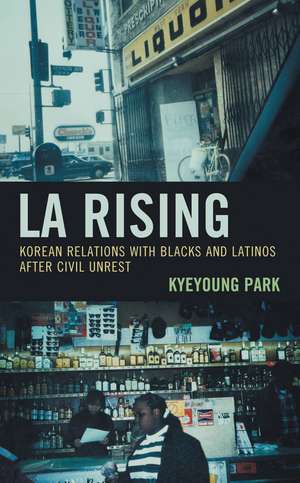
LA Rising
Autor Kyeyoung Parken Limba Engleză Hardback – 22 aug 2019
For more information, click here: https://lasocialscience.ucla.edu/2021/02/24/la-social-science-book-series-on-korean-intergroup-relations-in-la-with-professor-kyeyoung-park/
Preț: 791.07 lei
Preț vechi: 964.72 lei
-18%
Puncte Express: 1187
Carte tipărită la comandă
Livrare economică 27 noiembrie-11 decembrie
Livrare prin curier în România Termenul estimat este afișat lângă disponibilitate.
Transport gratuit pentru acest produs Plată online sau ramburs, în funcție de opțiunile comenzii.
Retur gratuit în 14 zile Comandă securizată și suport în română.
Specificații
ISBN-13: 9781498577052
ISBN-10: 1498577059
Pagini: 330
Ilustrații: 12 b/w photos; 3 tables;
Dimensiuni: 157 x 235 x 22 mm
Greutate: 0.63 kg
Editura: Bloomsbury Publishing
Locul publicării:New York, United States
ISBN-10: 1498577059
Pagini: 330
Ilustrații: 12 b/w photos; 3 tables;
Dimensiuni: 157 x 235 x 22 mm
Greutate: 0.63 kg
Editura: Bloomsbury Publishing
Locul publicării:New York, United States
Cuprins
Part I: Korean, African, and Latin Americans in South Los Angeles
Introduction: Theoretical Interpretations of Ethnic Tension
Chapter 1: The Political Economy of Ethno-Racial Identities in South Los Angeles
Part II: Black-Korean Tension Before the Unrest
Chapter 2: Disentangling "Race and Racism"
Chapter 3: Culture, Race, and Clash
Chapter 4: Triangulating Class at the Crossroads of Race and Ethnicity
Part III: Black, Latino, and Korean Relations after the Unrest: How Race and Ethnicity Have Become the Expresser of Changing Class Relations
Chapter 5: Class Relations of Surveillance
Chapter 6: Changing the Business Plan: Korean Merchants Try to Reintegrate into the South LA Community
Chapter 7: Ethnic Tension in the Aftermath: "Rebuilding LA without Liquor Stores"
Part IV: Conclusion
Chapter 8: An Analysis of Latino-Korean Relations in the Workplace: Latino Perspectives in the Aftermath of the 1992 Los Angeles Civil Unrest
Chapter 9: The Racial Cartography of Post-Unrest LA
Introduction: Theoretical Interpretations of Ethnic Tension
Chapter 1: The Political Economy of Ethno-Racial Identities in South Los Angeles
Part II: Black-Korean Tension Before the Unrest
Chapter 2: Disentangling "Race and Racism"
Chapter 3: Culture, Race, and Clash
Chapter 4: Triangulating Class at the Crossroads of Race and Ethnicity
Part III: Black, Latino, and Korean Relations after the Unrest: How Race and Ethnicity Have Become the Expresser of Changing Class Relations
Chapter 5: Class Relations of Surveillance
Chapter 6: Changing the Business Plan: Korean Merchants Try to Reintegrate into the South LA Community
Chapter 7: Ethnic Tension in the Aftermath: "Rebuilding LA without Liquor Stores"
Part IV: Conclusion
Chapter 8: An Analysis of Latino-Korean Relations in the Workplace: Latino Perspectives in the Aftermath of the 1992 Los Angeles Civil Unrest
Chapter 9: The Racial Cartography of Post-Unrest LA
Recenzii
Based on extensive ethnographic fieldwork before and after the Los Angeles unrest in 1992, this study focuses on the relations among African Americans, Latinos, and Koreans in an area that was undergoing rapid demographic and economic changes. Race, class, citizenship, and culture were the axes in a "racial cartography" of structural inequality that impacted the hierarchical power relations and conflicts among the three groups. Illuminating and innovative, the insights here are highly pertinent to those interested in the future of race relations in this country.
Advancing a generative concept of "racial cartography," Park deftly illustrates how different axes of inequality-race, class, culture, and citizenship-profoundly shape the types and overall tenor of relations between groups of color. Drawing upon ethnographic and interview data, Park highlights not only patterns of resentment and conflict between racialized groups, but moments of understanding and cooperation as well.
Taking as its axis the violent unrest following the Rodney King verdict in 1992 and reaching back to the Watts rebellion of 1965 and forward to the present, this powerful study tracks the forces of race, class, culture and citizenship as they have shaped relations among Koreans, Blacks and Latinos in South Los Angeles over the last four decades of increasing US income inequality. During the charged and economically devastated post-King moment and the following period of community mobilization, Kyeyoung Park and her multi-ethnic team of researchers documented the uncensored voices of residents negotiating what Park calls the multipolar "racial cartography" of the inner city. Park's neo-Marxist ethnographic analysis bravely and directly confronts both the structural causes and the intense interpersonal manifestations of racial and ethnic inequality. The resulting picture defies easy stereotyping: it will surprise you, disturb you, and above all broaden your understanding of the profound impact of racialized capitalism in America.
Advancing a generative concept of "racial cartography," Park deftly illustrates how different axes of inequality-race, class, culture, and citizenship-profoundly shape the types and overall tenor of relations between groups of color. Drawing upon ethnographic and interview data, Park highlights not only patterns of resentment and conflict between racialized groups, but moments of understanding and cooperation as well.
Taking as its axis the violent unrest following the Rodney King verdict in 1992 and reaching back to the Watts rebellion of 1965 and forward to the present, this powerful study tracks the forces of race, class, culture and citizenship as they have shaped relations among Koreans, Blacks and Latinos in South Los Angeles over the last four decades of increasing US income inequality. During the charged and economically devastated post-King moment and the following period of community mobilization, Kyeyoung Park and her multi-ethnic team of researchers documented the uncensored voices of residents negotiating what Park calls the multipolar "racial cartography" of the inner city. Park's neo-Marxist ethnographic analysis bravely and directly confronts both the structural causes and the intense interpersonal manifestations of racial and ethnic inequality. The resulting picture defies easy stereotyping: it will surprise you, disturb you, and above all broaden your understanding of the profound impact of racialized capitalism in America.