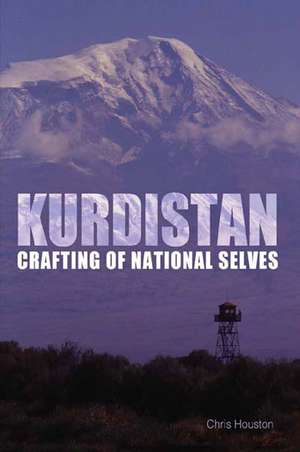
Kurdistan: Crafting of National Selves
Autor Christopher Houstonen Limba Engleză Paperback – iun 2008
Preț: 199.03 lei
Preț vechi: 266.51 lei
-25%
Puncte Express: 299
Carte disponibilă
Livrare economică 14-28 noiembrie
Livrare prin curier în România Termenul estimat este afișat lângă disponibilitate.
Transport gratuit de la 400.00 lei Plată online sau ramburs, în funcție de opțiunile comenzii.
Retur gratuit în 14 zile Comandă securizată și suport în română.
Specificații
ISBN-13: 9781845202699
ISBN-10: 1845202694
Pagini: 256
Dimensiuni: 156 x 232 x 12 mm
Greutate: 0.3 kg
Editura: Bloomsbury Publishing
Colecția Berg Publishers
Locul publicării:London, United Kingdom
ISBN-10: 1845202694
Pagini: 256
Dimensiuni: 156 x 232 x 12 mm
Greutate: 0.3 kg
Editura: Bloomsbury Publishing
Colecția Berg Publishers
Locul publicării:London, United Kingdom
Cuprins
Introduction Chapter 1: Nationalizing Origins: Imagining the Ottoman Empire and Kurdistan Chapter 2: 'Set aside from the Pen and Cut off from the Foot': Imagining the Ottoman Empire and Kurdistan Chapter 3: Representing Kurds: A Brief History of Kurds and Kurdistan in Ethnography Chapter 4: Kemalism and the Crafting of National Selves in Kurdistan Chapter 5: Kurdish Inhabitation of the 'Kemalist City' Conclusion
Recenzii
The book opens new horizons toward the understanding of the Kurdish question as a major problem in the Middle East.
This book is not so much about how Kurds imagine their nation and construct their identities as members of it, but more about how the nation-states where Kurds live mould the national identities to which Kurds are expected to conform. And a very chilly, top-down power dynamic it looks too, despite the author's commendable insistence on the plurality of Kurdish communities, the dimension of gender (rarely seen in writings on Kurds) and issues of individual and negotiation.
[T]he study is valuable for an understanding of how the history of the Kurds was shaped, especially in Turkey, and it promotes a discussion of the history of the Kurds by exposing many problematic issues in various studies dealing with them.
This book is not so much about how Kurds imagine their nation and construct their identities as members of it, but more about how the nation-states where Kurds live mould the national identities to which Kurds are expected to conform. And a very chilly, top-down power dynamic it looks too, despite the author's commendable insistence on the plurality of Kurdish communities, the dimension of gender (rarely seen in writings on Kurds) and issues of individual and negotiation.
[T]he study is valuable for an understanding of how the history of the Kurds was shaped, especially in Turkey, and it promotes a discussion of the history of the Kurds by exposing many problematic issues in various studies dealing with them.