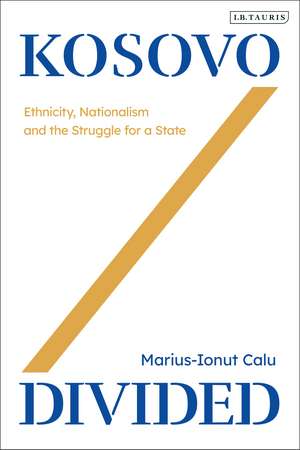
Kosovo Divided: Ethnicity, Nationalism and the Struggle for a State
Autor Marius-Ionut Caluen Limba Engleză Paperback – 21 oct 2021
Preț: 236.32 lei
Preț vechi: 307.67 lei
-23%
Puncte Express: 354
Carte tipărită la comandă
Livrare economică 02-16 decembrie
Livrare prin curier în România Termenul estimat este afișat lângă disponibilitate.
Transport gratuit de la 400.00 lei Plată online sau ramburs, în funcție de opțiunile comenzii.
Retur gratuit în 14 zile Comandă securizată și suport în română.
Specificații
ISBN-13: 9780755637249
ISBN-10: 0755637240
Pagini: 264
Dimensiuni: 150 x 234 x 18 mm
Greutate: 0.4 kg
Editura: Bloomsbury Publishing
Colecția I.B.Tauris
Locul publicării:London, United Kingdom
ISBN-10: 0755637240
Pagini: 264
Dimensiuni: 150 x 234 x 18 mm
Greutate: 0.4 kg
Editura: Bloomsbury Publishing
Colecția I.B.Tauris
Locul publicării:London, United Kingdom
Cuprins
Introduction
1 Statebuilding and Multiethnic Governance
2 Post-conflict and Post-independence Statebuilding in Kosovo
3 The Integration, Accommodation and Protection of Kosovo Serbs
4 Non-dominant Minorities in Kosovo
5 Managing Diversity through Decentralization
Conclusion: The Struggle Continues
1 Statebuilding and Multiethnic Governance
2 Post-conflict and Post-independence Statebuilding in Kosovo
3 The Integration, Accommodation and Protection of Kosovo Serbs
4 Non-dominant Minorities in Kosovo
5 Managing Diversity through Decentralization
Conclusion: The Struggle Continues
Recenzii
By exposing the unintended consequences of the internationally engineered management of diversity that both weakened the state and hampered integration of minorities in post-conflict Kosovo, Calu makes a crucial and indispensable argument for examining the fatal gap between state-building templates and state-building practices.
Marius Calu's empirically rich and theoretically robust analysis is a fascinating, and original contribution. By highlighting how the ambitious aspirations of liberal state-building floundered when implemented in Kosovo, Calu demonstrates that externally contrived policies designed to facilitate plurality and multi-ethnic harmony, had a series of unintended negative consequences. The book's findings have great relevance beyond Kosovo and should be read by all those interested in managing divergent identities within the modern state.
This valuable work carefully analyses the gap between the rhetoric and practice of building a multi-ethnic Kosovo. Importantly, it goes beyond the Serbian community and considers other often overlooked groups, such as Roma, Ashkali and Bosniaks. This makes it a particularly welcome contribution to our understanding of contemporary Kosovo.
Marius Calu's empirically rich and theoretically robust analysis is a fascinating, and original contribution. By highlighting how the ambitious aspirations of liberal state-building floundered when implemented in Kosovo, Calu demonstrates that externally contrived policies designed to facilitate plurality and multi-ethnic harmony, had a series of unintended negative consequences. The book's findings have great relevance beyond Kosovo and should be read by all those interested in managing divergent identities within the modern state.
This valuable work carefully analyses the gap between the rhetoric and practice of building a multi-ethnic Kosovo. Importantly, it goes beyond the Serbian community and considers other often overlooked groups, such as Roma, Ashkali and Bosniaks. This makes it a particularly welcome contribution to our understanding of contemporary Kosovo.