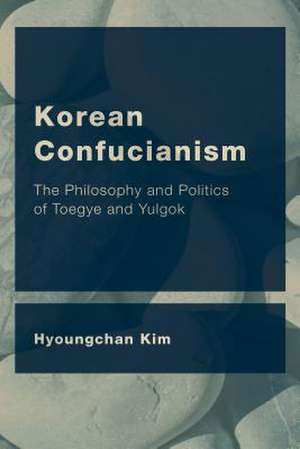
Korean Confucianism: The Philosophy and Politics of Toegye and Yulgok
Autor Hyoungchan Kimen Limba Engleză Hardback – 16 oct 2018
| Toate formatele și edițiile | Preț | Express |
|---|---|---|
| Paperback (1) | 247.56 lei 43-57 zile | |
| Bloomsbury Publishing – 16 oct 2018 | 247.56 lei 43-57 zile | |
| Hardback (1) | 693.75 lei 43-57 zile | |
| Bloomsbury Publishing – 16 oct 2018 | 693.75 lei 43-57 zile |
Preț: 693.75 lei
Preț vechi: 1112.44 lei
-38%
Puncte Express: 1041
Preț estimativ în valută:
122.67€ • 141.77$ • 105.98£
122.67€ • 141.77$ • 105.98£
Carte tipărită la comandă
Livrare economică 04-18 mai
Specificații
ISBN-13: 9781786608604
ISBN-10: 178660860X
Pagini: 288
Dimensiuni: 154 x 232 x 22 mm
Greutate: 0.5 kg
Editura: Bloomsbury Publishing
Colecția Rowman & Littlefield
Locul publicării:New York, United States
ISBN-10: 178660860X
Pagini: 288
Dimensiuni: 154 x 232 x 22 mm
Greutate: 0.5 kg
Editura: Bloomsbury Publishing
Colecția Rowman & Littlefield
Locul publicării:New York, United States
Cuprins
Preface / 1. The Enduring Dialog of Toegye and Yulgok / 2. The First Encounter / 3. Yulgok Asks and Toegye Answers 1 (in May, 1558) / 4. The Four Beginnings and Seven Feelings: Eight-Year Debate between Toegye and Kobong / 5. Yulgok Asks and Toegye Answers 2: On The Doctrine of the Mean / 6. Yulgok Asks and Toegye Answers 3: On Ten Diagrams on Sage Learning / 7. The Four Beginnings and Seven Feelings; the Human Mind and the Moral Mind / 8. The Politics of the Royal Court / 9. Conclusion: The Resolution of the King and Retainers' Adherence to Confucian Ideals
Recenzii
Korean Confucianism is an excellent introduction to Neo-Confucianism in Korea which discusses the on-going philosophical discourse between two major philosophical figures of the sixteenth century. Part biography, the book's narrative and analysis is enriched with many translated texts accompanied by the original text. This book could become the English-language standard work.
This book is arguably the most comprehensive comparative analysis of the two most influential Korean Neo-Confucian scholars, Yi Toegye and Yi Yulgok, available in English. It is a clear and concise summary of highly sophisticated issues surrounding these scholars. I highly recommend this book for anyone interested in Korean intellectual history and philosophical debates.
Korean Confucianism: ThePhilosophy and Politics of Toegye and Yulgok belongs on the bookshelf of anyone interested in the history of Confucianism. With eloquence and insight, it shows of how two 16th century scholars, who were master and disciple as well as political rivals, revitalized Neo-Confucianism by promoting Confucian self-cultivation and Confucian ideal governance. Armed with deep learning, Hyoungchan Kim illuminates the philosophical as well as the political complexities of Confucianism in Joseon Dynasty. One cannot imagine a more enlightening account of the lived realities of Korean Confucianism in philosophical and political life.
Professor Hyoungchan Kim's Korean Confucianism: The Philosophy and Politics of Toegye and Yulgok is an important contribution to the emerging field of Korean traditional philosophy in general and Korean Neo-Confucianism in particular. This delightful, clear and detailed discussion of the Neo-Confucian philosophical and political visions on the part of Toegye and Yulgok goes a long way in clarifying the significant interconnections of the two different yet related visions in a new light. In particular, it takes readers on a stimulating, challenging and rewarding journey into the intricate workings of the mind, feelings and human nature through the eyes of the two towering Korean philosophers. It will be a must-read primer for anyone considering entering the field of Korean Confucianism in the decades to come.
This book is arguably the most comprehensive comparative analysis of the two most influential Korean Neo-Confucian scholars, Yi Toegye and Yi Yulgok, available in English. It is a clear and concise summary of highly sophisticated issues surrounding these scholars. I highly recommend this book for anyone interested in Korean intellectual history and philosophical debates.
Korean Confucianism: ThePhilosophy and Politics of Toegye and Yulgok belongs on the bookshelf of anyone interested in the history of Confucianism. With eloquence and insight, it shows of how two 16th century scholars, who were master and disciple as well as political rivals, revitalized Neo-Confucianism by promoting Confucian self-cultivation and Confucian ideal governance. Armed with deep learning, Hyoungchan Kim illuminates the philosophical as well as the political complexities of Confucianism in Joseon Dynasty. One cannot imagine a more enlightening account of the lived realities of Korean Confucianism in philosophical and political life.
Professor Hyoungchan Kim's Korean Confucianism: The Philosophy and Politics of Toegye and Yulgok is an important contribution to the emerging field of Korean traditional philosophy in general and Korean Neo-Confucianism in particular. This delightful, clear and detailed discussion of the Neo-Confucian philosophical and political visions on the part of Toegye and Yulgok goes a long way in clarifying the significant interconnections of the two different yet related visions in a new light. In particular, it takes readers on a stimulating, challenging and rewarding journey into the intricate workings of the mind, feelings and human nature through the eyes of the two towering Korean philosophers. It will be a must-read primer for anyone considering entering the field of Korean Confucianism in the decades to come.