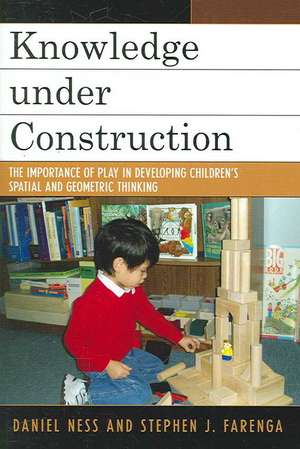
Knowledge under Construction: The Importance of Play in Developing Children's Spatial and Geometric Thinking
Autor Daniel Ness, Stephen J. Farengaen Limba Engleză Paperback – 26 mar 2007
Preț: 379.68 lei
Preț vechi: 508.62 lei
-25%
Puncte Express: 570
Carte tipărită la comandă
Livrare economică 30 noiembrie-14 decembrie
Livrare prin curier în România Termenul estimat este afișat lângă disponibilitate.
Transport gratuit de la 400.00 lei Plată online sau ramburs, în funcție de opțiunile comenzii.
Retur gratuit în 14 zile Comandă securizată și suport în română.
Specificații
ISBN-13: 9780742547896
ISBN-10: 0742547892
Pagini: 282
Dimensiuni: 153 x 233 x 19 mm
Greutate: 0.46 kg
Editura: Bloomsbury Publishing
Colecția Rowman & Littlefield
Locul publicării:New York, United States
ISBN-10: 0742547892
Pagini: 282
Dimensiuni: 153 x 233 x 19 mm
Greutate: 0.46 kg
Editura: Bloomsbury Publishing
Colecția Rowman & Littlefield
Locul publicării:New York, United States
V-ar putea interesa
-
 -23%Preț: 872.40 lei1133.00 lei
 -
 -29%Preț: 185.78 lei260.72 lei
 -
 Preț: 416.51 lei
 -
 Preț: 419.08 lei
 -
 Preț: 447.42 lei
 -
 Developmental Cognitive Science Goes to SchoolNancy L. Stein-15%Preț: 456.89 lei537.52 lei
 -
 Constructivist Instruction: Success or Failure?Sigmund Tobias-15%Preț: 529.17 lei622.55 lei
 -
 Schools for All Kinds of MindsMary-Dean BarringerPreț: 163.65 lei
 -
 The Cambridge Handbook of LiteracyDavid R. Olson-11%Preț: 448.07 lei503.45 lei
 -
 Preț: 389.74 lei
 -
 The Anti-Bullying HandbookKeith Sullivan-15%Preț: 543.20 lei639.06 lei
 -
 Success Comes in Cans: Learning Lessons for LifeKriss Akabusi-20%Preț: 118.45 lei148.80 lei
Cuprins
Chapter 1 Spatial, Geometric, and Architectural Thinking: The Big Picture
Chapter 2 Developmental Perspectives on Spatial and Geometric Thinking
Chapter 3 Children as Architects: The Identification of Architectural Principles Underlying Young Children's Geometric Constructions
Chapter 4 Contextual Observation: The Assessment for Measuring Spatial, Geometric, and Architectural Thinking of Young Children (SPAGAR)
Chapter 5 Age, Gender, Socioeconomic Status Factors in Spatial, Geometric, and Architectural Thinking
Chapter 6 Constructing Alone: Cases 1 and 2
Chapter 7 Constructing Interactively: Cases 3 and 4
Chapter 8 Beyond the Blocks: Implementing Praxis
Chapter 2 Developmental Perspectives on Spatial and Geometric Thinking
Chapter 3 Children as Architects: The Identification of Architectural Principles Underlying Young Children's Geometric Constructions
Chapter 4 Contextual Observation: The Assessment for Measuring Spatial, Geometric, and Architectural Thinking of Young Children (SPAGAR)
Chapter 5 Age, Gender, Socioeconomic Status Factors in Spatial, Geometric, and Architectural Thinking
Chapter 6 Constructing Alone: Cases 1 and 2
Chapter 7 Constructing Interactively: Cases 3 and 4
Chapter 8 Beyond the Blocks: Implementing Praxis
Recenzii
For preschool educators as well as interested developmental researchers, Knowledge under Construction offers a succinct, useful introduction to the topic, delineating various aspects of spatial, geometric, and architectural thinking and related theoretical perspectives that can be brought to bear on children's construction play. The book also contains helpful pedagogical features such as a set of topics and questions at the end of each chapter for discussion. Major contributions of the book are in situating this important developmental topic in natural settings (young children's spontaneous construction play) and in pointing to some promising directions regarding how this knowledge can shed light on preschool and elementary education, particularly in science and mathematics.
Daniel Ness and Stephen Farenga demonstrate that there is more going on during free play than previously presumed; specifically, they delineate emergent mathematical and scientific thinking....The unique characteristic of this book is the study of young children as architects manipulating blocks during play, and the identification of architectural principles underlying the development of spatial and geometric thinking.
This is a fascinating book that explores how young children construct knowledge with regard to the spatial and geometric aspects of behavior during block play....The boko has a contribution to make in mathematics, early childhood education, and the field of cognitive sciences. The research is a pioneering study in an area where little data currently exists and serves as a catalyst for further investigations into the importance of play, cognitive development, and success in school.
Significant for educators, parents, and researchers.... These are important findings that buttress the instructional goals of the National Council of Teachers of mathematics (NCTM) for young learners.... Thought-provoking quotes and...expansive use of examples.... The authors provide insights into the implications of the research for those concerned with the education of young children. This is one of the most comprehensive works to date on the spatial, geometric, and architectural thinking of young children. Overall, this book significantly contributes to our understanding of the oftentimes overlooked mathematical abilities of our youngest learners.
This is a well-written, abundantly documented volume whose authors achieve their aim: to identify and define values and significance inherent in or related to young children's block play. This is an area of research heretofore somewhat neglected or underestimated with regard to various dimensions of the child's mathematical and scientific development. Daniel Ness and Stephen Farenga demonstrate that there is more going on during free play than previously presumed; specifically, they delineate emergent mathematical and scientific behaviors that form the basis for the development of mathematical and scientific thinking.
Despite its importance in early childhood mathematics education, young children's block play has seldom been investigated in depth. But now the field is fortunate to have Ness and Farenga's detailed study of young children's use of blocks to explore basic ideas of space, geometry, and even architecture. This book shows how intellectually rich the opportunities that block play offers are, and how children-regardless of gender and socioeconomic status-make splendid and surprising use of them. This book should be of vital interest to early childhood educators!
The work of Ness and Farenga can meet the needs of early childhood educators by helping them understand how the everyday actions of young children in block play summon spatial characteristics and how educators can support the continued learning of young children through free play, rather than through more formal learning methods.
Daniel Ness and Stephen Farenga demonstrate that there is more going on during free play than previously presumed; specifically, they delineate emergent mathematical and scientific thinking....The unique characteristic of this book is the study of young children as architects manipulating blocks during play, and the identification of architectural principles underlying the development of spatial and geometric thinking.
This is a fascinating book that explores how young children construct knowledge with regard to the spatial and geometric aspects of behavior during block play....The boko has a contribution to make in mathematics, early childhood education, and the field of cognitive sciences. The research is a pioneering study in an area where little data currently exists and serves as a catalyst for further investigations into the importance of play, cognitive development, and success in school.
Significant for educators, parents, and researchers.... These are important findings that buttress the instructional goals of the National Council of Teachers of mathematics (NCTM) for young learners.... Thought-provoking quotes and...expansive use of examples.... The authors provide insights into the implications of the research for those concerned with the education of young children. This is one of the most comprehensive works to date on the spatial, geometric, and architectural thinking of young children. Overall, this book significantly contributes to our understanding of the oftentimes overlooked mathematical abilities of our youngest learners.
This is a well-written, abundantly documented volume whose authors achieve their aim: to identify and define values and significance inherent in or related to young children's block play. This is an area of research heretofore somewhat neglected or underestimated with regard to various dimensions of the child's mathematical and scientific development. Daniel Ness and Stephen Farenga demonstrate that there is more going on during free play than previously presumed; specifically, they delineate emergent mathematical and scientific behaviors that form the basis for the development of mathematical and scientific thinking.
Despite its importance in early childhood mathematics education, young children's block play has seldom been investigated in depth. But now the field is fortunate to have Ness and Farenga's detailed study of young children's use of blocks to explore basic ideas of space, geometry, and even architecture. This book shows how intellectually rich the opportunities that block play offers are, and how children-regardless of gender and socioeconomic status-make splendid and surprising use of them. This book should be of vital interest to early childhood educators!
The work of Ness and Farenga can meet the needs of early childhood educators by helping them understand how the everyday actions of young children in block play summon spatial characteristics and how educators can support the continued learning of young children through free play, rather than through more formal learning methods.