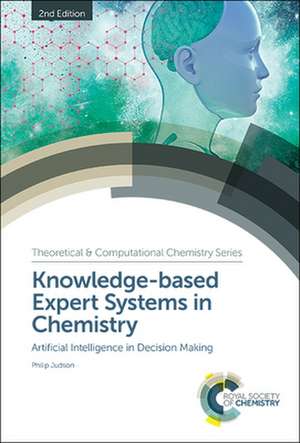
Knowledge-Based Expert Systems in Chemistry
Autor Philip Judsonen Limba Engleză Hardback – 15 feb 2019
Preț: 1074.61 lei
Preț vechi: 1452.18 lei
-26%
Puncte Express: 1612
Carte disponibilă
Livrare economică 06-20 noiembrie
Livrare express 22-28 octombrie pentru 35.87 lei
Livrare prin curier în România Termenul estimat este afișat lângă disponibilitate.
Transport gratuit pentru acest produs Plată online sau ramburs, în funcție de opțiunile comenzii.
Retur gratuit în 14 zile Comandă securizată și suport în română.
Specificații
ISBN-13: 9781788014717
ISBN-10: 1788014715
Pagini: 284
Ilustrații: No
Dimensiuni: 163 x 236 x 20 mm
Greutate: 0.59 kg
Ediția:Nouă
Editura: RSC Publishing
ISBN-10: 1788014715
Pagini: 284
Ilustrații: No
Dimensiuni: 163 x 236 x 20 mm
Greutate: 0.59 kg
Ediția:Nouă
Editura: RSC Publishing
V-ar putea interesa
-
 What's Inside My Computer?Christine Zuchora-Walske-18%Preț: 44.14 lei53.60 lei
 -
 -5%Preț: 526.72 lei554.43 lei
Cuprins
Introduction Knowledge-Based Approach to Synthesis Planning EROS and CAMEO Spin-off from the Harvard project Structure, sub-structure and super-structure searching - technical Structure representations Explicit and implicit hydrogen atoms Aromaticity, tautomerism, stereochemistry Predicting toxicity - DEREK PHARM-MATCH and TOX-MATCH, Oncologic, and HazardExpert TopKat and Multicase The 2D/2.5D/3D debate Using reasoning - Derek for Windows Predicting metabolism - Meteor Relative reasoning Biodegradation Other potential applications Consensus modelling Evaluation and Validation Conclusions/Where now?
Notă biografică
Philip Judson studied chemistry at the University of Manchester before working on the synthesis of novel herbicides and fungicides for Fisons. When computing started being used in chemistry he made a change of career which later led to his becoming Head of Chemical Information and Computing for Schering AG. He was one of the founders of Lhasa Limited, a not-for-profit company specialising in knowledge-based expert systems in chemistry including the widely-used Derek for Windows system for predicting chemical toxicity. His research interests centre on the use of non-numerical reasoning methods for computer prediction of chemical toxicity, metabolism, and degradation. He developed and maintains software for chemical hazard classification and material safety data sheet management which are supplied by his company, Lexeus Limited.
Textul de pe ultima copertă
This is currently the only book available on the development of knowledge-based, and related, expert systems in chemistry and toxicology. Written by a pioneer in the field, it shows how computers can work with qualitative information where precise numerical methods are not satisfactory. An underlying theme is the current concern in society about the conflicts between basing decisions on reasoned judgements and wanting precise decisions and measurable effectiveness. As well as explaining how the computer programs work, the book provides insights into how personal and political factors influence scientific progress. The introduction of regulations such as REACH in Europe and modifications to UN and OECD Guidelines on assessment of chemical hazard mean that the use of toxicity prediction is at a turning point. They put a heavy burden on the chemical industry but, for the first time, allow for the use of computer prediction to support or replace in vivo and in vitro experiments. There is increasing recognition among scientists and regulators that qualitative computer methods have much to offer and that in some circumstances they may be more reliable and informative than quantitative methods. This excellent introduction to a field where employment opportunities are growing is aimed at students, scientists and academics with a knowledge of chemistry.