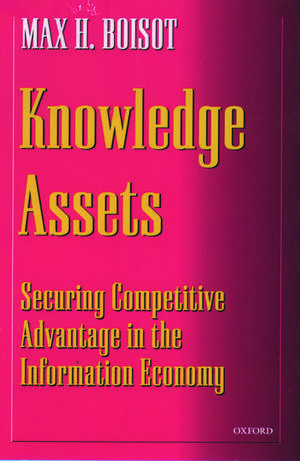
Knowledge Assets: Securing Competitive Advantage in the Information Economy
Autor Max H. Boisoten Limba Engleză Paperback – 23 sep 1999
Preț: 595.54 lei
Preț vechi: 773.84 lei
-23%
Puncte Express: 893
Carte tipărită la comandă
Livrare economică 04-15 decembrie
Livrare prin curier în România Termenul estimat este afișat lângă disponibilitate.
Transport gratuit pentru acest produs Plată online sau ramburs, în funcție de opțiunile comenzii.
Retur gratuit în 14 zile Comandă securizată și suport în română.
Specificații
ISBN-13: 9780198296072
ISBN-10: 019829607X
Pagini: 308
Ilustrații: numerous figures, and tables
Dimensiuni: 156 x 234 x 18 mm
Greutate: 0.48 kg
Ediția:Revised
Editura: OUP OXFORD
Colecția OUP Oxford
Locul publicării:Oxford, United Kingdom
ISBN-10: 019829607X
Pagini: 308
Ilustrații: numerous figures, and tables
Dimensiuni: 156 x 234 x 18 mm
Greutate: 0.48 kg
Ediția:Revised
Editura: OUP OXFORD
Colecția OUP Oxford
Locul publicării:Oxford, United Kingdom
V-ar putea interesa
-
 Preț: 256.72 lei
 -
 -15%Preț: 643.21 lei756.72 lei
 -
 The Infinite AlphabetCésar A. HidalgoPreț: 191.23 lei
 -
 NonlinearJohn MaedaPreț: 148.56 lei
 -
 Preț: 135.08 lei
 -
 Capitalism without CapitalJonathan HaskelPreț: 106.06 lei
 -
 Information RulesCarl ShapiroPreț: 251.98 lei
 -
 Preț: 295.30 lei
 -
 Preț: 458.44 lei
 -
 -20%Preț: 122.54 lei153.18 lei
 -
 Preț: 142.20 lei
 -
 Preț: 137.61 lei
 -
 Preț: 143.86 lei
 -
 The New Nature of BusinessAndre HoffmannPreț: 116.19 lei
 -
 The Outsider AdvantageCiera RogersPreț: 122.39 lei
 -
 Read Write OwnChris DixonPreț: 93.10 lei
 -
 Data CultureAlex VailPreț: 108.10 lei
 -
 Nature, Culture, and InequalityThomas PikettyPreț: 93.66 lei
 -
 Shadows At WorkSteven D'Souza-10%Preț: 85.00 lei94.11 lei
Recenzii
Max Boisot has written a book for any thinking manager, politician or lawyer interested in the role of information and intellectual property in the evolution of the information economy.
For those struggling to understand how knowledge-based organizations can develop and exploit their distinctive competences, Boisot's book provides profound insights and challenges.
...this is for the scientist who want to impress managers. It's a serious book.
In his new book Boisot... addresses and explores new issues that are relevant from a managerial point of view. Without any doubt Boisot's I-space theory is one of the most comprehensive theories in the management literature.
...his book represents an important step towards the development of a knowledge-based theory of the firm. It is likely to be of use to academics, as well as the growing clan of practitioners in firms who are interested in management and organisational theory.
If you accept that knowledge and the ability to use it is a key competitive resource, you must read this book. If you do not accept this, then also read it to discover where you are wrong before it is too late!
For those struggling to understand how knowledge-based organizations can develop and exploit their distinctive competences, Boisot's book provides profound insights and challenges.
...this is for the scientist who want to impress managers. It's a serious book.
In his new book Boisot... addresses and explores new issues that are relevant from a managerial point of view. Without any doubt Boisot's I-space theory is one of the most comprehensive theories in the management literature.
...his book represents an important step towards the development of a knowledge-based theory of the firm. It is likely to be of use to academics, as well as the growing clan of practitioners in firms who are interested in management and organisational theory.
If you accept that knowledge and the ability to use it is a key competitive resource, you must read this book. If you do not accept this, then also read it to discover where you are wrong before it is too late!
Notă biografică
Max Boisot is Professor of Strategic Management at ESADE in Barcelona. He is also Poh Seng Yeoh Research Fellow at the Sol Snider Entrepreneurial Center, The Wharton School, University of Pennsylvania; Senior Associate at the Judge Institute of Management Studies; and Visiting Fellow at the Management School, Imperial College in London. From 1984 to 1989 he was the first dean and director of the China-EC Management Programme in Beijing, which has now become the China-Europe International Business School (CEIBS).