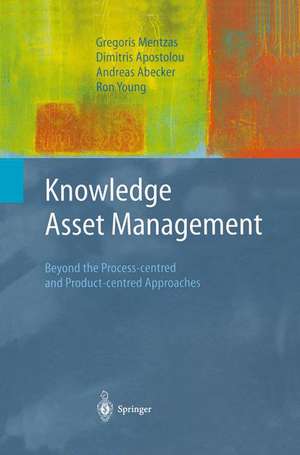
Knowledge Asset Management
Autor Gregoris Mentzas, Dimitris Apostolou, Andreas Abecker, Ron Youngen Limba Engleză Hardback – 20 noi 2002
Preț: 639.90 lei
Preț vechi: 799.88 lei
-20%
Puncte Express: 960
Carte tipărită la comandă
Livrare economică 28 noiembrie-12 decembrie
Livrare prin curier în România Termenul estimat este afișat lângă disponibilitate.
Transport gratuit pentru acest produs Plată online sau ramburs, în funcție de opțiunile comenzii.
Retur gratuit în 14 zile Comandă securizată și suport în română.
Specificații
ISBN-13: 9781852335830
ISBN-10: 1852335831
Pagini: 195
Ilustrații: XV, 195 p.
Dimensiuni: 164 x 241 x 25 mm
Greutate: 0.46 kg
Ediția:2003 edition
Editura: SPRINGER LONDON
Locul publicării:London, United Kingdom
ISBN-10: 1852335831
Pagini: 195
Ilustrații: XV, 195 p.
Dimensiuni: 164 x 241 x 25 mm
Greutate: 0.46 kg
Ediția:2003 edition
Editura: SPRINGER LONDON
Locul publicării:London, United Kingdom
V-ar putea interesa
-
 Preț: 254.13 lei
 -
 -15%Preț: 643.21 lei756.72 lei
 -
 The Infinite AlphabetCésar A. HidalgoPreț: 191.23 lei
 -
 Knowledge Management in Theory and PracticeKimiz Dalkir-16%Preț: 518.14 lei617.25 lei
 -
 NonlinearJohn MaedaPreț: 148.56 lei
 -
 Preț: 367.44 lei
 -
 Reimagining Operational ExcellencePhilip KotlerPreț: 156.63 lei
 -
 How to Measure Anything in Project ManagementDouglas W. HubbardPreț: 357.24 lei
 -
 Customer 360Martin KihnPreț: 155.01 lei
 -
 Preț: 330.23 lei
 -
 Preț: 142.20 lei
 -
 From Values to ActionHarry M Jansen KraemerPreț: 188.69 lei
 -
 Preț: 137.61 lei
 -
 Preț: 143.86 lei
 -
 The New Nature of BusinessAndre HoffmannPreț: 116.02 lei
 -
 Cultivating Communities of PracticeEtienne WengerPreț: 230.23 lei
 -
 Data CultureAlex VailPreț: 108.10 lei
 -
 Knowledge ManagementCarl FrappaoloPreț: 71.16 lei
 -
 ClickJake KnappPreț: 137.41 lei
 -
 The Future of Knowledge ManagementConstantin Bratianu-18%Preț: 1158.14 lei1412.36 lei
Public țintă
Professional/practitionerCuprins
1 Process and Product Approaches in Knowledge Management.- 1.1 Knowledge and Knowledge Management.- 1.2 The Process and Product Approaches in KM.- 1.3 The Process and Product Approaches in KM Software.- 1.4 The Process and Product Approaches in KM Methods and Services.- 1.5 The Process and Product Approaches in KM Projects.- 1.6 The Need to Integrate the Two Approaches.- 2 The Know-Net Approach and Framework.- 2.1 A Strategic Perspective to Knowledge Assets.- 2.2 Conceptual Foundation of Know-Net.- 2.3 Overview of the Know-Net Framework.- 2.4 Knowledge Assets.- 2.5 Knowledge Networking Levels.- 2.6 KM Infrastructure.- 2.7 Using the Framework in an Integrated Manner.- 3 The Know-Net Method.- 3.1 Introduction.- 3.2 Strategic Planning for KM (Stage I: Plan).- 3.3 Developing the Knowledge Organization (Stage II: Develop).- 3.4 Operating the Knowledge Organization (Stage III: Operate).- 3.5 Measurement of Knowledge Assets.- 4 The Know-Net Tool.- 4.1 Introduction.- 4.2 Design Goals of the Know-Net Tool.- 4.3 Fundamental Elements of the Know-Net Tool.- 4.4 The Knowledge Server.- 4.5 The KM Applications.- 4.6 The Strategic Knowledge Navigator.- 4.7 The Knowledge Worker Navigator.- 4.8 The Knowledge Systems Administrator Navigator.- 4.9 The Advanced Search Interface.- 4.10 Summary and Related Work.- 5 Case Studies of the Know-Net Solution.- 5.1 Introduction.- 5.2 Case Summaries of the Know-Net Application in IT Service Companies.- 6 The Case of Planet S.A..- 6.1 Context of the Case Study and the Company.- 6.2 KM Business Case: Applying Stage I of the Know-Net Method.- 6.3 Developing a Knowledge Organization: Application of Stage II.- 6.4 Measuring the KM Initiative.- 7 Knowledge Asset Management: Know-Net and Beyond.- 7.1 Introduction.- 7.2 Knowledge Assets as a Key Link for Holistic KM.- 7.3 Knowledge Assets as a Concept for Future Research.- 7.4 Leveraging Knowledge Assets for k-Business.- Appendix A Knowledge Orientation Matrix.- A.1 Overview.- A.2 Questionnaire for Developing the Matrix.- A.3 Evaluating the Knowledge Orientation Matrix.- Appendix B Analyze and Leverage Knowledge in Business Processes.- B.l Module 1: Analyze Business Processes.- B.2 Module 2: Leverage Knowledge in Business Processes.- Appendix C Analyze and Leverage Knowledge Networks.- C.l Module 3: Analyze Knowledge Networks.- C.2 Module 4: Leverage Knowledge Networks.- Appendix D Develop the Knowledge Asset Schema.- D.l Purpose of Module.- D.2 Knowledge Object Store and Knowledge Ontology.- D.3 Development of the Knowledge Object Store.- D.4 Development of the Knowledge Ontology.- References and Further Reading.
Caracteristici
The book presents an original approach to knowledge management which is explored in depth Includes supplementary material: sn.pub/extras