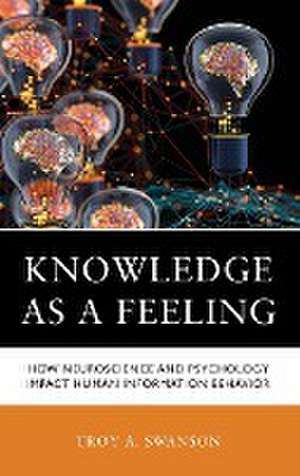
Knowledge as a Feeling: How Neuroscience and Psychology Impact Human Information Behavior
Autor Troy A. Swansonen Limba Engleză Hardback – 26 mai 2023
The feeling of knowing has significant implications for information science challenging theoreticians and practitioners to reconsider how individuals process information. For information behavior, the feeling of knowing offers a fuller picture looking at conscious and unconscious processing in the production of knowledge. For information literacy, the feeling of knowing sheds light on how individuals evaluate information and synthesize new sources into their existing knowledge. Ultimately, the feeling of knowing leads us toward new reflective and metacognitive tools that help meet this moment in the evolution of our information ecosystem.
This book explores the idea that knowing is a feeling that results from the interactions of the brain's unconscious and conscious processes and not through the accumulation of facts. It's intended to help librarians, educators, and information scientists better understand what neuroscience and psychology are teaching about what it means to know and how our brain learns.
Preț: 546.90 lei
Preț vechi: 819.54 lei
-33%
Puncte Express: 820
Carte tipărită la comandă
Livrare economică 29 august-12 septembrie
Livrare prin curier în România Termenul estimat este afișat lângă disponibilitate.
Transport gratuit pentru acest produs Plată online sau ramburs, în funcție de opțiunile comenzii.
Retur gratuit în 14 zile Comandă securizată și suport în română.
Specificații
ISBN-13: 9781538178928
ISBN-10: 1538178923
Pagini: 326
Dimensiuni: 160 x 230 x 28 mm
Greutate: 0.64 kg
Editura: Bloomsbury Publishing
Colecția Rowman & Littlefield
Locul publicării:New York, United States
ISBN-10: 1538178923
Pagini: 326
Dimensiuni: 160 x 230 x 28 mm
Greutate: 0.64 kg
Editura: Bloomsbury Publishing
Colecția Rowman & Littlefield
Locul publicării:New York, United States
Recenzii
This well-researched book by teaching librarian Swanson is aimed at educators who seek to recognize principles from neuroscience and psychology regarding how the mind processes information and the role of emotions in information processing. Swanson effectively argues that emotions contribute to decisions produced by unconscious processing and drive much of human thinking. Emotion can overshadow both conscious reasoning and the examination of evidence. Especially interesting is Swanson's focus on metacognition and reflection, as this invites readers to make judgements about their own beliefs. Recognizing the feeling of knowing may help people better identify confirmation bias and perhaps other mechanisms that reinforce existing beliefs during the information-seeking process. Swanson, who served on the Association of College and Research Libraries' task force responsible for issuing the Framework for Information Literacy for Higher Education, proposes an additional frame titled "Knowledge as a Feeling" to address how the mind works through challenging ideas during the research process. Swanson also explores how the feeling of knowing is highly situational and social, dependent on people's relationships within social groups and their life experiences, worldview, and culture. This book is a good contribution to the literature supporting information literacy instruction by educators. Recommended. Graduate students, faculty, and professionals.
Swanson provides an extremely useful synthesis of current research on thinking and learning and bridges a longstanding gap between the literatures of neuroscience and information literacy. The connections he makes between theory and practice, particularly his inclusion of both affective and social dimensions of learning should encourage us to question our assumptions and reconsider our methods. The book is approachable, peppered with thought exercises thatilluminate his explanations, and will catalyse new approaches to information literacy instruction and research.
Swanson provides a concise and accessible overview of neuroscience and psychology that has long been missing from LIS approaches to information behavior and information literacy. This book should push our discussions, research and practice in a much-needed direction and open the door to more impactful information literacy instruction.
Troy Swanson's Knowledge as a Feeling: How Neuroscience and Psychology Impact Human Information Behavior is an engaging and enjoyable exploration of how we think and why it matters to librarians and other educators. Through his examination of the research in neuroscience, psychology, philosophy, and information science, Swanson helps readers understand the importance of applying a metacognitive approach to teaching information literacy.
Swanson provides an extremely useful synthesis of current research on thinking and learning and bridges a longstanding gap between the literatures of neuroscience and information literacy. The connections he makes between theory and practice, particularly his inclusion of both affective and social dimensions of learning should encourage us to question our assumptions and reconsider our methods. The book is approachable, peppered with thought exercises thatilluminate his explanations, and will catalyse new approaches to information literacy instruction and research.
Swanson provides a concise and accessible overview of neuroscience and psychology that has long been missing from LIS approaches to information behavior and information literacy. This book should push our discussions, research and practice in a much-needed direction and open the door to more impactful information literacy instruction.
Troy Swanson's Knowledge as a Feeling: How Neuroscience and Psychology Impact Human Information Behavior is an engaging and enjoyable exploration of how we think and why it matters to librarians and other educators. Through his examination of the research in neuroscience, psychology, philosophy, and information science, Swanson helps readers understand the importance of applying a metacognitive approach to teaching information literacy.