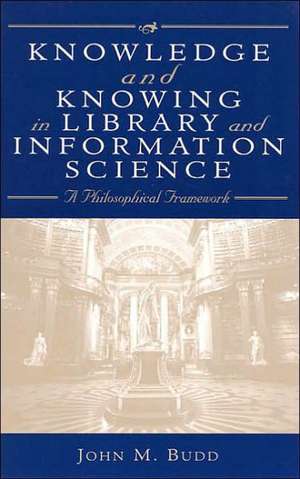
Knowledge and Knowing in Library and Information Science: A Philosophical Framework
Autor John M. Budden Limba Engleză Paperback – 25 mai 2001
The intellectual history of library and information (LIS) is long and complex (and in some important ways, mirrors that of the social sciences generally.) Philosophy and practice in modern science established a way of thinking that has been, and remains influential in LIS. That way of thinking has been addressed and reinforced throughout the last four centuries. "Knowledge and Knowing in Library and Information Science" critiques those ways of thinking, presents an intellectual history demonstrating how present thought and practice in library and information science and information reached its present state, and also proposes a conceptual framework to guide future thinking and action.
Preț: 423.56 lei
Preț vechi: 616.15 lei
-31%
74.97€ • 87.47$ • 64.92£
Carte tipărită la comandă
Livrare economică 26 februarie-12 martie
Specificații
ISBN-10: 0810840251
Pagini: 365
Dimensiuni: 135 x 218 x 27 mm
Greutate: 0.47 kg
Editura: Bloomsbury Publishing
Colecția Scarecrow Press
Locul publicării:New York, United States
V-ar putea interesa
-
 The InformationJames GleickPreț: 103.55 lei
 -
 How to Build a Digital LibraryIan H. Witten-21%Preț: 387.78 lei488.47 lei
 -
 -18%Preț: 194.45 lei236.87 lei
 -
 -57%Preț: 154.46 lei357.06 lei
 -
 -23%Preț: 304.37 lei393.84 lei
 -
 Preț: 410.77 lei
 -
 Fundamentals of Collection Development and ManagementPeggy JohnsonPreț: 523.96 lei
 -
 Winning Library Grants: A Game PlanHerbert B. LandauPreț: 405.79 lei
 -
 Preț: 388.86 lei
 -
 Library Management 101: A Practical GuideDiane L. VelasquezPreț: 487.99 lei
 -
 Handbook of Information ManagementAlison Scammell-18%Preț: 1085.99 lei1324.39 lei
 -
 Cataloging and ClassificationLois Mai Chan-15%Preț: 523.53 lei615.92 lei
 -
 -31%Preț: 436.66 lei634.89 lei
 -
 Reference and Information Services: An IntroductionKay Ann CassellPreț: 530.29 lei
 -
 Handmade Tales: Stories to Make and TakeDianne de Las Casas-27%Preț: 196.37 lei269.73 lei
 -
 -21%Preț: 357.02 lei449.15 lei
 -
 Handmade Tales 2: More Stories to Make and TakeDianne de Las Casas-21%Preț: 216.48 lei272.36 lei
 -
 A History of Modern Librarianship: Constructing the Heritage of Western CulturesPamela Spence Richards-22%Preț: 366.12 lei469.90 lei
Recenzii
A broad, well-balanced and sympathetic book about knowledge written especially for librarians and information scientists...the author is among the very few persons in LIS that are well qualified in philosophy, and this book reflects his qualificationsssss
...This is an important book...it will serve as an important starting point for discussions about the ongoing maturation of the field.
A very sounds intellectual guide through the philosophical bases upon which library and information science is grounded..An excellent guide to subtopics..a thorough and well-grounded review of a large and sophisticated literature characterized very well and brought legitimately to bear on the issues of theory and practice in LIS.
Though he recognizes that the main purpose of his profession is to provide information and sources of information for clients, Budd (information science and learning technologies, U. of Missouri-Columbia) thinks it important for practitioners to think about the intellectual foundations that shape its practice. He begins with a look at science in general and more specifically social science, then considers how principles there can be applied to library and information science.