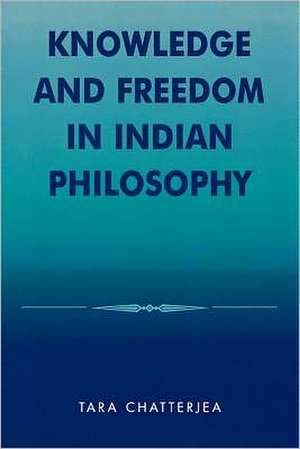
Knowledge and Freedom in Indian Philosophy
Autor Tara Chatterjeaen Limba Engleză Paperback – 5 aug 2003
| Toate formatele și edițiile | Preț | Express |
|---|---|---|
| Paperback (1) | 291.19 lei 6-8 săpt. | |
| Bloomsbury Publishing – 5 aug 2003 | 291.19 lei 6-8 săpt. | |
| Hardback (1) | 511.81 lei 6-8 săpt. | |
| Bloomsbury Publishing – 11 dec 2002 | 511.81 lei 6-8 săpt. |
Preț: 291.19 lei
Preț vechi: 394.01 lei
-26%
Puncte Express: 437
Preț estimativ în valută:
51.48€ • 59.89$ • 44.78£
51.48€ • 59.89$ • 44.78£
Carte tipărită la comandă
Livrare economică 17 aprilie-01 mai
Specificații
ISBN-13: 9780739106921
ISBN-10: 0739106929
Pagini: 178
Dimensiuni: 153 x 227 x 14 mm
Greutate: 0.27 kg
Editura: Bloomsbury Publishing
Colecția Lexington Books
Locul publicării:New York, United States
ISBN-10: 0739106929
Pagini: 178
Dimensiuni: 153 x 227 x 14 mm
Greutate: 0.27 kg
Editura: Bloomsbury Publishing
Colecția Lexington Books
Locul publicării:New York, United States
V-ar putea interesa
-
 The Art of WarSun TzuPreț: 27.22 lei
 -
 The Tree of YogaB. K. S. iyengarPreț: 67.92 lei
 -
 Light on PranayamaB. K. S. iyengarPreț: 89.58 lei
 -
 The Book of Master MoMo Zi-19%Preț: 72.54 lei90.10 lei
 -
 -14%Preț: 675.15 lei785.05 lei
 -
 The Essential HuainanziKing Of Huainan LiPreț: 255.82 lei
 -
 GurujiGuy DonahayePreț: 193.04 lei
 -
 -15%Preț: 435.23 lei512.03 lei
 -
 Preț: 187.06 lei
 -
 Meditation Now or NeverSteve Hagen-21%Preț: 58.96 lei74.61 lei
 -
 ConfuciusProfessor Charlene Tan-24%Preț: 259.81 lei343.31 lei
 -
 The First and Last FreedomJ. Krishnamurti-21%Preț: 80.60 lei102.08 lei
Cuprins
Chapter 1 Introduction
Chapter 2 Did Prabhakara Hold the View that Knowledge Is Self-Manifesting?
Chapter 3 The Concept of Saksin
Chapter 4 An Attempt to Understand Svatah-pramanyavada in Advaita Vedanta
Chapter 5 Svatah-Pramanyavada in Mimamsa
Chapter 6 The Concept of Truth in Buddhist Logic
Chapter 7 Krishna Chandra Bhattacharyya and Anekantavada
Chapter 8 Moksa, the Parama Purusartha
Chapter 9 Svadharma
Chapter 10 Niskama Karma
Chapter 11 In Search of Egoism and Altruism in Hindu Thought
Chapter 2 Did Prabhakara Hold the View that Knowledge Is Self-Manifesting?
Chapter 3 The Concept of Saksin
Chapter 4 An Attempt to Understand Svatah-pramanyavada in Advaita Vedanta
Chapter 5 Svatah-Pramanyavada in Mimamsa
Chapter 6 The Concept of Truth in Buddhist Logic
Chapter 7 Krishna Chandra Bhattacharyya and Anekantavada
Chapter 8 Moksa, the Parama Purusartha
Chapter 9 Svadharma
Chapter 10 Niskama Karma
Chapter 11 In Search of Egoism and Altruism in Hindu Thought
Recenzii
Tara Chatterjea's collection of essays is comparative philosophy at its best, properly grounded in a thorough knowledge of the Sanskrit texts but also wide-ranging in its grasp of issues relevant to traditional and modern European philosophizing. Theory of knowledge, philosophy of mind, ethics, and philosophical psychology are all critically explored from the perspectives of traditional Indian philosophy and modern western thought.
These essays shed much-needed light on some central topics in classical Indian epistemology and ethics. Chatterjea deftly explores what a variety of Indian philosophers have had to say about truth and its place in the correct analysis of knowledge. She has many interesting points to make about the nature and overall structure of Indian ethics. Her readings of the texts and their tradition are philosophically astute, and suggestive of novel approaches to solving some key philosophical problems.
Tara Chatterjea's book satisfies the two challenges that anyone aspiring to advance Indian philosophy has to meet: a close study of the Sanskrit texts and a critical ability to analyze, formulate, and question the positions and arguments. In both regards, the essays in this book are exemplary contributions.
These essays shed much-needed light on some central topics in classical Indian epistemology and ethics. Chatterjea deftly explores what a variety of Indian philosophers have had to say about truth and its place in the correct analysis of knowledge. She has many interesting points to make about the nature and overall structure of Indian ethics. Her readings of the texts and their tradition are philosophically astute, and suggestive of novel approaches to solving some key philosophical problems.
Tara Chatterjea's book satisfies the two challenges that anyone aspiring to advance Indian philosophy has to meet: a close study of the Sanskrit texts and a critical ability to analyze, formulate, and question the positions and arguments. In both regards, the essays in this book are exemplary contributions.