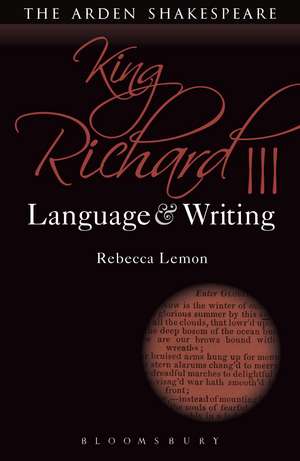
King Richard III: Language and Writing: Arden Student Skills: Language and Writing
Autor Rebecca Lemonen Limba Engleză Paperback – 8 feb 2018
The book explores several different approaches to Shakespeare's language. It looks at how the subtleties of Shakespeare's language reveal the thought processes and motivations of his characters, often in ways those characters themselves don't recognise; it analyses how Shakespeare's language works within or sometimes against various historical contexts, the contexts of stage performance, of genre and of discourses of his day (of religion, law, commerce, and friendship); and it explores how the peculiarities of Shakespeare's language often point to broad issues, themes, or ways of thinking that transcend any one character or line of action. Each chapter includes a "Writing Matters" section, giving students ideas and guidance for building their own critical response to the play and the skills to articulate it with confidence.


Preț: 135.53 lei
Preț vechi: 155.58 lei
-13%
Puncte Express: 203
Carte tipărită la comandă
Livrare economică 09-23 iunie
Specificații
ISBN-13: 9781474253345
ISBN-10: 1474253342
Pagini: 200
Dimensiuni: 126 x 196 x 14 mm
Greutate: 0.22 kg
Editura: Bloomsbury Publishing
Colecția The Arden Shakespeare
Seria Arden Student Skills: Language and Writing
Locul publicării:London, United Kingdom
ISBN-10: 1474253342
Pagini: 200
Dimensiuni: 126 x 196 x 14 mm
Greutate: 0.22 kg
Editura: Bloomsbury Publishing
Colecția The Arden Shakespeare
Seria Arden Student Skills: Language and Writing
Locul publicării:London, United Kingdom
V-ar putea interesa
-
 D. H. Lawrence and ItalyD. H. Lawrence-20%Preț: 83.26 lei103.52 lei
 -
 Preț: 289.16 lei
 -
 The Cambridge Companion to Modernist PoetryAlex DavisPreț: 301.41 lei
 -
 Hamlet, Prince of Denmark 4 Audio CD SetWilliam ShakespearePreț: 282.20 lei
 -
 The Cambridge Introduction to Ezra PoundIra B. NadelPreț: 179.64 lei
 -
 The Cambridge Companion to Robert FrostRobert FaggenPreț: 212.23 lei
 -
 The Cambridge Companion to Tom StoppardKatherine E. KellyPreț: 191.25 lei
 -
 The Cambridge Companion to Brian FrielAnthony RochePreț: 277.79 lei
 -
 Preț: 369.52 lei
 -
 The Cambridge Companion to the Modernist NovelMorag ShiachPreț: 306.69 lei
 -
 The Cambridge Introduction to TragedyJennifer WallacePreț: 210.02 lei
 -
 The Cambridge Introduction to ShakespeareEmma SmithPreț: 179.64 lei
 -
 The Cambridge Companion to BrechtPeter ThomsonPreț: 278.98 lei
 -
 The Cambridge Introduction to Shakespeare's TragediesJanette DillonPreț: 174.47 lei
 -
 The Cambridge Companion to George OrwellJohn RoddenPreț: 268.51 lei
 -
 Hamlet: Language and WritingProf. Dympna Callaghan-17%Preț: 136.33 lei163.70 lei
 -
 Perfect Readings for WeddingsJonathan Law-20%Preț: 43.83 lei54.83 lei
Cuprins
Series Preface
Introduction
1. Language in Print: Words, Lines, Speeches
2. Language: Forms and Uses
3. Language Through Time
4.Writing Skills and Topics
Introduction
1. Language in Print: Words, Lines, Speeches
2. Language: Forms and Uses
3. Language Through Time
4.Writing Skills and Topics
Recenzii
Lemon's guide displays.breadth and insight, even as it touches down on quite different categories, including the forms and features of the play in print, the discourse of conscience, the device of murder, and the array of Richards brought forth by modernity (Fascist, Libyan, Digital, and Documentary, among others). This choice for discretion over consistency in format and emphasis is no doubt a reason that the series, under the editorship of Dympna Callaghan, has attracted such excellent contributors. Its latest companions are boons for those teaching writing-intensive courses, as well as for those simply seeking better essays from their students.