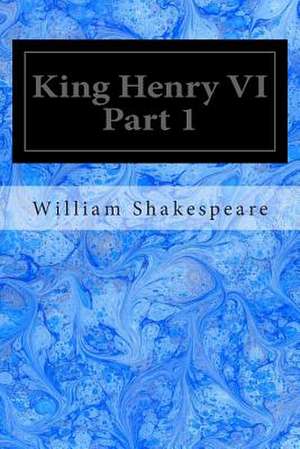
King Henry VI Part 1
Autor William Shakespeareen Limba Engleză Paperback
Preț: 45.37 lei
Puncte Express: 68
Carte disponibilă
Livrare economică 05-19 noiembrie
Livrare prin curier în România Termenul estimat este afișat lângă disponibilitate.
Transport gratuit de la 400.00 lei Plată online sau ramburs, în funcție de opțiunile comenzii.
Retur gratuit în 14 zile Comandă securizată și suport în română.
Specificații
ISBN-13: 9781495966446
ISBN-10: 1495966445
Pagini: 88
Dimensiuni: 152 x 229 x 5 mm
Greutate: 0.13 kg
Editura: CREATESPACE
ISBN-10: 1495966445
Pagini: 88
Dimensiuni: 152 x 229 x 5 mm
Greutate: 0.13 kg
Editura: CREATESPACE
V-ar putea interesa
-
 Henry VI, Part OneWilliam Shakespeare-26%Preț: 52.51 lei71.08 lei
 -
 RSC School Shakespeare: A Midsummer Night's DreamWilliam Shakespeare-26%Preț: 77.89 lei105.35 lei
 -
 William Shakespeare: A Very Short IntroductionStanley Wells-20%Preț: 56.15 lei70.53 lei
 -
 Is This a Dagger Which I See Before Me?William Shakespeare-37%Preț: 18.43 lei29.05 lei
 -
 The CornerDavid SimonPreț: 119.81 lei
 -
 Shakespeare's Sonnets: RevisedProf Katherine Duncan-Jones-14%Preț: 82.23 lei95.28 lei
 -
 Doing ShakespeareSimon Palfrey-16%Preț: 145.79 lei172.85 lei
 -
 Shakespeare in LondonDr. Hannah Crawforth-11%Preț: 171.38 lei193.07 lei
 -
 Essential Shakespeare: The Arden Guide to Text and InterpretationDr. Pamela Bickley-23%Preț: 184.43 lei240.65 lei
 -
 Twelfth Night: Language and WritingFrances E. DolanPreț: 143.12 lei
 -
 Transforming the Teaching of Shakespeare with the Royal Shakespeare CompanyProfessor Joe WinstonPreț: 179.78 lei
 -
 -23%Preț: 202.74 lei263.24 lei
 -
 Shakespeare's Medical Language: A DictionarySujata Iyengar-15%Preț: 291.74 lei341.54 lei
 -
 Shakespeare and ReligionProfessor Alison Shell-17%Preț: 193.00 lei231.22 lei
 -
 King Henry the Sixth: Parts I, II, and IIIWilliam Shakespeare-15%Preț: 99.82 lei117.60 lei
 -
 Romeo and JulietWilliam Shakespeare-41%Preț: 46.33 lei78.09 lei
Descriere
Descriere de la o altă ediție sau format:
A fresh look at a play usually regarded as the first component of a three-part historical epic, this edition argues that Henry VI Part 1 is a 'prequel', a freestanding piece that returns for ironic and dramatic effect to a story already familiar to its audience. The play's ingenious use of stage space is closely analysed, as is its manipulation of a series of setpiece combats to give a coherent syntax of action. Discussion of the dramatic structure created by the opposing figures of Talbot and Jeanne la Pucelle, and exploration of the critical controversies surrounding the figure of Jeanne, lead to a reflection on the nature of the history play as genre in the 1590s.
A fresh look at a play usually regarded as the first component of a three-part historical epic, this edition argues that Henry VI Part 1 is a 'prequel', a freestanding piece that returns for ironic and dramatic effect to a story already familiar to its audience. The play's ingenious use of stage space is closely analysed, as is its manipulation of a series of setpiece combats to give a coherent syntax of action. Discussion of the dramatic structure created by the opposing figures of Talbot and Jeanne la Pucelle, and exploration of the critical controversies surrounding the figure of Jeanne, lead to a reflection on the nature of the history play as genre in the 1590s.
Notă biografică
William Shakespeare (1564-1616) was an English dramatist, poet, and actor, generally regarded as the greatest playwright of all time.