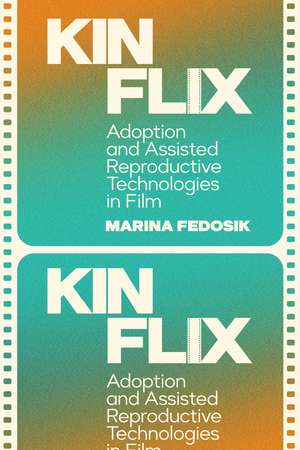
Kinflix: Adoption and Assisted Reproductive Technologies in Film: Formations: Adoption, Kinship, and Culture
Autor Marina Fedosiken Limba Engleză Paperback – 3 noi 2025
In Kinflix, Marina Fedosik analyzes cinematic representations of adoption and technologically assisted reproduction to identify the intersecting paradigms through which Western cultures understand these ways of making families. Looking at diverse genres—films include The Omen,Raising Arizona,Losing Isaiah,Blade Runner, and more—Fedosik finds that the heterocoital family remains a hegemonic metaphor for representing and structuring all other methods of reproduction. This potentially precludes understanding adoption and ARTs on their own terms and requires those involved in nontraditional family formation to negotiate kinship connections and identities against the cultural demands of this model.
Resisting simple ideological readings of film genres, Fedosik unsettles cultural scripts around adoption and reproduction and scrutinizes moments where formulaic genre logic may be troubled by representations of lived experience that transcend common tropes of family formation. She argues that adoption as a reproductive technology is uniquely situated to expose cultural tensions around nontraditional methods of reproduction that are rapidly developing in the post-IVF biocultural landscape. Rapidly changing reproductive technologies, Fedosik asserts, demand a cultural response—and require more expansive reflection on reproductive futurities.
Resisting simple ideological readings of film genres, Fedosik unsettles cultural scripts around adoption and reproduction and scrutinizes moments where formulaic genre logic may be troubled by representations of lived experience that transcend common tropes of family formation. She argues that adoption as a reproductive technology is uniquely situated to expose cultural tensions around nontraditional methods of reproduction that are rapidly developing in the post-IVF biocultural landscape. Rapidly changing reproductive technologies, Fedosik asserts, demand a cultural response—and require more expansive reflection on reproductive futurities.
| Toate formatele și edițiile | Preț | Express |
|---|---|---|
| Paperback (1) | 247.41 lei 22-36 zile | |
| Ohio State University Press – 3 noi 2025 | 247.41 lei 22-36 zile | |
| Hardback (1) | 644.50 lei 38-44 zile | |
| The Ohio State University Press – 3 noi 2025 | 644.50 lei 38-44 zile |

Preț: 247.41 lei
Nou
Puncte Express: 371
Preț estimativ în valută:
43.80€ • 51.00$ • 38.05£
43.80€ • 51.00$ • 38.05£
Carte disponibilă
Livrare economică 02-16 februarie
Preluare comenzi: 021 569.72.76
Specificații
ISBN-13: 9780814259634
ISBN-10: 0814259634
Pagini: 244
Ilustrații: 11 b&w images
Dimensiuni: 152 x 229 x 18 mm
Greutate: 0.3 kg
Editura: Ohio State University Press
Colecția Ohio State University Press
Seria Formations: Adoption, Kinship, and Culture
ISBN-10: 0814259634
Pagini: 244
Ilustrații: 11 b&w images
Dimensiuni: 152 x 229 x 18 mm
Greutate: 0.3 kg
Editura: Ohio State University Press
Colecția Ohio State University Press
Seria Formations: Adoption, Kinship, and Culture
Recenzii
“Kinflix forges a completely original conversation between film studies and adoption/ART studies. Fedosik persuasively demonstrates how the pull of biocentric definitions of personhood persists even in positive representations of alternative family formations.” —Margaret Homans, author of The Imprint of Another Life: Adoption Narratives and Human Possibility
“With few other scholarly works considering adoption and ART in contemporary media culture, Kinflix—and its expertly rendered close readings—has broad multidisciplinary appeal, especially across adoption studies, women’s studies, film studies, and literature.” —Kim Park Nelson, author of Invisible Asians: Korean American Adoptees, Asian American Experiences, and Racial Exceptionalism
Notă biografică
Marina Fedosik is Senior Lecturer at Princeton University. She studies cultural representations of adoption, kinship, and nontraditional reproduction.
Extras
The cinematic narratives analyzed in this book represent a range of nontraditional reproductive options, beginning with adoption that troubles the traditional understanding of “real” kinship by creating a configuration with two sets of parents: the biological-heterocoital and the adoptive ones. As a logical extension of this line of inquiry, this book also ventures into narratives of assisted reproduction, both already available and potentially possible, that may disrupt accepted understandings of reproduction and kinship even further. As an anchor point for analysis, this book defines traditional reproductive human origin as heterocoital, that is, the result of a heterosexual reproductive act between two genitors of the opposing (binary, male/female) sex. The possibility of producing a child whose origin differs from the heterocoital creates further cultural anxieties around assisted reproduction technologies (ARTs) because they may introduce into the process a number of genitors different from the conventional heterosexual two. Kinflix concerns itself with such anxieties and examines representations of non-heterocoital reproduction in narrative cinema to understand the ways in which cultural ideas about human reproduction and kinship respond to reproductive technologies as they shape our values, social lives, and affective scripts we live by. The analysis of nontraditional reproduction in narrative Western cinema ultimately shows that even in the absence of the heterocoital act, reproductive capacity, and the heterosexuality traditionally understood as the cultural bedrock of reproduction, patriarchy-inflected Western cultures aim to preserve heterocoital logic of kinship as they come to terms with technological advances in human reproduction. Thus, the selection of films does not follow any specific chronology, even though most of them were made in the second half of the twentieth and the beginning of the twenty-first centuries when the discussion of adoption and assisted reproduction has become more culturally prominent. The selection of films is an attempt to pull together a corpus of texts that includes well-known films that have produced a noticeable cultural response together with lesser-known ones and limit cases that show something significant about our imaginaries of nontraditional reproduction. These categories offer a gamut of conventional cultural approaches to nontraditional reproduction as well as the ways that challenge the status quo.
While much attention is paid to the specifics of representations of adoption and ART in visual texts, the end goal of the book is to uncover the overarching logic of cultural thinking about human biological and social reproduction, including conceptual shifts in accepted ideas as well as cultural resistances to such changes. This tug-of-war, staged in nontraditional reproduction narratives, signals the need to meet ongoing technological changes with new ways of thinking about human identity, kinship, and resultant social formations. The chapters of the book examine the logic of nontraditional reproduction representations in different genres of cinema in order to uncover possible reasons for insistence on heterocoital origin as a matter of humanity. By extending thinking into the territory where a child’s heterocoital origin is unknown, uncertain, or does not exist and therefore cannot be called upon to secure personhood and belonging as a matter of culturally established and institutionalized heterocoital frameworks, narratives of nontraditional reproduction push us to consider consequences of non-heterocoital reproductive and kinship practices for our social life and especially their stakes for entities whose universally recognized human origin is in question.
Some of such consequences have already been foreshadowed in critical adoption studies (CAS)—a field that critically examines ideas about origins, kinship, family, identity, and belonging that are often taken for granted. For example, cultural insistence on heterocoital origin as a condition for a recognizable social identity is revealed by an essential adoption paradox. The cultural demand to develop and maintain an adoptive kinship bond indistinguishable from biogenetic affiliation is persistently coupled with this bond’s constant “derealization” by imagining it as just like the real one. Adoption revealed early the presence of such cultural imperatives through the existence of adoption-specific double binds. Time and time again, the cultural distinction between adoptive and “real”—in other words, heterocoital—kinship compels adoption participants to negotiate paradoxes of identity and belonging that originate from this dichotomy. For example, Barbara Melosh observes that, typically, in Western cultures the adoptive family has to appear “as if begotten,” and yet it is perpetually measured against the biological model it can never fully replicate. Sally Sales invokes a similar double bind when she explains that the adoptee’s individualization and personhood depend on simultaneous identification and differentiation from the “original [biological] kin.” Sales demonstrates that the Western, middle-class cultural process of individuation depends on biogenetic origin knowledge, and so the adopted child’s origin is always constitutive to the adoptive family and adoptee’s selfhood. This identity-belonging paradigm persists whether the cultural imperative is to hide and repress the biogenetic origin of the child or to acknowledge and cultivate it.
While much attention is paid to the specifics of representations of adoption and ART in visual texts, the end goal of the book is to uncover the overarching logic of cultural thinking about human biological and social reproduction, including conceptual shifts in accepted ideas as well as cultural resistances to such changes. This tug-of-war, staged in nontraditional reproduction narratives, signals the need to meet ongoing technological changes with new ways of thinking about human identity, kinship, and resultant social formations. The chapters of the book examine the logic of nontraditional reproduction representations in different genres of cinema in order to uncover possible reasons for insistence on heterocoital origin as a matter of humanity. By extending thinking into the territory where a child’s heterocoital origin is unknown, uncertain, or does not exist and therefore cannot be called upon to secure personhood and belonging as a matter of culturally established and institutionalized heterocoital frameworks, narratives of nontraditional reproduction push us to consider consequences of non-heterocoital reproductive and kinship practices for our social life and especially their stakes for entities whose universally recognized human origin is in question.
Some of such consequences have already been foreshadowed in critical adoption studies (CAS)—a field that critically examines ideas about origins, kinship, family, identity, and belonging that are often taken for granted. For example, cultural insistence on heterocoital origin as a condition for a recognizable social identity is revealed by an essential adoption paradox. The cultural demand to develop and maintain an adoptive kinship bond indistinguishable from biogenetic affiliation is persistently coupled with this bond’s constant “derealization” by imagining it as just like the real one. Adoption revealed early the presence of such cultural imperatives through the existence of adoption-specific double binds. Time and time again, the cultural distinction between adoptive and “real”—in other words, heterocoital—kinship compels adoption participants to negotiate paradoxes of identity and belonging that originate from this dichotomy. For example, Barbara Melosh observes that, typically, in Western cultures the adoptive family has to appear “as if begotten,” and yet it is perpetually measured against the biological model it can never fully replicate. Sally Sales invokes a similar double bind when she explains that the adoptee’s individualization and personhood depend on simultaneous identification and differentiation from the “original [biological] kin.” Sales demonstrates that the Western, middle-class cultural process of individuation depends on biogenetic origin knowledge, and so the adopted child’s origin is always constitutive to the adoptive family and adoptee’s selfhood. This identity-belonging paradigm persists whether the cultural imperative is to hide and repress the biogenetic origin of the child or to acknowledge and cultivate it.
Cuprins
Contents
List of Illustrations
Introduction Adoption and Other Forms of Post-Heterocoital Reproductions
Chapter 1 Adoption and ARTs in (Melo)Drama: The Two Mothers Problem
Chapter 2 Adoption and ARTs in Horror Film: The Hidden Spring of Heterocoital Origin
Chapter 3 Adoption and ARTs in Comedy: Testing the Limits of the Heterocoital Order
Chapter 4 Adoption and ARTs in Science Fiction: Reproductive Futurities
Conclusion
Acknowledgments
Works Cited
Index
List of Illustrations
Introduction Adoption and Other Forms of Post-Heterocoital Reproductions
Chapter 1 Adoption and ARTs in (Melo)Drama: The Two Mothers Problem
Chapter 2 Adoption and ARTs in Horror Film: The Hidden Spring of Heterocoital Origin
Chapter 3 Adoption and ARTs in Comedy: Testing the Limits of the Heterocoital Order
Chapter 4 Adoption and ARTs in Science Fiction: Reproductive Futurities
Conclusion
Acknowledgments
Works Cited
Index
Descriere
Analyzes cinematic representations of adoption and technologically assisted reproduction to identify the intersecting paradigms through which Western cultures understand these ways of making families.