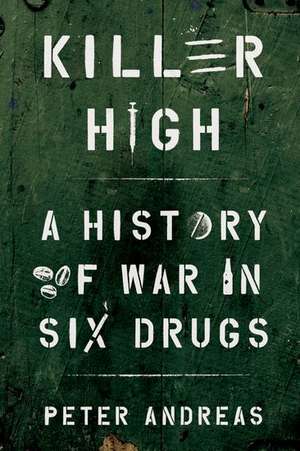
Killer High: A History of War in Six Drugs
Autor Peter Andreasen Limba Engleză Paperback – 27 apr 2022
Preț: 172.88 lei
Preț vechi: 202.96 lei
-15%
Puncte Express: 259
Carte tipărită la comandă
Livrare economică 27 noiembrie-02 decembrie
Livrare prin curier în România Termenul estimat este afișat lângă disponibilitate.
Transport gratuit de la 400.00 lei Plată online sau ramburs, în funcție de opțiunile comenzii.
Retur gratuit în 14 zile Comandă securizată și suport în română.
Specificații
ISBN-13: 9780197629994
ISBN-10: 0197629997
Pagini: 352
Ilustrații: 44 b&w halftones
Dimensiuni: 239 x 155 x 23 mm
Greutate: 0.5 kg
Editura: Oxford University Press
Colecția OUP USA
Locul publicării:New York, United States
ISBN-10: 0197629997
Pagini: 352
Ilustrații: 44 b&w halftones
Dimensiuni: 239 x 155 x 23 mm
Greutate: 0.5 kg
Editura: Oxford University Press
Colecția OUP USA
Locul publicării:New York, United States
Recenzii
Killer High, well-written and extensively researched, shows how the drugs-war relationship has served state interests and ambitions.
Since time immemorial, soldiers have consumed mind-altering substances; Andreas (International Studies/Brown Univ.; Smuggler Nation: How Illicit Trade Made America, 2013, etc.) delivers an impressive, often unsettling history of six.
Peter Andreas...has drawn from an impressive and eclectic mix of sources to give psychoactive and addictive drugs a fuller place in discussions of war. His book steps back from the headlines to draw a full arc that reads as both complement and counterpoint to enduring fables and simplistic accounts surrounding wars and nations you may think you know. Organized into six main chapters on the varied drugs-war relationships - one each for alcohol, tobacco, caffeine, opium, speed and cocaine - it offers a fascinating interpretive lens for drugs' roles in making war and, in turn, wars' roles in spreading drugs around the world.
Peter Andreas always writes about captivating topics, but his take on the combination of violence and drugs may be his best yet. This is a history of conflict and capitalism and how the two are intertwined. It also provides a fascinating perspective on consumer behavior and the creation of our drugged culture. Beautifully written, this book is both scholarly and wonderfully entertaining. A great read!
Ingeniously plotted, briskly written, and strikingly illustrated, Killer High delivers a kaleidoscopic trip through the history of drugs and war. Peter Andreas looks at the drug-war relationship from every angle: how combatants and noncombatants used drugs; how wars were fought through, for, or against drugs; and how wars shaped the fates of drugs, often speeding their rise as global commodities.
Killer High frees history from the names-and-dates straightjacket and looks more deeply at why we fight. From the drinking binges of Alexander the Great to anti-drug campaigns in Afghanistan and Latin America, it illuminates the hidden relationship between drugs and war. By reimagining the past so insightfully, it helps us understand the conflicts of today and tomorrow.
"Peter Andreas is that rare political scientist who can weave serious and compelling historical arguments and who writes with the breadth and clarity of a public intellectual. Killer High is a killer book-the definitive work on the history of drugs and warfare.
Killer High is a captivating book, laced with provocative insights about the enduring relationship between drugs and war and further enlivened with entertaining flashes of wit.
Since time immemorial, soldiers have consumed mind-altering substances; Andreas (International Studies/Brown Univ.; Smuggler Nation: How Illicit Trade Made America, 2013, etc.) delivers an impressive, often unsettling history of six.
Peter Andreas...has drawn from an impressive and eclectic mix of sources to give psychoactive and addictive drugs a fuller place in discussions of war. His book steps back from the headlines to draw a full arc that reads as both complement and counterpoint to enduring fables and simplistic accounts surrounding wars and nations you may think you know. Organized into six main chapters on the varied drugs-war relationships - one each for alcohol, tobacco, caffeine, opium, speed and cocaine - it offers a fascinating interpretive lens for drugs' roles in making war and, in turn, wars' roles in spreading drugs around the world.
Peter Andreas always writes about captivating topics, but his take on the combination of violence and drugs may be his best yet. This is a history of conflict and capitalism and how the two are intertwined. It also provides a fascinating perspective on consumer behavior and the creation of our drugged culture. Beautifully written, this book is both scholarly and wonderfully entertaining. A great read!
Ingeniously plotted, briskly written, and strikingly illustrated, Killer High delivers a kaleidoscopic trip through the history of drugs and war. Peter Andreas looks at the drug-war relationship from every angle: how combatants and noncombatants used drugs; how wars were fought through, for, or against drugs; and how wars shaped the fates of drugs, often speeding their rise as global commodities.
Killer High frees history from the names-and-dates straightjacket and looks more deeply at why we fight. From the drinking binges of Alexander the Great to anti-drug campaigns in Afghanistan and Latin America, it illuminates the hidden relationship between drugs and war. By reimagining the past so insightfully, it helps us understand the conflicts of today and tomorrow.
"Peter Andreas is that rare political scientist who can weave serious and compelling historical arguments and who writes with the breadth and clarity of a public intellectual. Killer High is a killer book-the definitive work on the history of drugs and warfare.
Killer High is a captivating book, laced with provocative insights about the enduring relationship between drugs and war and further enlivened with entertaining flashes of wit.
Notă biografică
Peter Andreas is the John Hay Professor of International Studies at Brown University, where he holds a joint appointment between the Department of Political Science and the Watson Institute for International and Public Affairs. Andreas has published ten books, including Smuggler Nation: How Illicit Trade Made America. He has also written for publications such as Foreign Affairs, Foreign Policy, The Guardian, Harper's, The Nation, The New Republic, Slate, The New York Times, and The Washington Post. A graduate of Swarthmore College and Cornell University, he lives with his family in Providence, Rhode Island.
Cuprins
- Preface
- Introduction: How Drugs Made War and War Made Drugs
- 1: Drunk on the Front
- 2: Where there's Smoke There's War
- 3: Caffeinated Conflict
- 4: Opium, Empire, and Geopolitics
- 5: Speed Warfare
- 6: Cocaine Wars
- Conclusion: The Drugged Battlefields of the Twenty-First Century
- Notes
- Index