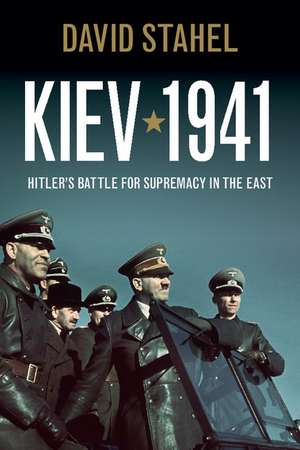
Kiev 1941
Autor David Stahelen Limba Engleză Hardback – 31 oct 2012
Notăm cu interes modul în care Kiev 1941 reușește să depășească barierele istoriografiei militare convenționale, propunând o abordare interdisciplinară care îmbină analiza strategică de nivel înalt cu sociologia militară și logistica. David Stahel nu se limitează la cronica unei victorii tactice răsunătoare a Wehrmacht-ului, ci investighează modul în care succesul aparent a mascat epuizarea resurselor vitale ale Germaniei. Remarcăm atenția deosebită acordată 'grupurilor de panzere', coloana vertebrală a campaniei, ale căror pierderi materiale și umane în stepele Ucrainei au pecetluit, în viziunea autorului, eșecul final în Est. Această lucrare completează perspectiva oferită de Hitler's Panzers East de R.H.S. Stolfi, adăugând o analiză mult mai nuanțată asupra costurilor operaționale. În timp ce Stolfi se concentrează pe oportunitatea strategică pierdută de a cuceri Moscova, Stahel demonstrează prin date concrete — susținute de 13 hărți și tabele detaliate — că mașina de război germană era deja grav avariată înainte de asaltul final asupra capitalei sovietice. Cartea se înscrie într-o suită de lucrări fundamentale ale autorului, precum Operation Barbarossa and Germany's Defeat in the East, rafinând argumentul că înfrângerea Germaniei a fost un proces început încă din primele luni ale invaziei, nu doar un rezultat al iernii rusești. Structura volumului este riguros organizată în zece capitole ce reflectă o progresie logică: de la contextul ideologic și strategic inițial, trecând prin masacrul propriu-zis din Ucraina, până la concluziile despre 'liniștea dinaintea furtunii' ce a precedat Operațiunea Taifun. Credem că valoarea editorială a acestui titlu rezidă tocmai în capacitatea de a demonta mitul invincibilității germane din 1941, oferind cititorului o imagine clară a modului în care rezistența sovietică și uzura logistică au transformat o victorie tactică într-un impas strategic.
Preț: 644.22 lei
Preț vechi: 723.84 lei
-11%
Carte tipărită la comandă
Livrare economică 30 noiembrie-14 decembrie
Specificații
ISBN-10: 110701459X
Pagini: 486
Ilustrații: 21 b/w illus. 13 maps 3 tables
Dimensiuni: 157 x 235 x 31 mm
Greutate: 0.8 kg
Ediția:New.
Editura: Cambridge University Press
Locul publicării:New York, United States
V-ar putea interesa
-
 WallensteinG. Mortimer-18%Preț: 803.20 lei979.51 lei
 -
 French ToastHarriet Welty RochefortPreț: 105.02 lei
 -
 The Insurgency in Chechnya and the North Caucasus: From Gazavat to JihadRobert W. Schaefer-29%Preț: 390.66 lei553.11 lei
 -
 The Origins of the Slavic NationsSerhii PlokhyPreț: 209.04 lei
 -
 Preț: 307.13 lei
 -
 Italy in the Making January 1st 1848 to November 16th 1848G. F. -H BerkeleyPreț: 375.89 lei
 -
 German Orientalism in the Age of EmpireSuzanne L. MarchandPreț: 379.08 lei
 -
 Preț: 452.17 lei
 -
 Preț: 231.12 lei
 -
 Nazi EmpireShelley BaranowskiPreț: 277.78 lei
 -
 The Business of WarDavid ParrottPreț: 298.17 lei
 -
 Somme MudE P F Lynch-29%Preț: 66.88 lei94.51 lei
 -
 Preț: 321.89 lei
 -
 The Wildest ProvinceRoderick BaileyPreț: 118.64 lei
 -
 Power PoliticsFrancis TombsPreț: 362.69 lei
De ce să citești această carte
Recomandăm această carte istoricilor și pasionaților de istorie militară care doresc să înțeleagă complexitatea Frontului de Est dincolo de cifrele brute. Cititorul câștigă o perspectivă critică asupra deciziilor comandamentului german și a impactului lor pe termen lung. Este o lectură esențială pentru a înțelege de ce Bătălia de la Kiev, deși un succes tactic imens, a reprezentat de fapt începutul sfârșitului pentru planurile lui Hitler în Uniunea Sovietică.
Despre autor
David Stahel este un istoric recunoscut, specializat în istoria militară a Germaniei naziste și în campaniile de pe Frontul de Est. Cu studii de masterat la King's College London și un doctorat obținut la Universitatea Humboldt din Berlin, Stahel și-a dedicat cariera cercetării mecanismelor interne ale Wehrmacht-ului în Al Doilea Război Mondial. În prezent lector la University of New South Wales, Australia, el este autorul mai multor volume de referință publicate la Cambridge University Press, lucrările sale fiind apreciate pentru cercetarea riguroasă și capacitatea de a reevalua momentele cheie ale conflictului germano-sovietic prin prisma logisticii și a uzurii militare.
Descriere scurtă
Cuprins
Recenzii
'David Stahel's new book on the battle of Kiev is a brilliant contribution to our knowledge of the German-Soviet war. Ranging widely over strategic debates within the high command, operational and tactical details of the fighting, the logistical situation behind the front, and industrial production at home, this is an essential book for any student of World War II. A major addition to the literature from a master scholar.' Robert M. Citino, author of Death of the Wehrmacht: The German Campaigns of 1942
'A fitting follow-on to Stahel's previous books, Kiev 1941 is a fresh, accurate, and authoritative volume. A thoroughly enjoyable read, it injects a healthy dose of realism into the history of this dramatic battle. Dismantling myths left and right, the book sets right one of the most significant stages of Operation Barbarossa.' David Glantz, author of Barbarossa Derailed: The Battle for Smolensk, 10 July–10 September 1941
'Building on his work in Operation Barbarossa and Germany's Defeat in the East, in Kiev 1941 David Stahel further highlights how German operational successes were no compensation for strategic miscalculation. Stahel uses a rich mix of German archival and other sources to provide a comprehensive analysis of the battle from a German perspective - a valuable contribution to the literature.' Alexander Hill, author of The Great Patriotic War of the Soviet Union, 1941–1945: A Documentary Reader
'Most original … a thoughtful and thought-provoking text.' Richard Overy, Literary Review
'… this book is essential reading for what was the greatest military encounter of the Second World War. In a succinctly worded, well-argued text, it has opened a new debate on the very ability of Nazi Germany to wage a major war … Stahel is to be congratulated for a controversial and stimulating book. It comes highly recommended.' Military History Monthly
'[Stahel's] incisive survey cuts through much of the postwar myth making [and] shows mastery of the German sources … Issues of logistics and command are leavened by valuable insights into the strategic miscalculations of Hitler and his high command and vivid use of veteran testimony.' Michael Jones, BBC History Magazine
'Even readers familiar with the Russian theater of WWII will find much to intrigue them here, although the wonder of Stahel's book is how accessible it is to the non-specialist; in addition to recounting the history of a pivotal battle, [he] is very conscious that he's telling a story as well. A dark story – two evil nations tearing each other's guts out – but, in Stahel's hands, a powerful and a necessary one as well. A highly recommended account.' Open Letters Monthly
'Relying mainly on German sources, [Stahel] brings new evidence to bear on the conflict with the official war diaries of German divisions, as well as making good use of published editions of the private field-post letters and diaries of German soldiers of all ranks … overall [he] conveys extremely complex military action with exemplary clarity.' Richard J. Evans, The New Republic
'Like [Stahel's] previous book, Kiev, 1941 is a magnificent work of historical revision, a first-rate example of how military history ought to be written.' Mackubin Thomas Owens, The Weekly Standard
'[Stahel] makes extensive use of the diaries and letters of German soldiers as well as works by and about German generals and political figures like Hitler and Goebbels – there are about a hundred pages of endnotes and bibliography. Excellent maps and tables clarify the complex military operations … To sum up, in this most detailed English-language treatment of the battle of Kiev, David Stahel furnishes ample evidence that, despite its Ukrainian victories in late September 1941, Germany remained ill prepared to defeat the USSR.' Walter G. Moss, Michigan War Studies Review
'Stahel provides vivid depictions of the Ostheer's growing 'demodernization' … and convincingly shows that the victory in Ukraine was a result both of Hitler's insistence on turning his forces southwards and away from Moscow, and of Stalin's determination to hold on to Kiev despite the clear indications of a looming catastrophe.' Omer Bartov, The Times Literary Supplement
'To historians with a serious interest in the Eastern Front in World War II, David Stahel is fast becoming a household name … While a number of historians before him have also dealt with the subject, Stahel has brought to his study a remarkable familiarity with primary and secondary German sources as well as a willingness to unambiguously re-address a question which has mystified generations of historians: did the Ostheer ever have a chance of inflicting crippling damage on the USSR in 1941?' Klaus Schmider, The Journal of Military History
'Stahel has written a well-balanced, often provocative … book, which sheds much new light on our knowledge of the fighting around the capital of the Ukraine.' Martijn Lak, The Journal of Slavic Military Studies
'… masterful … superbly researched and well written …' Leo J. Daugherty, III, The Journal of Slavic Military Studies