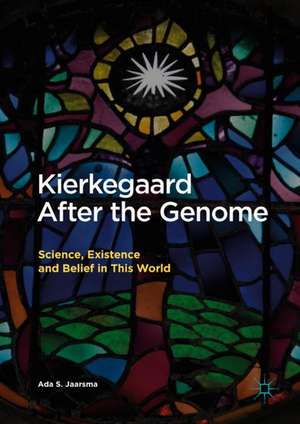
Kierkegaard After the Genome
Autor Ada S. Jaarsmaen Limba Engleză Hardback – sep 2017
This book brings Søren Kierkegaard’s nineteenth-century existentialist project into our contemporary age, applying his understanding of “freedom” and “despair” to science and science studies, queer, decolonial and critical race theory, and disability studies. The book draws out the materialist dimensions of belief, examining the existential dynamics of phenomena like placebos, epigenetics, pedagogy, and scientific inquiry itself. Each chapter dramatizes the ways in which abstractions like “race” or “genes” and even “belief” are sites of contested practices with pressing political significance. Focusing on the existential dangers posed by neo-liberal and finance capitalist systems, the book brings to life the resources for resistance found within science studies and critical approaches to race, secularity, and disability. Throughout the book, Kierkegaard becomes an ally with ecological and developmental evolutionary theorists, as well as with science studies, critical race, andcrip theorists who foreground the relational and impassioned nature of existence.
Preț: 564.16 lei
Preț vechi: 663.71 lei
-15%
Puncte Express: 846
Carte tipărită la comandă
Livrare economică 08-22 iunie
Specificații
ISBN-13: 9783319579801
ISBN-10: 3319579800
Pagini: 244
Ilustrații: XIII, 227 p. 1 illus.
Dimensiuni: 153 x 216 x 18 mm
Greutate: 0.43 kg
Ediția:1st edition 2017
Editura: Springer
Locul publicării:Cham, Switzerland
ISBN-10: 3319579800
Pagini: 244
Ilustrații: XIII, 227 p. 1 illus.
Dimensiuni: 153 x 216 x 18 mm
Greutate: 0.43 kg
Ediția:1st edition 2017
Editura: Springer
Locul publicării:Cham, Switzerland
Cuprins
1. Sin, Secularity and Belief in This World.- 2. The Existential Stakes of Epigenetics.- 3. Placebos and the Materiality of Belief.- 4. Design, Disability and Play: Becoming in the Classroom.- 5 Is Science Post-Secular? Cures, Despair and Spiritual Practice.
Recenzii
“A remarkable resource not only for Kierkegaard scholars but for anyone interested in the relationship between philosophy, religion, and science as lived practices, this book opens up new spaces for research and articulates a promising way of living as reflectively engaged, fully invested, and socially located. Summing Up: Recommended. Upper-division undergraduates and above.” (J. A. Simmons, Choice, Vol. 55 (8), April, 2018)
Notă biografică
Ada S. Jaarsma is associate professor of philosophy at Mount Royal University. Her articles have appeared in Gender and Education, Studies in Philosophy and Education, European Legacy, Constellations, Journal for Cultural and Religious Theory, and Hypatia.
Textul de pe ultima copertă
This book brings Søren Kierkegaard’s nineteenth-century existentialist project into our contemporary age, applying his understanding of “freedom” and “despair” to science and science studies, queer, decolonial and critical race theory, and disability studies. The book draws out the materialist dimensions of belief, examining the existential dynamics of phenomena like placebos, epigenetics, pedagogy, and scientific inquiry itself. Each chapter dramatizes the ways in which abstractions like “race” or “genes” and even “belief” are sites of contested practices with pressing political significance. Focusing on the existential dangers posed by neo-liberal and finance capitalist systems, the book brings to life the resources for resistance found within science studies and critical approaches to race, secularity, and disability. Throughout the book, Kierkegaard becomes an ally with ecological and developmental evolutionary theorists, as well as with science studies, critical race, and crip theorists who foreground the relational and impassioned nature of existence.
Caracteristici
Presents the surprising existential insights of science studies scholars Discusses the 21st century relevance of ?Søren Kierkegaard Poses exstentialism as a way to think about scientific controversies Includes supplementary material: sn.pub/extras Includes supplementary material: sn.pub/extras