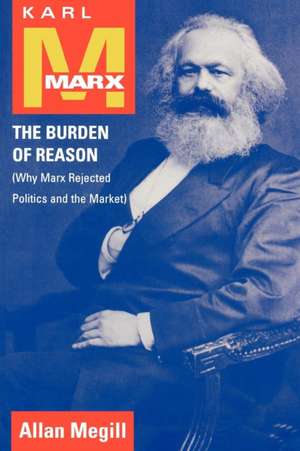
Karl Marx: The Burden of Reason (Why Marx Rejected Politics and the Market)
Autor Allan Megillen Limba Engleză Paperback – 11 dec 2001
Considerăm că valoarea aplicativă a volumului Karl Marx rezidă în capacitatea sa de a clarifica fundamentele teoretice care explică ostilitatea lui Marx față de mecanismele pieței și ale politicii parlamentare. În loc să abordeze subiectul prin lentila ideologică obișnuită, Allan Megill propune o reconstrucție riguroasă a „raționalismului” marxian, demonstrând cum dialectica derivată din istoria filosofiei a modelat viziunea acestuia asupra unei societăți viitoare lipsite de proprietate privată. Suntem de părere că această perspectivă este esențială pentru cercetătorii care doresc să înțeleagă nu doar ce a scris Marx, ci și structura logică internă care i-a dictat concluziile economice.
Din punct de vedere al structurii, progresia volumului este una analitică: pornește de la geneza dialecticii (capitolul 2), trece prin motivele respingerii politicii și a pieței (capitolele 3 și 4), pentru a culmina cu o evaluare critică a limitelor istoriei raționale unificate propuse de Marx. Un element distinctiv este anexa ce cuprinde scrierile jurnalistice din 1842-43, oferind un context istoric rar explorat în manualele standard. Lucrarea constituie o alternativă la Marx de Jaime Edwards pentru cursurile de filosofie politică, cu avantajul unei ancorări documentare superioare prin utilizarea ediției critice MEGA, ceea ce îi conferă o acuratețe filologică sporită.
Raportat la opera anterioară a autorului, precum Historical Knowledge, Historical Error, unde Megill investiga limitele perspectivei istorice, acest titlu aplică aceleași standarde de rigoare istoriografică asupra unui singur studiu de caz monumental. Tonul este critic, dar informat, evitând atât hagiografia, cât și demonizarea, oferind în schimb o descriere originală a întreprinderii marxiene care forțează cititorul să reevalueze utilitatea acestui corpus teoretic în lumea contemporană.
Preț: 352.34 lei
Preț vechi: 449.15 lei
-22%
Carte tipărită la comandă
Livrare economică 07-21 noiembrie
Specificații
ISBN-10: 0742511669
Pagini: 400
Dimensiuni: 146 x 230 x 22 mm
Greutate: 0.51 kg
Ediția:0400
Editura: Bloomsbury Publishing
Colecția Rowman & Littlefield
Locul publicării:New York, United States
V-ar putea interesa
-
 The State and RevolutionVladimir Il'Ich Lenin-27%Preț: 66.76 lei90.90 lei
 -
 CapitalKarl Marx-20%Preț: 116.89 lei146.70 lei
 -
 The Communist ManifestoKarl Marx-27%Preț: 47.00 lei64.37 lei
 -
 Why Read Marx Today?Jonathan Wolff-21%Preț: 71.14 lei90.37 lei
 -
 Marx and EthicsPhilip J. Kain-28%Preț: 357.64 lei500.02 lei
 -
 Chinese Foreign Policy: Theory and PracticeThomas W. Robinson-32%Preț: 686.17 lei1011.05 lei
 -
 Karl Marx: Selected WritingsKarl Marx-57%Preț: 421.16 lei987.72 lei
 -
 Preț: 121.01 lei
 -
 The Essential MarxKarl MarxPreț: 81.55 lei
 -
 How to Read Karl MarxErnst FischerPreț: 144.76 lei
 -
 Modernism in the Streets: A Life and Times in EssaysMarshall BermanPreț: 156.59 lei
 -
 Fear of MirrorsTariq AliPreț: 164.31 lei
 -
 Late MarxismFredric JamesonPreț: 115.76 lei
 -
 Marx's RevengeMeghnad DesaiPreț: 148.94 lei
 -
 The Prophet OutcastIsaac DeutscherPreț: 280.60 lei
 -
 -19%Preț: 150.59 lei185.28 lei
De ce să citești această carte
Recomandăm această carte studenților și cercetătorilor în științe politice și filosofie care caută o analiză de profunzime, dincolo de clișeele ideologice. Cititorul câștigă o înțelegere clară a modului în care raționalismul filosofic a dictat soluțiile economice radicale ale lui Marx. Este un instrument critic indispensabil pentru a separa moștenirea validă a lui Marx de eșecurile istorice ale regimurilor care i-au revendicat influența, totul bazat pe cele mai recente surse documentare.
Despre autor
Allan Megill este profesor de istorie la University of Virginia și un reputat istoric al ideilor. Expertiza sa se concentrează pe istoriografie și pe evoluția gândirii europene moderne. Prin lucrări precum Historical Knowledge, Historical Error, Megill s-a impus ca o voce critică în analiza modului în care istoricii produc și validează cunoașterea. În Karl Marx, el aplică această rigoare metodologică pentru a explora rădăcinile filosofice ale marxismului, utilizând în premieră surse primare din ediția MEGA pentru a oferi o nouă perspectivă asupra raționalismului lui Karl Marx.
Descriere
Cuprins
Chapter 2 Marx's Rationalism: How the Dialectic Came From the History of Philosophy
Chapter 3 Why Marx Rejected Politics
Chapter 4 Why Marx Rejected Private Property and the Market
Chapter 5 The Character and Limits of Marx's Unified Rational History of Humankind
Chapter 6 Conclusion: For and Against Marxism
Chapter 7 Appendix: A Topically Organized List of Marx's Journalistic Writings of 1842-43
Chapter 8 Notes
Chapter 9 Bibliography
Chapter 10 Index
Recenzii
In Allan Megill's exciting presentation, Marx is neither a hero nor an anti-hero, but one of the representative theorists of the 19th century. The book addresses new, hitherto neglected, questions to the Marxian oeuvre and opens up a post-Marxist inquiry concerning its relevance or irrelevance.
Karl Marx: The Burden of Reason is a distinctively modern-post Communist and post Marxist-assessment of what is living and what is dead in the thought of Karl Marx, a virtual report card on Marx's philosophy and social theory, scrupulously formulated, thoroughly researched, and argued from an explicit position in the historical present. Hide-bound Marxist-socialists (like myself) will find Megill's assessments challenging if not to say disconcerting. On Megill's view, Marx the rationalist philosopher is, as they say, 'history.'
Original and erudite-a novel approach to the meaning and significance of Marx's views on modern society.
Following the demise of Marxism, Allan Megill performs a painstakingly careful autopsy of the remains. The cause of death turns out to be Marx's unwarranted faith in the embeddedness of reason in human affairs, a premise that thwarted his appreciation of the virtues of politics and the market. And yet for all its faults, Marxism left a valuable legacy-organs that can, as it were, be harvested for future use-that this erudite, fair-minded, and closely argued study works hard to preserve.
The most careful and scholarly reassessment now available. . . . It shows an extraordinarily thorough command of the enormous literature on Marx. Proceeding by asking a series of cogent questions about Marx's basic assumptions, theoretical procedures, and historical contexts, Megill offers a rigorous postmortem. He shows why Marxism had to fail and why aspects of it are worth resuscitating. It will be the touchstone for serious future study of Marxist theory.
It is a pleasure to turn to Allan Megill's Karl Marx. Allan Megill shows things-this being the mark of the true scholar. Megill's argument is one that is going to have to be confronted, and met. It provokes and challenges the reader. It also bristles with thought, or, more precisely, with thinking. Megill gets an almost alarming number of things right.
Meticulously developed thesis.
I would like to teach a course with Allan Megill. This thought occurred to me already when reading the second page of his book. By the time I had finished the book, I concluded that it would have to be a year-long course. For Megill's meticulously researched, densely packed analysis addresses so many important issues in Marx's work, and raises so many more for intellectual history, that it would take that long to do them justice. Because his [Megill's] book raises so many essential issues concerning historiology, Marx's complex thought, and its contemporary relevance, it deserves to be considered in much greater breadth and depth than I could do here. If it gets the attention it deserves (which in this era that has buried Marx in an unmarked grave, is not a foregone conclusion), then Megill will have realized his goal of starting what could be a very valuable debate.
One simply revels in the academic and intellectual quality on offer here: scholarship, thought, and engagement of a rare kind.
I believe Megill has given us something of real worth here. In particular his readings of the significance and origin of the early work is excellent; his attempts to unravel the ontological, epistemological, and methodological underpinnings of Marx's work as a whole are particularly illuminating; and I can't think of a better account of the materialist basis of 'historical materialism.' Above all, one simply revels in the academic and intellectual quality on offer here: scholarship, thought, and engagment of a rare kind. Megill has, as Wittgenstein put it, gone 'the bloody hard way,' and it shows.
Intellectual historian Allan Megill's Karl Marx: The Burden of Reason holds the distinction of being the first English-language book that uses the new MEGA as its principle source. This erudite study is that rare commodity, a serious and well-informed yet strongly critical exploration of Marx's thought.... One of the merits of a truly scholarly work like this one is that the author presents his arguments and evidence, as well as the acknowledgments of counterarguments and counterevidence, so judiciously that even readers with opposing standpoints can find support within the text with their arguments against those of the author....In the Preface he indicates that he may write a sequel focusing on Capital. That would be a happy development indeed.