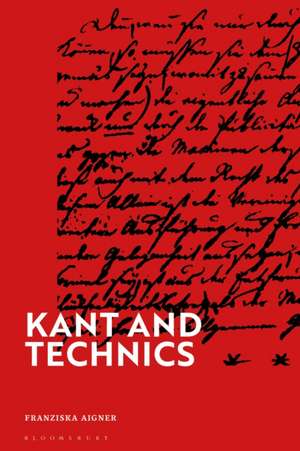
Kant and Technics: From the Critique of Pure Reason to the Opus Postumum
Autor Franziska Aigneren Limba Engleză Hardback – 14 noi 2024
The intention of this book is two-fold. On the one hand, it argues that, despite Heidegger, Simondon, and Stiegler's inability of recognizing it, there is an explicit concept of technics at work in Kant's philosophy. This technics is however not a technics that was overlooked by Heidegger, Simondon, and Stiegler. Instead, this book shows that, from the Critique of Pure Reason (1780) until the posthumously published Opus Postumum (1796-1803), transcendental philosophy is at once constituted against, while at the same time relying upon, and proceeding from technics. On the other hand, this book engages with the broader relation between philosophy and technics. If there is indeed such a thing as a Kantian thought on technics, then Kant can no longer be considered philosophy's most prominent 'techno-oblivious' thinker. The question about the relation between Kant and technics is thus nothing less than a question about the relation between philosophy and technics as a whole.
Preț: 552.80 lei
Preț vechi: 818.04 lei
-32%
Puncte Express: 829
Carte tipărită la comandă
Livrare economică 26 noiembrie-10 decembrie
Livrare prin curier în România Termenul estimat este afișat lângă disponibilitate.
Transport gratuit pentru acest produs Plată online sau ramburs, în funcție de opțiunile comenzii.
Retur gratuit în 14 zile Comandă securizată și suport în română.
Specificații
ISBN-13: 9781350299030
ISBN-10: 1350299030
Pagini: 272
Dimensiuni: 155 x 234 x 20 mm
Greutate: 0.58 kg
Editura: Bloomsbury Publishing
Colecția Bloomsbury Academic
Locul publicării:London, United Kingdom
ISBN-10: 1350299030
Pagini: 272
Dimensiuni: 155 x 234 x 20 mm
Greutate: 0.58 kg
Editura: Bloomsbury Publishing
Colecția Bloomsbury Academic
Locul publicării:London, United Kingdom
Cuprins
Foreword: Howard Caygill (Kingston University, UK)
1. Introduction
1.1 Heidegger, Simondon, and Stiegler on Philosophy's Technical Aporia and Kant
1.2 Gerhard Lehmann and Wilfried Seibicke on technics in Kant
1.3 Introducing Technics from the Critique of Pure Reason until the Opus Postumum
2. Reason's Instrumentality and the Need for a Discipline
2.1 Kant's diagnosis of reason in the Critique of Pure Reason
2.2 Reason's Instrumentality and the Canon/Organon Distinction
2.3 Method, the Technical Part of Logic
2.4 A Discipline for Reason
3. Kant's Technical Objects
3.1 Mechanisms and Automatisms
3.2 Two Touchstones of Truth
3.3 Guiding Threads, 'thirds', Schemata
3.4 The Compass
4. Cosmo-technics in the Opus Postumum
4.1 Technical-practical Reason and the Technical Power of Judgment
4.2 Technical-practical Reason in the System of Transcendental Philosophy
4.3 On Positing
4.4 God, the World, and the Human
4.5 Technical-practical Reason and the World
4.6 Styx Interfusa Coërcet: The Transition
5. Conclusion
5.1 Kant and the History of Technical Thought
5.2 Kant and Heidegger, Simondon, and Stiegler
1. Introduction
1.1 Heidegger, Simondon, and Stiegler on Philosophy's Technical Aporia and Kant
1.2 Gerhard Lehmann and Wilfried Seibicke on technics in Kant
1.3 Introducing Technics from the Critique of Pure Reason until the Opus Postumum
2. Reason's Instrumentality and the Need for a Discipline
2.1 Kant's diagnosis of reason in the Critique of Pure Reason
2.2 Reason's Instrumentality and the Canon/Organon Distinction
2.3 Method, the Technical Part of Logic
2.4 A Discipline for Reason
3. Kant's Technical Objects
3.1 Mechanisms and Automatisms
3.2 Two Touchstones of Truth
3.3 Guiding Threads, 'thirds', Schemata
3.4 The Compass
4. Cosmo-technics in the Opus Postumum
4.1 Technical-practical Reason and the Technical Power of Judgment
4.2 Technical-practical Reason in the System of Transcendental Philosophy
4.3 On Positing
4.4 God, the World, and the Human
4.5 Technical-practical Reason and the World
4.6 Styx Interfusa Coërcet: The Transition
5. Conclusion
5.1 Kant and the History of Technical Thought
5.2 Kant and Heidegger, Simondon, and Stiegler
Recenzii
Philosophy has, it turns out, neither forgotten nor repressed technics: the present work reveals with remarkable tenacity that it stands at the very heart of the Kantian philosophy from the first Critique to the very end. A remarkable work of scholarship, not to say conceptual and linguistic inventiveness, that both reveals new aspects of Kant's work and makes a significant intervention in contemporary post-Kantian philosophy.