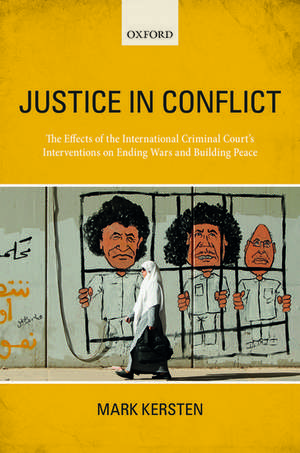
Justice in Conflict: The Effects of the International Criminal Court's Interventions on Ending Wars and Building Peace
Autor Mark Kerstenen Limba Engleză Paperback – 16 iun 2016
Problema fundamentală pe care Justice in Conflict o abordează este tensiunea paralizantă dintre necesitatea tragerii la răspundere a autorilor de atrocități și imperativul de a opri războaiele active. Atunci când comunitatea internațională intervine într-un conflict în desfășurare, se pune întrebarea: prezența Curții Penale Internaționale (CPI) facilitează sau blochează pacea? Credem că Mark Kersten reușește să depășească dezbaterea sterilă „pace versus justiție” prin propunerea unui cadru analitic nou, care nu mai privește aceste două concepte ca fiind în opoziție totală, ci ca elemente fluide influențate de interese politice concrete. Reținem că autorul nu se limitează la teorie, ci aplică această grilă pe două studii de caz complexe: Libia și nordul Ugandei. Pe linia practică a volumului The International Criminal Court in Ongoing Intrastate Conflicts de Patrick S. Wegner, dar cu un focus specific pe modul în care interesele statelor care sesizează Curtea dictează direcția investigațiilor, Kersten demonstrează că impactul CPI este rareori neutru. În contextul operei sale, această lucrare rafinează conceptele de justiție internaționalizată discutate în Hybrid Justice, mutând accentul de pe structura curților pe efectele lor politice și sociale directe. Cititorul va înțelege mecanismele prin care CPI alege să vizeze o anumită parte a unui conflict, descoperind că rezultatele sunt inevitabil mixte și profund dependente de negocierile dintre interesele instituționale ale Curții și cele ale actorilor statali. Este o analiză sobră, care refuză concluziile simpliste în favoarea unei înțelegeri profunde a modului în care justiția penală internațională funcționează „în vivo”, în mijlocul focului.
Preț: 327.47 lei
Preț vechi: 373.47 lei
-12%
Carte disponibilă
Livrare economică 21-27 mai
Specificații
ISBN-10: 0198777159
Pagini: 272
Dimensiuni: 155 x 234 x 15 mm
Greutate: 0.42 kg
Editura: OUP OXFORD
Colecția OUP Oxford
Locul publicării:Oxford, United Kingdom
V-ar putea interesa
-
 Preț: 77.97 lei
 -
 The American Century and Beyond: U.S. Foreign Relations, 1893-2014George C. Herring-15%Preț: 120.73 lei142.08 lei
 -
 Voluntary Euthanasia and the Common LawMargaret Otlowski-23%Preț: 457.35 lei594.01 lei
 -
 Criminal JusticeLucia Zedner-10%Preț: 356.98 lei397.40 lei
 -
 International Crimes and the Ad Hoc TribunalsGuénaël Mettraux-31%Preț: 454.36 lei655.79 lei
 -
 Excusing CrimeJeremy Horder-19%Preț: 393.55 lei483.77 lei
 -
 Criminal ResponsibilityVictor Tadros-11%Preț: 396.00 lei444.94 lei
 -
 -31%Preț: 381.38 lei551.60 lei
 -
 -23%Preț: 339.88 lei441.68 lei
 -
 Killing in Self-DefenceFiona Leverick-34%Preț: 705.53 lei1076.15 lei
 -
 -13%Preț: 318.55 lei364.87 lei
 -
 Genocide: A World HistoryNorman M. Naimark-27%Preț: 179.64 lei246.06 lei
 -
 Race, Crime, and the LawRandall KennedyPreț: 134.29 lei
 -
 Courtroom 302Steve BogiraPreț: 90.42 lei
 -
 The Problems of GenocideA. Dirk MosesPreț: 276.89 lei
 -
 International Criminal Law DeskbookCraig Barker-15%Preț: 461.09 lei542.46 lei
De ce să citești această carte
Această carte este esențială pentru specialiștii în drept internațional și relații internaționale care doresc să înțeleagă de ce intervențiile CPI produc rezultate atât de diferite. Cititorul va câștiga o perspectivă critică asupra modului în care justiția este utilizată ca instrument în negocierile de pace, învățând să identifice influența intereselor politice în spatele mandatelor de arestare internaționale. Este un ghid riguros pentru înțelegerea realpolitik-ului din spatele idealurilor de justiție globală.
Despre autor
Mark Kersten este un cercetător recunoscut în domeniul dreptului penal internațional și al studiilor de conflict. Expertiza sa se concentrează pe intersecția dintre politica internațională și justiție, fiind un colaborator activ în analizele privind rolul Curții Penale Internaționale în zonele de criză. În lucrările sale anterioare, precum Hybrid Justice, a explorat mecanismele instituționale de tranziție, iar prin Justice in Conflict își consolidează poziția de observator critic al modului în care tribunalele internaționale influențează dinamica războaielor contemporane și a proceselor de reconciliere.
Descriere
Recenzii
The book contains a remarkable 43-page bibliography that will be an asset in the hands of scholars, practitioners and policymakers in the areas of international criminal justice, conflict resolution and peace and conflict studies. This value is reinforced by the analytical index, the list of interviews and a series of tables summarizing the ICC interventions and the main arguments provided by the author.
Kersten's book is highly recommended reading for all those who are interested in the ICC, and indeed in international courts in general, and who wish to develop a clearer understanding of how the court functions in a political context.
This outstanding book is one of very few sustained studies of the operation of the International Criminal Court and its role in international politics. Kersten makes two critical contributions to existing scholarship: a sophisticated and nuanced theorisation of the relationship between peace and justice, and an analysis of the ways in which the Office of the Prosecutor negotiates its own interests alongside the interests of States Parties and the UN Security Council, which have profound effects on target selection and therefore on the quality of justice delivered. Written in a clear and engaging style and based on extensive first-hand research, it will be invaluable to students, scholars and practitioners who want to understand why the ICC behaves as it does and what the impact of the Court is upon conflict, peace and international politics.
Based on extensive original research from the situations in Uganda and Libya where the ICC prosecutor pushed for justice at the same time political actors negotiated for peace, Mark Kersten shows that the pursuit of both objectives did not undermine the realistic prospect of achieving either. Justice in Conflict urges a "fact-based " rather than "faith-based " approach to peace and justice and should encourage the international prosecutor and diplomat to work in ways that will help rather than hinder their chances for mutual success.
Mark Kersten brilliantly moves forward the peace vs. justice debate by offering a nuanced and fine-grained analysis of the ICC's impact on conflict. Focusing on Uganda and Libya, he analyses how state and non-state actors seek to deploy the power of the ICC to legitimize their own goals and shape the conflict narrative. This is essential reading for anyone who wants to understand the political and legal space that the ICC occupies and must navigate.
Kerstens nuanced analysis depicts the ICC as a conflicted court acting in conflict zones. Through an engaging and accessible style, he convincingly shows that the implications of pursuing during-conflict justice are varied and fluid, rather than dichotomous and deterministic. With the rising chorus of calls for international criminal justice in various countries, ranging from Syria to Israel/Palestine to Colombia, Kersten urges readers to maintain a healthy skepticism when categorical, and often ideological, assertions are made regarding both the positive and negative effects of ICC interventions... Kersten offers a refreshing contribution to the growing literature on the politics of international criminal justice.