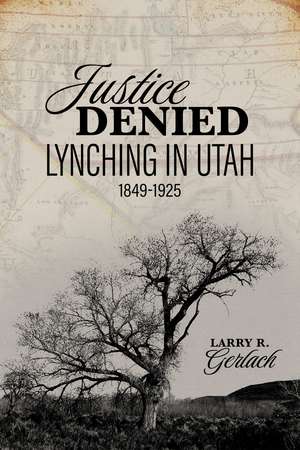
Justice Denied: Lynching in Utah, 1849–1925
Autor Larry Gerlachen Limba Engleză Paperback – 30 noi 2026
In Justice Denied: Lynching in Utah, 1849-1925, Larry Gerlach argues that, though lynching is associated with the American South, vigilante movements were most common in the American West. Despite an emphasis on law and order in Utah’s Mormon-dominated towns, individuals took it upon themselves to impose their sense of justice. Groups of citizens formed vigilante committees, taking the law into their own hands to advance special interests, expedite the judicial process of persons known or believed to be guilty of a crime, or punish those whose conduct countered community interests or values. While the identities of lynchers were usually well-known, law enforcement officials typically refused to do their duty and arrest those responsible for murder, and members of the community kept silent, ignoring their civic, ethical, and moral responsibilities.
In an effort to acknowledge this history of injustice and remember the victims as more than just names in historical records, Gerlach documents the lives and deaths of sixteen individuals, all but one murdered in the second half of the nineteenth century. Through years of research and careful analysis of historical records, Gerlach reconstructs these stories, determined to set the record straight.
Preț: 188.46 lei
Precomandă
Puncte Express: 283
Carte nepublicată încă
Livrare prin curier în România Precomanda se expediază când titlul devine disponibil.
Transport gratuit de la 400.00 lei Plată online sau ramburs, în funcție de opțiunile comenzii.
Retur gratuit în 14 zile Comandă securizată și suport în română.
Doresc să fiu notificat când acest titlu va fi disponibil:
Se trimite...
Specificații
ISBN-13: 9781647693152
ISBN-10: 1647693152
Pagini: 412
Dimensiuni: 152 x 229 mm
Ediția:First Edition
Editura: University of Utah Press
Colecția University of Utah Press
ISBN-10: 1647693152
Pagini: 412
Dimensiuni: 152 x 229 mm
Ediția:First Edition
Editura: University of Utah Press
Colecția University of Utah Press
Recenzii
“One of the most important works on the history of lynching in the American West. Gerlach has unearthed quite possibly every extant source on each of these Utah cases.”—Michael J. Pfeifer, John Jay College of Criminal Justice - CUNY
“These stories are powerful reminders of how easily the pursuit of justice can be derailed by fear, prejudice, and a thirst for revenge. Gerlach challenges us to confront uncomfortable truths in our past and underscores the importance of historical memory and giving voice to the silenced.”—Samuel P. Newton, University of Idaho
“These stories are powerful reminders of how easily the pursuit of justice can be derailed by fear, prejudice, and a thirst for revenge. Gerlach challenges us to confront uncomfortable truths in our past and underscores the importance of historical memory and giving voice to the silenced.”—Samuel P. Newton, University of Idaho
Notă biografică
Larry R. Gerlach is an emeritus professor of history at the University of Utah. He is the author of eighteen books, including Blazing Crosses in Zion: The Ku Klux Klan in Utah.
Extras
While historians have understandably focused on the extensive lynching of Black people in the American South, lynching in the West differed in chronology, circumstance, and victims. Consequently, “more work must be done on the significant amount of lynching violence that occurred in American regions outside the South, where hundreds of persons—including Hispanics, whites, Native Americans, African Americans, and Asians—died at the hands of lynch mobs.” This examination of lynching in Utah contributes to the history of lynching in the American West and thus the United States.
Every book has a beginning. This one about an overlooked chapter of Utah history began in the mid-1970s. I read several of the early studies of lynching that supported the campaign of the National Association for the Advancement of Colored People to convince Congress to pass federal antilynching legislation in 1920s and 1940s. I was also taken by the comprehensive studies of violence published under the auspices of the U. S. National Commission on the Causes and Prevention of Violence appointed in 1968 by President Lyndon Johnson after the assassinations of the Reverend Martin Luther King Jr. and Robert F. Kennedy. My interest piqued when a check of Utah state and local histories contained no mention of lynching,I compiled notes on lynchings while researching another neglected aspect of Utah history, the Ku Klux Klan. I finished Blazing Crosses in Zion, but the lynching project lay dormant as other research interests and administrative assignments took precedent.
Then, after an unusually long gestation period of nearly a half-century, I resolved to complete unfinished business. I had read with interest many of the lynching studies published in the first two decades of this century, but my motivation came from a visit in 2019 to the National Memorial for Peace and Justice in Montgomery, Alabama. The powerfully moving memorial, dedicated solely to the lynching of Black people, included only two Utah victims, both Black. I knew there were more victims in Utah, Black people were not the only ones who had been lynched, and lynching was an ignored chapter of Utah history. So, to fill an historiographical void in Utah as well as western lynching, I set out to write about “popular justice” in the Beehive State.
I initially thought of a writing a comprehensive article, but realized a general survey, while instructive, seemed ahistorical, an overview precluding a proper understanding of unique causes, methods, and consequences of an individual lynching. Then came an epiphany: the relatively few Utah lynchings provided an opportunity to provide a detailed and complete history of lynching in a territory cum state. The result is an unconventional history, comprehensive but featuring chronologically arranged case studies of fourteen lynchings as detailed and extensive as documentation allows. Set firmly in the context of personalities, time and place, the essays illustrate the variability of causes, circumstances, personalities, means and consequences of lynching. While unique, the chapters are connected by recurring themes: retribution for criminality, concerns about the judicial system, and establishing social control in unstable communities beset variously with racial, ethnic, and religious tensions. Euclid in Elements, Book I, Common Notion 5, said “The whole is greater than the part.” However, when it comes to lynching history, the individual parts are greater than the sum. Lynching was a common national occurrence, yet each lynching was a profoundly local event. Thus, while this book is written as Utah history and events based on Utah documents, it is an integral piece of the much wider history of lynching in America, a composite of other similar, albeit unique, local variables that proceed from same starting point—an offense deemed objective enough to warrant extralegal murder. The Epilogue, discussing both the uniqueness of lynching in Utah and the commonalities to lynching elsewhere, contributes to the growing mosaic of extralegal executions in America. The Postscript, which discusses the Day of Reconciliation discusses the interrelated themes of historical memory and community memorialization of lynching.
Uncovering a neglected aspect of Utah history turned out to be a bigger task than envisioned. Research on violence, lynching in particular, had exploded since the 1970s, so I first had to work through a pile of books, general surveys as well as individual, state and regional studies. The majority dealt with the Southern lynching of Blacks to maintain white supremacy and apartheid codes, but there was also welcome attention to lynching outside the South including the far west. Not happy reading, the books provided beneficial insights and perspectives, demonstrating once again that scholarship is a cumulative endeavor.
From the outset of research, I had to grapple with two fundamental issues. First, sources. As in all lynching research, newspapers—“the first rough draft of history”—provided the principal paper trail supplemented by diaries, journals, institutional records, remembrances recorded in local histories and in one instance, personal interviews. With only a handful of newspapers published during the territorial period and with no staff of investigative reporters, accounts of a lynching differ dramatically in content and are often confusing and contradictory. I have tried to ascertain commonalities and privilege information that seemed most likely given source and circumstance. Although it is improper to read between nonexistent lines, indisputable facts point to the possible and probable, so I have occasionally engaged in cautious and appropriate speculation.
The second problem was definitional. The terms “lynching” and “lynch law” derive from Charles Lynch, a militia colonel in Virginia during the American Revolution who without legal authority conducted “trials” of Loyalists at his home and sentenced them to imprisonment and flogging but not death. During the 1830s, “lynching” eventually evolved from non-lethal to lethal punishment. Most commonly associated with hanging by rope, extra-legal death was also inflicted by beating, beheading, burning, shooting, or stabbing. But the term continued to be used for non-lethal punitive acts. When in June 1846, a band of about eighty “Regulators” whipped eleven members of the Church of Jesus Christ of Latter-day Saints (Mormons) who remained in Nauvoo, Illinois, the Saints called them “lynchers.” In Utah Territory on August 26, 1850, a horse thief was “tried by Judge lynch and condemned to be whipped and accordingly received thirty lashes well laid on.”
What, then, constitutes as a lynching? Lynching is not an official category of criminality. It is a descriptive term for murder. A lynching is not, however, a random killing resulting from personal animosity, vengeful desire, momentary anger, uncontrolled passion, prejudice, or bigotry. Anti-lynching activists met at the Tuskegee Institute in 1940 to hammer out a common definition of lynching, finally agreeing a lynching was an extralegal killing “by a group [generally taken to mean three or more persons], done under the pretext of service to justice, race, or tradition.” The definition, customarily used by historians today, was intended to exclude random instances of a Southern white person killing a Black person. That is understandable given the extent of racial violence in the South, but the stipulation that lynching is group murder is too restrictive as one or two individuals may kill premeditatively “under the pretext of service to justice, race, or tradition.” That only one kind of extralegal execution is authentically a lynching is wrong; as Christopher Waldrep put it, “the word ‘lynching’ cannot be defined.”
Hard to define, lynching is easily known when you see it. The essential element that distinguishes lynching from homicide is purpose. To my mind, lynching is the premeditated murder of a person or persons committed, usually in public, in defense of official institutional beliefs or established community behavioral norms as well as retribution in the name of justice without due process of law for a particularly heinous crime, usually murder.
Finally, researching lives lived and lost from the distance of 150 years or so is a daunting task. Admittedly, what is known about lynching is fragmentary given the absence of participant testimonies and detailed on-sight descriptive accounts. A lynching is a complex event that raises numerous questions about circumstances, communities, victims, perpetrators, bystanders, and consequences, so to understand the backstory and causatum I set out to investigate five things: the nature of the community in which the lynching occurred, what precipitated the lynching, the identities of victims and lynchers, how the extra-legal execution took place, and the response(s) to the illegal murder.
My initial research identified eight Utah lynchings, and I wrote about three, each now extensively revised in view of new findings and expanded understanding. I have now found thirty or thirty-one lynchings. While some on the overland trail and in railroad construction camps were reported without detailed supporting evidence, there is no reason to believe they were created out of whole cloth, there being no self-serving reason for disclosing them. There well may have been others. There were few newspapers until the 1890s, and the dearth of comments in journals, diaries, and correspondence indicate lynching was not something to be talked or written about.
The historian cannot reanimate the dead, but to appreciate condition and circumstance, I walked about the sagebrush-rimmed ghostly remains of railroad camps and mining towns and the wholly transformed urban landscapes at the same time as lynching happened, experiencing wintery cold and snow in Logan and Wahsatch, summer heat in Salt Lake City and cool autumn breezes in Eureka and St. George. Visiting the places where people lived and died, underscored I was writing about human beings, and that it is easy to describe the realities of a lynching—where, who, why, and how—but much more difficult to understand the mindset and emotions of the victims, lynchers, onlookers and members of the community. While all records are descriptive of lynching, none reveal what was going through the minds of perpetrators or victims. As I wandered through the ruins of Silver Reef, words of a poem keep running through my mind:
Silver Reef! Town of Mystery, Town of Romance,
Town of Riddles still unsolved!
Oh, the secrets you are guarding in those
Deep, dark, gaping holes!
Now, a scarred and lonely landscape
Greets the trav’ler’s wondering gaze,
As he comes to view the remnants
Of this camp of by-gone days.
In the end, I know what happened, but cannot begin to fully understand why it happened. In no instance was the offense, usually murder, so objectionable or heinous that it warranted lynching.
Unable to plumb the inner thoughts of the historically voiceless lynchers or their victims, I had to come to grips with mine. Lo these many years, I have written a great deal, but nothing more challenging than this dark chapter of Utah history. I found it to be a dispiriting, grim experience. Researching and writing about lynching, a tale of extreme human behavior, of uncontrolled rage, of premeditated murder, is emotionally unsettling. It is not enjoyable to learn about the gruesomely violent death suffered by victims and the savage brutality of those who killed them. I was all too familiar with racism, prejudice, and bigotry—I came to know Klansmen—but the premediated, torturous public killing of person compounded by the community complicity, that was new.
Historians are not mere chroniclers. While striving for objectivity, empathy is necessary to understand the human experience. I obviously did not witness any lynching, but in reading documentary evidence felt as if I had. In my mind’s eye I visualized with sadness and anger the formation of the mob, the dragging away the victim, the lynching itself, even corpses dangling in midair for all to see. It was difficult to stomach. Nary a day went by that I did not have a visceral reaction to recounting the excruciating emotional anguish and physical pain suffered by a human being, the violent murder committed by otherwise decent law-abiding people, and the silence of community citizens that allowed lynchers to go unpunished. Why this affected me so, I cannot say. Maybe the sustained exposure to savage barbarity, or maybe the knowledge that violence bred of fear and irrational hatred still pervades modern society. In calmer moments at day’s end, I kept thinking how lynching violated so absolutely the basic values and principles upon which the country was founded, the victims’ “unalienable Rights” of “Life, Liberty and the pursuit of Happiness” and Constitutional guarantee “to a speedy and public trial, by an impartial jury.”
If there simply is no pleasure in researching and writing about lynching, why undertake a project so unpleasant, why exhume a depressing chapter of Utah history? Because I am a teacher of the historian variety. Writing this book fulfills a historical interest and desire to create a more complete understanding of Utah history, yes, but I principally envisioned it as an educational enterprise. For readers of Utah history, of course, but there is also a connection between the written and remembered past as it gets into classrooms. Just as Utah histories and classes did not mention the Ku Klux Klan before Blazing Crosses, I hoped lynching, both the murderous act and the complicity of those who stood by and then maintained silence, henceforth would be included in the conventional portrayal of the state’s history. And, by extension, lead to an understanding of the extralegal murder of so many people—Hispanics, whites, Native Americans, African Americans, and Asians—in the American West, indeed in the nation.
There is no gainsaying that “Americans have always been given to a kind of historical amnesia that marks much of their turbulent past through collective repression and selective recollection.” When friends and neighbors found out about my project, the universal reaction was shock, disgust, even disbelief. Lynching in Utah? How terrible. How could people do such a thing? There weren’t many Black people. One youngster asked: “What’s lynching?”
That the responses revealed ignorance of lynching in the state and the false view that it was solely a Southern racial crime—outside the South most victims were not Black—is not surprising.From the Civil War to after World War II, lynching was a major topic of national discussion and, judging from newspaper commentary, the talk of the town in Utah, especially in the 1880s. But whether due to neglect, a desire to let disagreeable and embarrassing events lie, or the belief that manifestations of uncontrolled mob violence were isolated events of little historical importance or public interest, Utah’s histories were virtually silent on lynch law.
Much of our historical memory is what we want to remember, and there is often a difference, sometimes a glaring chasm, between what happened in the past as opposed to what we say about it. We want to tell stories favorable to the community and ignore negative or controversial events. In some ways the past lives on with remarkable vibrancy in Utah, largely owing to an emphasis on the history of the Church of Jesus Christ of Latter-day Saints. But just as it is important for Utahns to remember stories of courage and inspiration—Mormon pioneers crossing the plains to a religious promised land and Southern European immigrants traveling across the ocean in search of a better life by working in mines—it is also important they learn about the regrettable vestiges of the past, people’s inhumanity to each other.An honest retelling of history includes all the people, events and experiences even if it tarnishes the traditional narrative. The burden of history is to tell the story no matter how unsettling or dispiriting; the absence of the brutal injustice committed in the name of justice is an intellectual and moral omission. Not to tell the story of lynching is to say it never happened or isn’t important, and to disrespect those whose lives were so cruelly taken and to excuse those responsible.
As the poet W. H. Auden wrote,
Acts of injustice done
Lies in history like bones, each one.
There are those who would say that events of long ago, like lynching, should be consigned to the dust bins of history as they have no relevance to our lives today. That was then, this is now. They would be wrong. History is cumulative, for good and for ill. Thomas Jefferson's Declaration of Independence, Abraham Lincoln's quest to preserve the Union, and the achievements of the immigrants who settled America live today. So, too, does the legacy of African slavery, military conquest of Indian tribes, Japanese internment camps, vigilantism, and lynching. Historical truth is not always welcome or well received, but knowing the past, learning from the noble and ignoble, elevates the human condition. John 8:32 applies: “You shall know the truth, and the truth shall set you free.”
Historical memory has contemporary relevance. It creates a common cultural language, communal sensibility and prevents ignorance. In 1999 U.S. District Judge David Sam dismissed a lawsuit filed against Delta Airlines by David Hollins, a former Black employee from Mississippi who alleged he was subjected to “racially and discriminatory conduct” when, the day after a coworker told him a lynching joke, he found a noose hanging above his workplace. Sam’s ruling, that “there is no viable evidence that either the hanging joke or rope incidents were racial or stemmed from racial animus,” revealed either embarrassing ignorance or willful denial of history. No reasonable person, let alone a Black man from Mississippi, could see a hangman’s noose as anything other than a frightening symbol of the racial terrorism and oppression that claimed thousands of Black lives. Unquestionably, lynching is “a painful and prominent element of the Black experience in America, second only to slavery.”
Readers of this troubling chapter of Utah history will be taken far beyond their historical comfort zones. Some will feel sadness, even revulsion, from chilling accounts of deliberate, senseless, violent killings. Others will choose not to read it for that reason. But however disturbing, the story of lynching is important. The basic themes are violence and death, but the prominent through lines are law and order, the nature of mob violence, the judicial system, the responsibility of the press, personal moral values, community behavior, and, above all, the choices people make and the consequences of those decisions. As such, this history of lynching in the distant past is a reminder of the tragic consequences to individuals and communities when angry emotions overwhelm rational thought. Today we do not lynch people, but our all-too many faults and contradictions do not allow for easy self-congratulation. A century after the last Utah lynching inhumanity persists in the most violent industrialized country on earth, in rampant homicides, the defacing and bombing of synagogues; racial, ethnic and homophobic hate crimes; public mass shootings, even in schools; police beatings and killings of defenseless Black people; and a frenzied armed mob assault on the nation’s capitol.
Items major and minor. While the circumstances and methods of some of the extralegal executions were untraditional, the purpose in each case clearly indicates a lynching. I have quoted extensively from newspapers partly to impart the color of the times, but primarily because what people read both reflected and shaped popular opinion. Since papers of the day frequently came and went by various names, I have included the publication city as well as masthead title in citations. Nineteenth century writing is notoriously erratic in terms of capitalization and spelling; both have been silently corrected save when originality seemed important. I have used “reported” or “reportedly” for important second-hand information, but not “alleged” for crimes committed when guilt is clearly demonstrable in the court of history, if not law. It is common today to use “Indigenous” and “Native American” for the original settlers of North America, but I have primarily used “Indian,” the term universally used in the nineteenth century and in modern Utah tribal histories written by Native people. Despite President Russell M. Nelson’s admonition in 2018 not to use “Mormon” or “LDS” in reference to the Church of Jesus Christ of Latter-day Saints or call its members “Mormons” I have used those terms as still commonly used by Saints and non-members. The racially derogatory term “Nigger” is retained in quotations both to illustrate the racism of the time and to provide accurate historical documentation. Instead of a bibliography listing the plethora of primary and secondary sources consulted, the items considered most pertinent for each chapter are identified in endnotes.
A word about the title. I had originally considered “Persons Unknown” because virtually nothing is known about the lynchers or their victims save in a few cases, inquest juries and newspapers typically attributed a lynching to “persons unknown,” and the history of lynching itself is largely unknown to Utahns. The title is apt, but I decided on the explicit “Justice Denied” because justice was denied when lynching victims were executed without their constitutional right to trial by jury, when law enforcement officials failed to do their duty, when lynchers in all but one instance escaped punishment for premeditated murder, and when members of communities were complicit by shrouding the tragic event with silence. As British philosopher Edmund Burke observed “The only thing necessary for the triumph of evil is for good men to do nothing.”
A personal comment. I was—and still am—uneasy about using the picture of Robert Marshall hanging from a tree on the dust jacket as it perpetuates the agony and tragedy of his death. On the other hand, the shocking image conveys, as words cannot, recognition of the ghastly horror of lynching and underscores that victims were human beings, not names, numbers, or statistics. Hopefully the grotesque photograph of the tragic event serves as something of a memorial to Marshall and all lynching victims as well as and a reminder of what can happen when angry emotions override rational thought. The history of lynching is a deplorable but instructive tale. Hopefully, I have done it justice.
[end of excerpt]
Every book has a beginning. This one about an overlooked chapter of Utah history began in the mid-1970s. I read several of the early studies of lynching that supported the campaign of the National Association for the Advancement of Colored People to convince Congress to pass federal antilynching legislation in 1920s and 1940s. I was also taken by the comprehensive studies of violence published under the auspices of the U. S. National Commission on the Causes and Prevention of Violence appointed in 1968 by President Lyndon Johnson after the assassinations of the Reverend Martin Luther King Jr. and Robert F. Kennedy. My interest piqued when a check of Utah state and local histories contained no mention of lynching,I compiled notes on lynchings while researching another neglected aspect of Utah history, the Ku Klux Klan. I finished Blazing Crosses in Zion, but the lynching project lay dormant as other research interests and administrative assignments took precedent.
Then, after an unusually long gestation period of nearly a half-century, I resolved to complete unfinished business. I had read with interest many of the lynching studies published in the first two decades of this century, but my motivation came from a visit in 2019 to the National Memorial for Peace and Justice in Montgomery, Alabama. The powerfully moving memorial, dedicated solely to the lynching of Black people, included only two Utah victims, both Black. I knew there were more victims in Utah, Black people were not the only ones who had been lynched, and lynching was an ignored chapter of Utah history. So, to fill an historiographical void in Utah as well as western lynching, I set out to write about “popular justice” in the Beehive State.
I initially thought of a writing a comprehensive article, but realized a general survey, while instructive, seemed ahistorical, an overview precluding a proper understanding of unique causes, methods, and consequences of an individual lynching. Then came an epiphany: the relatively few Utah lynchings provided an opportunity to provide a detailed and complete history of lynching in a territory cum state. The result is an unconventional history, comprehensive but featuring chronologically arranged case studies of fourteen lynchings as detailed and extensive as documentation allows. Set firmly in the context of personalities, time and place, the essays illustrate the variability of causes, circumstances, personalities, means and consequences of lynching. While unique, the chapters are connected by recurring themes: retribution for criminality, concerns about the judicial system, and establishing social control in unstable communities beset variously with racial, ethnic, and religious tensions. Euclid in Elements, Book I, Common Notion 5, said “The whole is greater than the part.” However, when it comes to lynching history, the individual parts are greater than the sum. Lynching was a common national occurrence, yet each lynching was a profoundly local event. Thus, while this book is written as Utah history and events based on Utah documents, it is an integral piece of the much wider history of lynching in America, a composite of other similar, albeit unique, local variables that proceed from same starting point—an offense deemed objective enough to warrant extralegal murder. The Epilogue, discussing both the uniqueness of lynching in Utah and the commonalities to lynching elsewhere, contributes to the growing mosaic of extralegal executions in America. The Postscript, which discusses the Day of Reconciliation discusses the interrelated themes of historical memory and community memorialization of lynching.
Uncovering a neglected aspect of Utah history turned out to be a bigger task than envisioned. Research on violence, lynching in particular, had exploded since the 1970s, so I first had to work through a pile of books, general surveys as well as individual, state and regional studies. The majority dealt with the Southern lynching of Blacks to maintain white supremacy and apartheid codes, but there was also welcome attention to lynching outside the South including the far west. Not happy reading, the books provided beneficial insights and perspectives, demonstrating once again that scholarship is a cumulative endeavor.
From the outset of research, I had to grapple with two fundamental issues. First, sources. As in all lynching research, newspapers—“the first rough draft of history”—provided the principal paper trail supplemented by diaries, journals, institutional records, remembrances recorded in local histories and in one instance, personal interviews. With only a handful of newspapers published during the territorial period and with no staff of investigative reporters, accounts of a lynching differ dramatically in content and are often confusing and contradictory. I have tried to ascertain commonalities and privilege information that seemed most likely given source and circumstance. Although it is improper to read between nonexistent lines, indisputable facts point to the possible and probable, so I have occasionally engaged in cautious and appropriate speculation.
The second problem was definitional. The terms “lynching” and “lynch law” derive from Charles Lynch, a militia colonel in Virginia during the American Revolution who without legal authority conducted “trials” of Loyalists at his home and sentenced them to imprisonment and flogging but not death. During the 1830s, “lynching” eventually evolved from non-lethal to lethal punishment. Most commonly associated with hanging by rope, extra-legal death was also inflicted by beating, beheading, burning, shooting, or stabbing. But the term continued to be used for non-lethal punitive acts. When in June 1846, a band of about eighty “Regulators” whipped eleven members of the Church of Jesus Christ of Latter-day Saints (Mormons) who remained in Nauvoo, Illinois, the Saints called them “lynchers.” In Utah Territory on August 26, 1850, a horse thief was “tried by Judge lynch and condemned to be whipped and accordingly received thirty lashes well laid on.”
What, then, constitutes as a lynching? Lynching is not an official category of criminality. It is a descriptive term for murder. A lynching is not, however, a random killing resulting from personal animosity, vengeful desire, momentary anger, uncontrolled passion, prejudice, or bigotry. Anti-lynching activists met at the Tuskegee Institute in 1940 to hammer out a common definition of lynching, finally agreeing a lynching was an extralegal killing “by a group [generally taken to mean three or more persons], done under the pretext of service to justice, race, or tradition.” The definition, customarily used by historians today, was intended to exclude random instances of a Southern white person killing a Black person. That is understandable given the extent of racial violence in the South, but the stipulation that lynching is group murder is too restrictive as one or two individuals may kill premeditatively “under the pretext of service to justice, race, or tradition.” That only one kind of extralegal execution is authentically a lynching is wrong; as Christopher Waldrep put it, “the word ‘lynching’ cannot be defined.”
Hard to define, lynching is easily known when you see it. The essential element that distinguishes lynching from homicide is purpose. To my mind, lynching is the premeditated murder of a person or persons committed, usually in public, in defense of official institutional beliefs or established community behavioral norms as well as retribution in the name of justice without due process of law for a particularly heinous crime, usually murder.
Finally, researching lives lived and lost from the distance of 150 years or so is a daunting task. Admittedly, what is known about lynching is fragmentary given the absence of participant testimonies and detailed on-sight descriptive accounts. A lynching is a complex event that raises numerous questions about circumstances, communities, victims, perpetrators, bystanders, and consequences, so to understand the backstory and causatum I set out to investigate five things: the nature of the community in which the lynching occurred, what precipitated the lynching, the identities of victims and lynchers, how the extra-legal execution took place, and the response(s) to the illegal murder.
My initial research identified eight Utah lynchings, and I wrote about three, each now extensively revised in view of new findings and expanded understanding. I have now found thirty or thirty-one lynchings. While some on the overland trail and in railroad construction camps were reported without detailed supporting evidence, there is no reason to believe they were created out of whole cloth, there being no self-serving reason for disclosing them. There well may have been others. There were few newspapers until the 1890s, and the dearth of comments in journals, diaries, and correspondence indicate lynching was not something to be talked or written about.
The historian cannot reanimate the dead, but to appreciate condition and circumstance, I walked about the sagebrush-rimmed ghostly remains of railroad camps and mining towns and the wholly transformed urban landscapes at the same time as lynching happened, experiencing wintery cold and snow in Logan and Wahsatch, summer heat in Salt Lake City and cool autumn breezes in Eureka and St. George. Visiting the places where people lived and died, underscored I was writing about human beings, and that it is easy to describe the realities of a lynching—where, who, why, and how—but much more difficult to understand the mindset and emotions of the victims, lynchers, onlookers and members of the community. While all records are descriptive of lynching, none reveal what was going through the minds of perpetrators or victims. As I wandered through the ruins of Silver Reef, words of a poem keep running through my mind:
Silver Reef! Town of Mystery, Town of Romance,
Town of Riddles still unsolved!
Oh, the secrets you are guarding in those
Deep, dark, gaping holes!
Now, a scarred and lonely landscape
Greets the trav’ler’s wondering gaze,
As he comes to view the remnants
Of this camp of by-gone days.
In the end, I know what happened, but cannot begin to fully understand why it happened. In no instance was the offense, usually murder, so objectionable or heinous that it warranted lynching.
Unable to plumb the inner thoughts of the historically voiceless lynchers or their victims, I had to come to grips with mine. Lo these many years, I have written a great deal, but nothing more challenging than this dark chapter of Utah history. I found it to be a dispiriting, grim experience. Researching and writing about lynching, a tale of extreme human behavior, of uncontrolled rage, of premeditated murder, is emotionally unsettling. It is not enjoyable to learn about the gruesomely violent death suffered by victims and the savage brutality of those who killed them. I was all too familiar with racism, prejudice, and bigotry—I came to know Klansmen—but the premediated, torturous public killing of person compounded by the community complicity, that was new.
Historians are not mere chroniclers. While striving for objectivity, empathy is necessary to understand the human experience. I obviously did not witness any lynching, but in reading documentary evidence felt as if I had. In my mind’s eye I visualized with sadness and anger the formation of the mob, the dragging away the victim, the lynching itself, even corpses dangling in midair for all to see. It was difficult to stomach. Nary a day went by that I did not have a visceral reaction to recounting the excruciating emotional anguish and physical pain suffered by a human being, the violent murder committed by otherwise decent law-abiding people, and the silence of community citizens that allowed lynchers to go unpunished. Why this affected me so, I cannot say. Maybe the sustained exposure to savage barbarity, or maybe the knowledge that violence bred of fear and irrational hatred still pervades modern society. In calmer moments at day’s end, I kept thinking how lynching violated so absolutely the basic values and principles upon which the country was founded, the victims’ “unalienable Rights” of “Life, Liberty and the pursuit of Happiness” and Constitutional guarantee “to a speedy and public trial, by an impartial jury.”
If there simply is no pleasure in researching and writing about lynching, why undertake a project so unpleasant, why exhume a depressing chapter of Utah history? Because I am a teacher of the historian variety. Writing this book fulfills a historical interest and desire to create a more complete understanding of Utah history, yes, but I principally envisioned it as an educational enterprise. For readers of Utah history, of course, but there is also a connection between the written and remembered past as it gets into classrooms. Just as Utah histories and classes did not mention the Ku Klux Klan before Blazing Crosses, I hoped lynching, both the murderous act and the complicity of those who stood by and then maintained silence, henceforth would be included in the conventional portrayal of the state’s history. And, by extension, lead to an understanding of the extralegal murder of so many people—Hispanics, whites, Native Americans, African Americans, and Asians—in the American West, indeed in the nation.
There is no gainsaying that “Americans have always been given to a kind of historical amnesia that marks much of their turbulent past through collective repression and selective recollection.” When friends and neighbors found out about my project, the universal reaction was shock, disgust, even disbelief. Lynching in Utah? How terrible. How could people do such a thing? There weren’t many Black people. One youngster asked: “What’s lynching?”
That the responses revealed ignorance of lynching in the state and the false view that it was solely a Southern racial crime—outside the South most victims were not Black—is not surprising.From the Civil War to after World War II, lynching was a major topic of national discussion and, judging from newspaper commentary, the talk of the town in Utah, especially in the 1880s. But whether due to neglect, a desire to let disagreeable and embarrassing events lie, or the belief that manifestations of uncontrolled mob violence were isolated events of little historical importance or public interest, Utah’s histories were virtually silent on lynch law.
Much of our historical memory is what we want to remember, and there is often a difference, sometimes a glaring chasm, between what happened in the past as opposed to what we say about it. We want to tell stories favorable to the community and ignore negative or controversial events. In some ways the past lives on with remarkable vibrancy in Utah, largely owing to an emphasis on the history of the Church of Jesus Christ of Latter-day Saints. But just as it is important for Utahns to remember stories of courage and inspiration—Mormon pioneers crossing the plains to a religious promised land and Southern European immigrants traveling across the ocean in search of a better life by working in mines—it is also important they learn about the regrettable vestiges of the past, people’s inhumanity to each other.An honest retelling of history includes all the people, events and experiences even if it tarnishes the traditional narrative. The burden of history is to tell the story no matter how unsettling or dispiriting; the absence of the brutal injustice committed in the name of justice is an intellectual and moral omission. Not to tell the story of lynching is to say it never happened or isn’t important, and to disrespect those whose lives were so cruelly taken and to excuse those responsible.
As the poet W. H. Auden wrote,
Acts of injustice done
Lies in history like bones, each one.
There are those who would say that events of long ago, like lynching, should be consigned to the dust bins of history as they have no relevance to our lives today. That was then, this is now. They would be wrong. History is cumulative, for good and for ill. Thomas Jefferson's Declaration of Independence, Abraham Lincoln's quest to preserve the Union, and the achievements of the immigrants who settled America live today. So, too, does the legacy of African slavery, military conquest of Indian tribes, Japanese internment camps, vigilantism, and lynching. Historical truth is not always welcome or well received, but knowing the past, learning from the noble and ignoble, elevates the human condition. John 8:32 applies: “You shall know the truth, and the truth shall set you free.”
Historical memory has contemporary relevance. It creates a common cultural language, communal sensibility and prevents ignorance. In 1999 U.S. District Judge David Sam dismissed a lawsuit filed against Delta Airlines by David Hollins, a former Black employee from Mississippi who alleged he was subjected to “racially and discriminatory conduct” when, the day after a coworker told him a lynching joke, he found a noose hanging above his workplace. Sam’s ruling, that “there is no viable evidence that either the hanging joke or rope incidents were racial or stemmed from racial animus,” revealed either embarrassing ignorance or willful denial of history. No reasonable person, let alone a Black man from Mississippi, could see a hangman’s noose as anything other than a frightening symbol of the racial terrorism and oppression that claimed thousands of Black lives. Unquestionably, lynching is “a painful and prominent element of the Black experience in America, second only to slavery.”
Readers of this troubling chapter of Utah history will be taken far beyond their historical comfort zones. Some will feel sadness, even revulsion, from chilling accounts of deliberate, senseless, violent killings. Others will choose not to read it for that reason. But however disturbing, the story of lynching is important. The basic themes are violence and death, but the prominent through lines are law and order, the nature of mob violence, the judicial system, the responsibility of the press, personal moral values, community behavior, and, above all, the choices people make and the consequences of those decisions. As such, this history of lynching in the distant past is a reminder of the tragic consequences to individuals and communities when angry emotions overwhelm rational thought. Today we do not lynch people, but our all-too many faults and contradictions do not allow for easy self-congratulation. A century after the last Utah lynching inhumanity persists in the most violent industrialized country on earth, in rampant homicides, the defacing and bombing of synagogues; racial, ethnic and homophobic hate crimes; public mass shootings, even in schools; police beatings and killings of defenseless Black people; and a frenzied armed mob assault on the nation’s capitol.
Items major and minor. While the circumstances and methods of some of the extralegal executions were untraditional, the purpose in each case clearly indicates a lynching. I have quoted extensively from newspapers partly to impart the color of the times, but primarily because what people read both reflected and shaped popular opinion. Since papers of the day frequently came and went by various names, I have included the publication city as well as masthead title in citations. Nineteenth century writing is notoriously erratic in terms of capitalization and spelling; both have been silently corrected save when originality seemed important. I have used “reported” or “reportedly” for important second-hand information, but not “alleged” for crimes committed when guilt is clearly demonstrable in the court of history, if not law. It is common today to use “Indigenous” and “Native American” for the original settlers of North America, but I have primarily used “Indian,” the term universally used in the nineteenth century and in modern Utah tribal histories written by Native people. Despite President Russell M. Nelson’s admonition in 2018 not to use “Mormon” or “LDS” in reference to the Church of Jesus Christ of Latter-day Saints or call its members “Mormons” I have used those terms as still commonly used by Saints and non-members. The racially derogatory term “Nigger” is retained in quotations both to illustrate the racism of the time and to provide accurate historical documentation. Instead of a bibliography listing the plethora of primary and secondary sources consulted, the items considered most pertinent for each chapter are identified in endnotes.
A word about the title. I had originally considered “Persons Unknown” because virtually nothing is known about the lynchers or their victims save in a few cases, inquest juries and newspapers typically attributed a lynching to “persons unknown,” and the history of lynching itself is largely unknown to Utahns. The title is apt, but I decided on the explicit “Justice Denied” because justice was denied when lynching victims were executed without their constitutional right to trial by jury, when law enforcement officials failed to do their duty, when lynchers in all but one instance escaped punishment for premeditated murder, and when members of communities were complicit by shrouding the tragic event with silence. As British philosopher Edmund Burke observed “The only thing necessary for the triumph of evil is for good men to do nothing.”
A personal comment. I was—and still am—uneasy about using the picture of Robert Marshall hanging from a tree on the dust jacket as it perpetuates the agony and tragedy of his death. On the other hand, the shocking image conveys, as words cannot, recognition of the ghastly horror of lynching and underscores that victims were human beings, not names, numbers, or statistics. Hopefully the grotesque photograph of the tragic event serves as something of a memorial to Marshall and all lynching victims as well as and a reminder of what can happen when angry emotions override rational thought. The history of lynching is a deplorable but instructive tale. Hopefully, I have done it justice.
[end of excerpt]
Cuprins
List of Figures
Preface
Introduction: On Vigilantism and Lynching
1. The Different World of Utah
2. Recalcitrant Utes: Patsowet and Washear
3. Trails, Rails and Hills
4. The Carson Valley Three
5. Thomas Coleman
6. Charles Benson
7. Ah Sing
8. Thomas Forrest
9. William Harvey
10. John Murphy
11. George Segal
12. Joseph Fisher
13. Robert Marshall
Epilogue
Postscript
Acknowledgments
Appendix: Near Lynchings
Notes
Selected Bibliography
Index
Preface
Introduction: On Vigilantism and Lynching
1. The Different World of Utah
2. Recalcitrant Utes: Patsowet and Washear
3. Trails, Rails and Hills
4. The Carson Valley Three
5. Thomas Coleman
6. Charles Benson
7. Ah Sing
8. Thomas Forrest
9. William Harvey
10. John Murphy
11. George Segal
12. Joseph Fisher
13. Robert Marshall
Epilogue
Postscript
Acknowledgments
Appendix: Near Lynchings
Notes
Selected Bibliography
Index