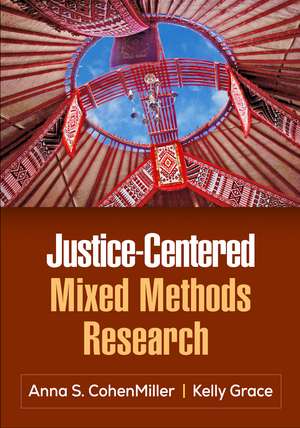
Justice-Centered Mixed Methods Research
Autor Anna S. CohenMiller, Kelly Graceen Limba Engleză Hardback – 21 mai 2026
Pedagogical Features
- Chapter-opening guiding questions.
- Within-chapter sidebars, topic boxes, and “Insights from Practice.â€
- Critical self-reflection questions for individual or class use.
- Bolded key terms and an end-of-book glossary.
- End-of-chapter suggested readings.
Preț: 475.10 lei
Preț vechi: 602.20 lei
-21%
Puncte Express: 713
Carte indisponibilă temporar
Doresc să fiu notificat când acest titlu va fi disponibil:
Se trimite...
Specificații
ISBN-13: 9781462562268
ISBN-10: 1462562264
Pagini: 300
Greutate: 0.64 kg
Ediția:1
Editura: Guilford Publications
Colecția Guilford Press
ISBN-10: 1462562264
Pagini: 300
Greutate: 0.64 kg
Ediția:1
Editura: Guilford Publications
Colecția Guilford Press
Recenzii
"A powerful book! This text is a much-needed resource to help emerging mixed methods researchers engage in critical self-reflection and decision making through a justice-centered lens. It integrates explanations of the research process with case examples and reflection questions that will prepare students to better serve communities."--Cherie M. Avent, PhD, Department of Educational Psychology, University of Illinois at Urbana–Champaign
"This book takes both a practical and theoretical approach to designing and implementing MMR for social justice. Reflections and cases from current MMR practitioners around the world make the book stand out. Bringing in these varied voices--instead of relying on the authors' perspectives alone--aligns with the justice-centered philosophy and makes the book more practical and applied than most other introductory MMR texts."--Peggy Shannon-Baker, PhD, College of Education, Georgia Southern University
"The sequencing of the chapters is logical and pedagogically sound. The authors lay the groundwork for embedding a justice-oriented lens into MMR and discuss everything from going into the field to generate data in relationship with participants to co-interpreting data and sharing findings. The book includes stimulating reflection questions and carefully designed tables that compare justice-oriented MMR with other MMR approaches. Readers of all levels of research experience will be engaged by the 'Insights from Practice' from a range of international scholars."--Norma Romm, DLitt et Phil, Research Associate and Professor Extraordinarius, College of Education, University of South Africa
"The 'Insights from Practice,' pedagogical features, and approachable writing make this text a clear choice for any methods instructor. Chapter-opening guiding questions offer the reader a nice roadmap of what they can expect to learn. End-of-chapter self-reflection questions are useful for instructors and students using the book in a course, as well as for researchers reading the book on their own."--Olivia G. Stewart, PhD, School of Education, St. John's University
"This book's accessible structure, practical guidance, and rich case studies make it an invaluable resource for researchers, educators, and community partners committed to ethical and impactful inquiry. Importantly, the authors integrate attention to Indigenous evaluation and decolonization, demonstrating how mixed methods research can be respectful of diverse knowledges and challenge entrenched inequities. A thread of relationality that is particularly resonant in Indigenous contexts runs through the book, showing how research can become transformative when built on long-term relationships of trust, reciprocity, and connection."--Fiona Cram, PhD, Director, Katoa Ltd., Aotearoa New Zealand-
"This book takes both a practical and theoretical approach to designing and implementing MMR for social justice. Reflections and cases from current MMR practitioners around the world make the book stand out. Bringing in these varied voices--instead of relying on the authors' perspectives alone--aligns with the justice-centered philosophy and makes the book more practical and applied than most other introductory MMR texts."--Peggy Shannon-Baker, PhD, College of Education, Georgia Southern University
"The sequencing of the chapters is logical and pedagogically sound. The authors lay the groundwork for embedding a justice-oriented lens into MMR and discuss everything from going into the field to generate data in relationship with participants to co-interpreting data and sharing findings. The book includes stimulating reflection questions and carefully designed tables that compare justice-oriented MMR with other MMR approaches. Readers of all levels of research experience will be engaged by the 'Insights from Practice' from a range of international scholars."--Norma Romm, DLitt et Phil, Research Associate and Professor Extraordinarius, College of Education, University of South Africa
"The 'Insights from Practice,' pedagogical features, and approachable writing make this text a clear choice for any methods instructor. Chapter-opening guiding questions offer the reader a nice roadmap of what they can expect to learn. End-of-chapter self-reflection questions are useful for instructors and students using the book in a course, as well as for researchers reading the book on their own."--Olivia G. Stewart, PhD, School of Education, St. John's University
"This book's accessible structure, practical guidance, and rich case studies make it an invaluable resource for researchers, educators, and community partners committed to ethical and impactful inquiry. Importantly, the authors integrate attention to Indigenous evaluation and decolonization, demonstrating how mixed methods research can be respectful of diverse knowledges and challenge entrenched inequities. A thread of relationality that is particularly resonant in Indigenous contexts runs through the book, showing how research can become transformative when built on long-term relationships of trust, reciprocity, and connection."--Fiona Cram, PhD, Director, Katoa Ltd., Aotearoa New Zealand-
Cuprins
1. An Introduction to Justice-Centered Mixed Methods Research
I. Preparing Justice-Centered Mixed Methods Research
2. Worldview and Paradigms for Framing Equitable and Justice-Centered Mixed Methods Research
3. Assumptions and Approaches in Justice-Centered Mixed Methods Research
4. Designs in Justice-Centered Mixed Methods Research
II. Research in the Field
5. Sampling and Triangulation/Crystallization Approaches in Justice-Centered Mixed Methods Research
6. Data Generation (Collection) in Justice-Centered Mixed Methods Research
7. Data Management in Justice-Centered Mixed Methods Research
8. Data Analysis in Justice-Centered Mixed Methods Research
III. Interpreting and Discussing Results for Justice-Centered Mixed Methods Research
9. Integration in Justice-Centered Mixed Methods Research
10. Data Visualization for Justice-Centered Mixed Methods Research
11. Reporting and Sharing for Justice-Centered Mixed Methods Research
IV. A Step Beyond the Research Project
12. Beyond the “End” of a Research Study in Justice-Centered Reflective Mixed Methods Research, with Nettie Boivin
Glossary
References
Index
I. Preparing Justice-Centered Mixed Methods Research
2. Worldview and Paradigms for Framing Equitable and Justice-Centered Mixed Methods Research
3. Assumptions and Approaches in Justice-Centered Mixed Methods Research
4. Designs in Justice-Centered Mixed Methods Research
II. Research in the Field
5. Sampling and Triangulation/Crystallization Approaches in Justice-Centered Mixed Methods Research
6. Data Generation (Collection) in Justice-Centered Mixed Methods Research
7. Data Management in Justice-Centered Mixed Methods Research
8. Data Analysis in Justice-Centered Mixed Methods Research
III. Interpreting and Discussing Results for Justice-Centered Mixed Methods Research
9. Integration in Justice-Centered Mixed Methods Research
10. Data Visualization for Justice-Centered Mixed Methods Research
11. Reporting and Sharing for Justice-Centered Mixed Methods Research
IV. A Step Beyond the Research Project
12. Beyond the “End” of a Research Study in Justice-Centered Reflective Mixed Methods Research, with Nettie Boivin
Glossary
References
Index
Notă biografică
Anna S. CohenMiller, PhD, is a transnational, award-winning justice-centered researcher and community-builder, TEDx speaker, and educational leader. Drawing inspiration from Indigenous wisdoms and arts-based research, Dr. CohenMiller has experience in the United States, Central Asia, and European higher education contexts, bridging disciplinary lines to demystify research and empower researchers and practitioners. She is Full Professor at Nord University, Norway, where she is Research Lead at PLUS: Centre for Professional Development and Learning.
Kelly Grace, PhD, specializes in issues of equity and social justice in comparative and international education, with particular interests in innovative methodology and applying quantitative methods to the examination of power dynamics and inequity. She has international research and evaluation experience in gender and social inclusion in Cambodia and Kazakhstan. Dr. Grace serves as Educational Assessment Specialist at The University of Texas Medical Branch.
Kelly Grace, PhD, specializes in issues of equity and social justice in comparative and international education, with particular interests in innovative methodology and applying quantitative methods to the examination of power dynamics and inequity. She has international research and evaluation experience in gender and social inclusion in Cambodia and Kazakhstan. Dr. Grace serves as Educational Assessment Specialist at The University of Texas Medical Branch.
Descriere
This insightful and practical book provides a comprehensive guide to conducting mixed methods research (MMR) from a social, environmental, and economic justice perspective.