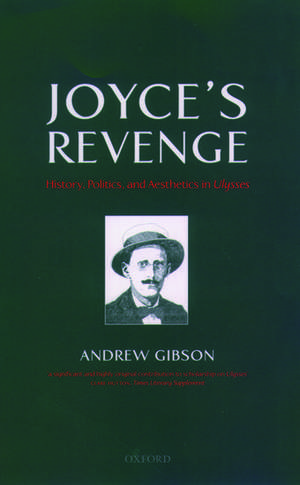
Joyce's Revenge: History, Politics, and Aesthetics in Ulysses
Autor Andrew Gibsonen Limba Engleză Paperback – 20 ian 2005
Preț: 509.52 lei
Preț vechi: 713.94 lei
-29%
Puncte Express: 764
Carte tipărită la comandă
Livrare economică 20 noiembrie-01 decembrie
Livrare prin curier în România Termenul estimat este afișat lângă disponibilitate.
Transport gratuit pentru acest produs Plată online sau ramburs, în funcție de opțiunile comenzii.
Retur gratuit în 14 zile Comandă securizată și suport în română.
Specificații
ISBN-13: 9780199282036
ISBN-10: 019928203X
Pagini: 320
Dimensiuni: 138 x 216 x 19 mm
Greutate: 0.39 kg
Editura: OUP OXFORD
Colecția OUP Oxford
Locul publicării:Oxford, United Kingdom
ISBN-10: 019928203X
Pagini: 320
Dimensiuni: 138 x 216 x 19 mm
Greutate: 0.39 kg
Editura: OUP OXFORD
Colecția OUP Oxford
Locul publicării:Oxford, United Kingdom
V-ar putea interesa
-
 A New History of Spanish Writing, 1939 to the 1990sChris Perriam-23%Preț: 203.86 lei263.67 lei
 -
 Margaret Storm Jameson: A LifeJennifer Birkett-20%Preț: 357.43 lei446.12 lei
 -
 Modern English War PoetryTim Kendall-11%Preț: 336.90 lei380.23 lei
 -
 Proust, Class, and NationEdward J. Hughes-31%Preț: 867.25 lei1261.67 lei
 -
 -17%Preț: 302.35 lei363.59 lei
 -
 -31%Preț: 627.66 lei910.03 lei
 -
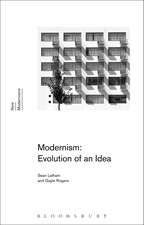 Modernism: Evolution of an IdeaProfessor Sean Latham-25%Preț: 200.84 lei266.69 lei
 -
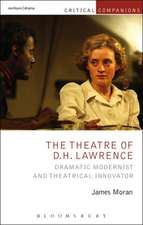 -25%Preț: 196.77 lei261.62 lei
 -
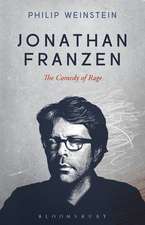 Jonathan Franzen: The Comedy of RageProfessor Philip Weinstein-44%Preț: 219.16 lei390.46 lei
 -
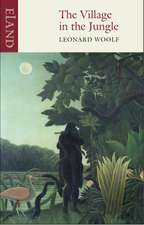 The Living GoddessIsabella TreePreț: 137.96 lei
 -
 The Modernist PapersFredric JamesonPreț: 257.59 lei
Recenzii
[a] superb study ... It is hard to pay sufficient tribute to Gibson's keenly detailed research and grasp of nuance in his discussion ... Joyce's Revenge deserves to become one of the landmarks in criticism devoted to Ulysses. Several chapters alone are worth the price of the book ... Shaprly and lucidly written, his book is accessible to readers who are not Joyce critics.
Andrew Gibson has written a book to be mined for decades to come for its unqiue historicaL insight, its extraordinary attention to detail and its powerful theoretical grasp. Joyce's Revenge is the kind of rare book one compulsively recommends to students and friends.
Andrew Gibson's is easily one of the most serious of academic books to have appeared on Joyce in recent years. It is densely researched, full of ideas, and well-embedded in current academic questions, and is sure to become a familiar point of reference in future debates as well as a standard to which subsequent researchers will have to aspire.
Review from previous edition The book's achievement and its considerable claim on the reader's attention arise from two virtues: the consistency of the interpretative perspective from chapter to chapter and the abundance of eye-opening, contextualizing historical detail. Many readers will learn a great deal about the Irish contexts of Joyce's writing, from the Great Famine until the early 1920s, though the book's primary focus is the period 1880-1920. Even readers who are historically well-informed are unlikely to have anticipated Gibson's deft evocations of Joyce's transformations of contradictory perspectives.
Joyce's Revenge makes a significant and distinctive contribution to Joyce studies, and it deserves a wide readership. The author is impressively well read in English and Irish cultural history, and the book identifies and explores an aspect of this history about which most Joyceans, perhaps, know less than they might. Among the books on Joyce I've studied recently this is perhaps the most absorbing read, cover to cover, of all of them.
This thought-provoking study makes a significant and highly original contribution to scholarship on Ulysses ... a particular strength of this book is the way in which it seeks to interpret the aesthetic of Ulysses as a whole, rather than focusing on a few key features or episodes.
Joyce's Revenge splendidly serves to show us how significant is a scrutiny of the intertwined history of Britain and Ireland for understanding the radical aesthetics of Ulysses. This is a book that will keep Joyce scholars busy, and rightly so, for some time to come.
The true distinction of Joyce's Revenge lies in its density. This comes in two forms: intellectual and historical. Every page in this book feels hard-won; every argument is sophisticated enough to include a host of variations, or a sequence of counter-arguments. There is almost a hint of Hegel or Adorno in Gibson's thought, the unremitting intensity with which a position is carried through in all its exemplification, then inverted with equal rigour.
Gibson's detailed reading of Ulysses against the background of its intertextual archive provides highly revealing and often surprising insights into Joyce's deconstructive representation of the ideological forces at work both in England and Ireland. Joyce's Revenge combines a masterly analytical approach with a supreme grasp of theory, intellectual rigour and a convincing power of persuasion. Among the many books on our shelves produced by the Joyce industry, Gibson's will figure among the first things to read on Ulysses.
Gibson's book presents a convincing and fruitful method to interpret Ulysses. It also - unlike many students of Joyce - takes Joyce seriously as both a thinker and an artist ... The worth of any theory is not in its cleverness but in its explanatory value. On this basis Gibson's book is a success and a most refreshing one.
The arrival of this book is a welcome occasion. Andrew Gibson combines a wealth of knowledge and research - about the particularities of English and Irish cultural politics between 1880 and 1920 - with an admirable sensitivity to the Joycean text. The book has much to do with what postcolonial theory calls 'hybridity' and 'mimicry', but is also densely and precisely historicized. Like the simultaneously meticulous, informed, and irreverent Joyce he describes, Gibson is scrupulous about historical particularity and cunning in his application of it. Joyce's Revenge immerses itself in a broad range of specific cultural discourses on subjects from nationalist politics to medical debates to the politics of street names, the politics of Shakespeare and bardolatry, Protestant-Catholic relations, Jewishness, Irish historiography, women's journals, and astronomy. The result is an important new study that will alter the ways we read Ulysses.
Andrew Gibson has written a book to be mined for decades to come for its unqiue historicaL insight, its extraordinary attention to detail and its powerful theoretical grasp. Joyce's Revenge is the kind of rare book one compulsively recommends to students and friends.
Andrew Gibson's is easily one of the most serious of academic books to have appeared on Joyce in recent years. It is densely researched, full of ideas, and well-embedded in current academic questions, and is sure to become a familiar point of reference in future debates as well as a standard to which subsequent researchers will have to aspire.
Review from previous edition The book's achievement and its considerable claim on the reader's attention arise from two virtues: the consistency of the interpretative perspective from chapter to chapter and the abundance of eye-opening, contextualizing historical detail. Many readers will learn a great deal about the Irish contexts of Joyce's writing, from the Great Famine until the early 1920s, though the book's primary focus is the period 1880-1920. Even readers who are historically well-informed are unlikely to have anticipated Gibson's deft evocations of Joyce's transformations of contradictory perspectives.
Joyce's Revenge makes a significant and distinctive contribution to Joyce studies, and it deserves a wide readership. The author is impressively well read in English and Irish cultural history, and the book identifies and explores an aspect of this history about which most Joyceans, perhaps, know less than they might. Among the books on Joyce I've studied recently this is perhaps the most absorbing read, cover to cover, of all of them.
This thought-provoking study makes a significant and highly original contribution to scholarship on Ulysses ... a particular strength of this book is the way in which it seeks to interpret the aesthetic of Ulysses as a whole, rather than focusing on a few key features or episodes.
Joyce's Revenge splendidly serves to show us how significant is a scrutiny of the intertwined history of Britain and Ireland for understanding the radical aesthetics of Ulysses. This is a book that will keep Joyce scholars busy, and rightly so, for some time to come.
The true distinction of Joyce's Revenge lies in its density. This comes in two forms: intellectual and historical. Every page in this book feels hard-won; every argument is sophisticated enough to include a host of variations, or a sequence of counter-arguments. There is almost a hint of Hegel or Adorno in Gibson's thought, the unremitting intensity with which a position is carried through in all its exemplification, then inverted with equal rigour.
Gibson's detailed reading of Ulysses against the background of its intertextual archive provides highly revealing and often surprising insights into Joyce's deconstructive representation of the ideological forces at work both in England and Ireland. Joyce's Revenge combines a masterly analytical approach with a supreme grasp of theory, intellectual rigour and a convincing power of persuasion. Among the many books on our shelves produced by the Joyce industry, Gibson's will figure among the first things to read on Ulysses.
Gibson's book presents a convincing and fruitful method to interpret Ulysses. It also - unlike many students of Joyce - takes Joyce seriously as both a thinker and an artist ... The worth of any theory is not in its cleverness but in its explanatory value. On this basis Gibson's book is a success and a most refreshing one.
The arrival of this book is a welcome occasion. Andrew Gibson combines a wealth of knowledge and research - about the particularities of English and Irish cultural politics between 1880 and 1920 - with an admirable sensitivity to the Joycean text. The book has much to do with what postcolonial theory calls 'hybridity' and 'mimicry', but is also densely and precisely historicized. Like the simultaneously meticulous, informed, and irreverent Joyce he describes, Gibson is scrupulous about historical particularity and cunning in his application of it. Joyce's Revenge immerses itself in a broad range of specific cultural discourses on subjects from nationalist politics to medical debates to the politics of street names, the politics of Shakespeare and bardolatry, Protestant-Catholic relations, Jewishness, Irish historiography, women's journals, and astronomy. The result is an important new study that will alter the ways we read Ulysses.
Notă biografică
Andrew Gibson is Professor of Modern Literature and Theory at Royal Holloway, University of London.