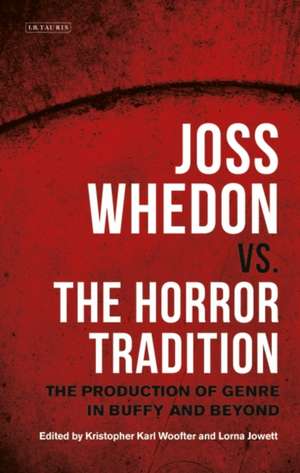
Joss Whedon vs. the Horror Tradition: The Production of Genre in Buffy and Beyond
Editat de Kristopher Karl Woofter, Lorna Jowetten Limba Engleză Paperback – 17 sep 2020
Preț: 244.30 lei
Preț vechi: 323.19 lei
-24%
Puncte Express: 366
Carte tipărită la comandă
Livrare economică 28 noiembrie-12 decembrie
Livrare prin curier în România Termenul estimat este afișat lângă disponibilitate.
Transport gratuit de la 400.00 lei Plată online sau ramburs, în funcție de opțiunile comenzii.
Retur gratuit în 14 zile Comandă securizată și suport în română.
Specificații
ISBN-13: 9781350201224
ISBN-10: 1350201227
Pagini: 344
Ilustrații: 33 bw illus
Dimensiuni: 136 x 216 x 22 mm
Greutate: 0.44 kg
Editura: Bloomsbury Publishing
Colecția Bloomsbury Academic
Locul publicării:London, United Kingdom
ISBN-10: 1350201227
Pagini: 344
Ilustrații: 33 bw illus
Dimensiuni: 136 x 216 x 22 mm
Greutate: 0.44 kg
Editura: Bloomsbury Publishing
Colecția Bloomsbury Academic
Locul publicării:London, United Kingdom
Cuprins
List of Illustrations x
Acknowledgments xii
Introduction Whedon Studies and the Ghost of Horror 1
Kristopher Karl Woofter and Lorna Jowett
Part I (Under)Groundwork: Horror Concepts and Conventions in the Whedonverse
1 The Slasher Template: Buffy the Vampire Slayer vs. John Carpenter's Halloween 17
Clayton Dillard
2 The Sonic Horror of "Hush" 34
Selma A. Purac
3 "The Body" That Will Not Sit Up: Shock, Stasis, and the Negative Space of the Horror Genre 53
Mario DeGiglio-Bellemare
4 The Melancholy Musical: Horror and Avant-Garde Strategies in "Once More, with Feeling" 73
Anne Golden
5 Angel's Dreams, Our Nightmares: Oneiric Horror in Angel and Buffy the Vampire Slayer 92
Cynthia Burkhead
6 Dollhouse's Terrible Places: Hauntings, Abjection, and the Repressed 105
Bronwen Calvert
7 Inscription and Subversion: The Cabin in the Woods and the Postmodern Horror Tradition 123
Stephanie Graves
Part II Mutant Enemies: TV Horror, Industry, and Influence
8 "For All I Know, It Could Be Hilarious or It Could Suck": Situating the Film Buffy the Vampire Slayer (1992) in Period Vampire Comedy 143
Jerry D. Metz Jr.
9 Monstrous Puppet Masters: Negotiating Violence and Horror in the Whedon Tele-verse 163
Stacey Abbott
10 Forever Knight, Angel, and Supernatural: A Genealogy of Television Horror/Crime Hybrids 181
Erin Giannini
Part III "It's About Power": Revisiting Whedon's "Revisionist" Horror
11 Whedon, Feminism, and the Possibility of Feminist Horror on Television 201
Lorna Jowett
12 Weird Whedon: Cosmic Dread and Sublime Alterity in the Whedonverse 219
Kristopher Karl Woofter
13 "All the Better to Know You": Investigating the Hybrid Monster and Allegories of Self/Other in
Buffy the Vampire Slayer 243
K. Brenna Wardell
14 Horror and the Last Frontier: Monstrous Borders and Bodies in Firefly and Westworld 261
Karen Herland
15 The Half-Lives of Horror: The Differential Embodiments of Dollhouse 281
Alanna Thain
Appendix I The Work of Joss Whedon and the Horror Tradition: A Selected Bibliography 298
Compiled by Alysa Hornick
Appendix II Foundational Works in Horror and Related Scholarship 308
About the Contributors 313
Index 317
Acknowledgments xii
Introduction Whedon Studies and the Ghost of Horror 1
Kristopher Karl Woofter and Lorna Jowett
Part I (Under)Groundwork: Horror Concepts and Conventions in the Whedonverse
1 The Slasher Template: Buffy the Vampire Slayer vs. John Carpenter's Halloween 17
Clayton Dillard
2 The Sonic Horror of "Hush" 34
Selma A. Purac
3 "The Body" That Will Not Sit Up: Shock, Stasis, and the Negative Space of the Horror Genre 53
Mario DeGiglio-Bellemare
4 The Melancholy Musical: Horror and Avant-Garde Strategies in "Once More, with Feeling" 73
Anne Golden
5 Angel's Dreams, Our Nightmares: Oneiric Horror in Angel and Buffy the Vampire Slayer 92
Cynthia Burkhead
6 Dollhouse's Terrible Places: Hauntings, Abjection, and the Repressed 105
Bronwen Calvert
7 Inscription and Subversion: The Cabin in the Woods and the Postmodern Horror Tradition 123
Stephanie Graves
Part II Mutant Enemies: TV Horror, Industry, and Influence
8 "For All I Know, It Could Be Hilarious or It Could Suck": Situating the Film Buffy the Vampire Slayer (1992) in Period Vampire Comedy 143
Jerry D. Metz Jr.
9 Monstrous Puppet Masters: Negotiating Violence and Horror in the Whedon Tele-verse 163
Stacey Abbott
10 Forever Knight, Angel, and Supernatural: A Genealogy of Television Horror/Crime Hybrids 181
Erin Giannini
Part III "It's About Power": Revisiting Whedon's "Revisionist" Horror
11 Whedon, Feminism, and the Possibility of Feminist Horror on Television 201
Lorna Jowett
12 Weird Whedon: Cosmic Dread and Sublime Alterity in the Whedonverse 219
Kristopher Karl Woofter
13 "All the Better to Know You": Investigating the Hybrid Monster and Allegories of Self/Other in
Buffy the Vampire Slayer 243
K. Brenna Wardell
14 Horror and the Last Frontier: Monstrous Borders and Bodies in Firefly and Westworld 261
Karen Herland
15 The Half-Lives of Horror: The Differential Embodiments of Dollhouse 281
Alanna Thain
Appendix I The Work of Joss Whedon and the Horror Tradition: A Selected Bibliography 298
Compiled by Alysa Hornick
Appendix II Foundational Works in Horror and Related Scholarship 308
About the Contributors 313
Index 317
Recenzii
Exposes both his deep affection for the horror genre and the complexity of the horror genre itself ... Provides a solid addition to study of the horror genre on both television and film, and in popular culture more generally.
Joss Whedon vs. the Horror Tradition takes nothing for granted, appealing to fans of both the creator and the genre. Scholarly yet accessible, it should be pop-culture required reading.
This book will fascinate horror scholars and television scholars alike. The analyses are text-specific yet thoughtfully grounded in the context of the horror tradition. The writers are original and insightful.
Joss Whedon vs. the Horror Tradition takes nothing for granted, appealing to fans of both the creator and the genre. Scholarly yet accessible, it should be pop-culture required reading.
This book will fascinate horror scholars and television scholars alike. The analyses are text-specific yet thoughtfully grounded in the context of the horror tradition. The writers are original and insightful.