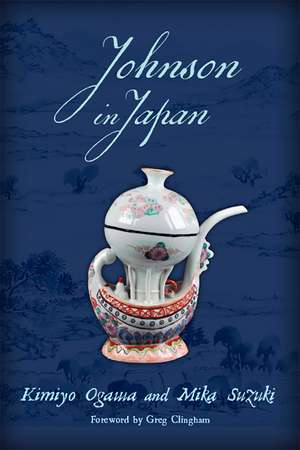
Johnson in Japan
Editat de Kimiyo Ogawa, Mika Suzuki Cuvânt înainte de Greg Clingham Contribuţii de Hideichi Eto, Noriyuki Harada, Yuri Yoshino, Miki Iwata, Noriyuki Hattori, Tadayuki Fukumoto, Masaaki Ogura, Hitoshi Suwabeen Limba Engleză Paperback – 16 oct 2020 – vârsta ani
Published by Bucknell University Press. Distributed worldwide by Rutgers University Press.
Preț: 331.40 lei
Nou
Puncte Express: 497
Preț estimativ în valută:
58.64€ • 68.77$ • 51.50£
58.64€ • 68.77$ • 51.50£
Carte indisponibilă temporar
Doresc să fiu notificat când acest titlu va fi disponibil:
Se trimite...
Preluare comenzi: 021 569.72.76
Specificații
ISBN-13: 9781684482412
ISBN-10: 1684482410
Pagini: 214
Ilustrații: 2 b-w images, 4 tables
Dimensiuni: 152 x 229 x 18 mm
Greutate: 0 kg
Editura: Bucknell University Press
Colecția Bucknell University Press
ISBN-10: 1684482410
Pagini: 214
Ilustrații: 2 b-w images, 4 tables
Dimensiuni: 152 x 229 x 18 mm
Greutate: 0 kg
Editura: Bucknell University Press
Colecția Bucknell University Press
Notă biografică
KIMIYO OGAWA is a professor in the department of English studies at Sophia University in Tokyo. Her publications include book chapters on Charlotte Lennox in British Romanticism in European Perspectives and on Jane Austen and Yaeko Nogami in British Romanticism in Asia.
MIKA SUZUKI is a professor in the department of language and literature at Shizuoka University in Shizuoka, Japan. Her publications include journal articles on Sarah Fielding and on Jane Austen and a book on Sarah Fielding in Japanese.
MIKA SUZUKI is a professor in the department of language and literature at Shizuoka University in Shizuoka, Japan. Her publications include journal articles on Sarah Fielding and on Jane Austen and a book on Sarah Fielding in Japanese.
Cuprins
List of Figures and Tables
Foreword by Greg Clingham
Note on Reference
Introduction
Chapter 1: A Brief History of Johnsonian Studies in Japan
Hideichi Eto
Chapter 2: Johnson, Biography, and Modern Japan
Noriyuki Harada
Chapter 3: Scientific Curiosity in Samuel Johnson’s Rasselas and Mary Shelley’s Frankenstein Kimiyo Ogawa
Chapter 4: Jane Austen and the Reception of Samuel Johnson in Japan:
The Domestication of Realism in Soseki Natsume’s Theory of Literature (1907)
Yuri Yoshino
Chapter 5: Johnson the Tea Poet: A Scholarly Role Model and a Literary Doctor in Modernizing Japan
Mika Suzuki
Chapter 6: Johnson and Garrick on Hamlet
Miki Iwata
Chapter 7: Abyssinian Johnson
Noriyuki Hattori
Chapter 8: Johnson’s Prose Style and His Notion of the Periodical Writer
Tadayuki Fukumoto
Chapter 9: An Analysis of Johnson's View of Knowledge: A Corpus Stylistic Approach
Masaaki Ogura
Chapter 10: Johnson’s Final Words: With Particular Reference to Boswell’s Dirty Deed on Sastres Hitoshi Suwabe
Appendix
Acknowledgments
Bibliography
Notes on Contributors
Index
Recenzii
"In conveying the ‘state of play’ of Johnson’s reputation in a world that might not previously have been thought receptive, Johnson in Japan makes a significant mark . . . successful in offering new critical insights, its presence means that there are important implications for Johnson’s cultural penetration (and therefore the kind of writer he is)."
"Samuel Johnson was fascinated by travel, and the Orient particularly took his fancy. He once seriously recommended that Boswell undertake a trip to see the Great Wall of China, because it would distinguish him in the eyes of other Britons. More recently, the East has reciprocated this interest, as scholars in Japan and China formed Johnsonian societies and published important books and articles on the Great Cham. Johnson in Japan draws together a number of intriguing and valuable essays under a rubric that is original and persuasive. It at once advances our knowledge of the intersection between Johnson and the East forward considerably, yet it perhaps more urgently encourages that Western scholars explore this richly fertile yet largely untapped field with greater assiduity."
Descriere
Johnson in Japan reflects not just the history of Samuel Johnson studies in Japan, but also the broader current conditions of scholarship in Japanese academia. In addition to Johnson’s works, the essays in this volume engage with works by other important English writers, such as Shakespeare, Mary Shelley, Jane Austen, and Matthew Arnold, and also with later Japanese writers.