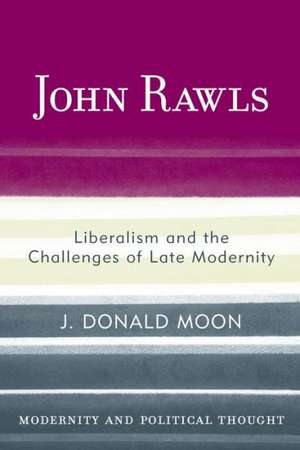
John Rawls: Liberalism and the Challenges of Late Modernity: Modernity and Political Thought
Autor J. Donald Moonen Limba Engleză Hardback – 26 aug 2014




Preț: 544.48 lei
Preț vechi: 816.13 lei
-33%
Puncte Express: 817
Carte tipărită la comandă
Livrare economică 20 noiembrie-04 decembrie
Livrare prin curier în România Termenul estimat este afișat lângă disponibilitate.
Transport gratuit pentru acest produs Plată online sau ramburs, în funcție de opțiunile comenzii.
Retur gratuit în 14 zile Comandă securizată și suport în română.
Specificații
ISBN-13: 9781442238275
ISBN-10: 1442238275
Pagini: 139
Dimensiuni: 156 x 232 x 16 mm
Greutate: 0.48 kg
Editura: Bloomsbury Publishing
Colecția Rowman & Littlefield
Seria Modernity and Political Thought
Locul publicării:New York, United States
ISBN-10: 1442238275
Pagini: 139
Dimensiuni: 156 x 232 x 16 mm
Greutate: 0.48 kg
Editura: Bloomsbury Publishing
Colecția Rowman & Littlefield
Seria Modernity and Political Thought
Locul publicării:New York, United States
Cuprins
Chapter One: Introduction: Challenges to Liberalism
Chapter Two: Political Liberalism: Justice as Social Cooperation
1. Justice as grounded in comprehensive doctrines
2. Political conceptions of justice
3. Political liberalism
4. Justice as Fairness
5. Conclusion
Chapter Three: Public Reason and Inclusion
1 Restraint and privatization
2 The need for consensus
3 The question of priority
4 Toleration and exclusion
Chapter Four: Class, Inequality, and Distributive Justice
1 Egalitarian liberalism
2 Incentives and inequality
3 Pluralism and social justice
4 Merit and desert
Chapter Five: Global Pluralism and International Justice
1 Rawls's Law of Peoples
2 Inclusiveness of the society of peoples
3 Peoples vs persons
4. Globalization, democracy and domestic basic structures
5 Conclusion: justice and global inequality
Chapter Six: Conclusion
Chapter Two: Political Liberalism: Justice as Social Cooperation
1. Justice as grounded in comprehensive doctrines
2. Political conceptions of justice
3. Political liberalism
4. Justice as Fairness
5. Conclusion
Chapter Three: Public Reason and Inclusion
1 Restraint and privatization
2 The need for consensus
3 The question of priority
4 Toleration and exclusion
Chapter Four: Class, Inequality, and Distributive Justice
1 Egalitarian liberalism
2 Incentives and inequality
3 Pluralism and social justice
4 Merit and desert
Chapter Five: Global Pluralism and International Justice
1 Rawls's Law of Peoples
2 Inclusiveness of the society of peoples
3 Peoples vs persons
4. Globalization, democracy and domestic basic structures
5 Conclusion: justice and global inequality
Chapter Six: Conclusion
Recenzii
Moon has written a brief overview of John Rawls's political philosophy. He also reviews some major criticisms of Rawls and defends Rawls against those criticisms. This book would be an excellent starting point for readers seeking a serious introduction to Rawls and the secondary literature Rawls's work generated. Moon provides a persuasive synthesis of Rawls's major works as a whole rather than seeing them as distinct works. The emphasis is primarily on tying Rawls's conclusions together rather than on Rawls's method. Moon argues that Rawls's liberalism is a 'radically new approach' in the history of political theory because it rejects a 'comprehensive doctrine' that does not have wide enough appeal in late modernity to serve as a fundamental principle. Moon describes Rawls as a 'chastened liberal,' which stands in contrast to Enlightenment liberalism, rendered untenable by the traumas of the 20th century. Moon presents Rawls's theory as political and practical rather than abstract. Rawls developed a justification of liberalism that satisfies democratic norms. The book raises a number of important points, not just about Rawls's work but also about 20th-century political philosophy and the project of political philosophy in general. Summing Up: Recommended. Upper-division undergraduate and graduate collections.