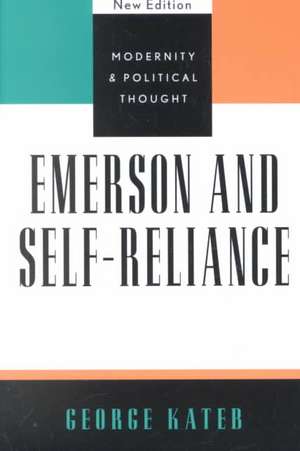
Emerson and Self-Reliance: Modernity and Political Thought
Autor George Kateben Limba Engleză Paperback – 3 apr 2002




Preț: 322.57 lei
Preț vechi: 417.18 lei
-23%
Puncte Express: 484
Carte tipărită la comandă
Livrare economică 07-21 decembrie
Livrare prin curier în România Termenul estimat este afișat lângă disponibilitate.
Transport gratuit de la 400.00 lei Plată online sau ramburs, în funcție de opțiunile comenzii.
Retur gratuit în 14 zile Comandă securizată și suport în română.
Specificații
ISBN-13: 9780742521452
ISBN-10: 0742521451
Pagini: 272
Dimensiuni: 153 x 224 x 20 mm
Greutate: 0.39 kg
Ediția:New.
Editura: Bloomsbury Publishing
Colecția Rowman & Littlefield
Seria Modernity and Political Thought
Locul publicării:New York, United States
ISBN-10: 0742521451
Pagini: 272
Dimensiuni: 153 x 224 x 20 mm
Greutate: 0.39 kg
Ediția:New.
Editura: Bloomsbury Publishing
Colecția Rowman & Littlefield
Seria Modernity and Political Thought
Locul publicării:New York, United States
V-ar putea interesa
-
 War Stories and PoemsRudyard Kipling-18%Preț: 70.96 lei86.75 lei
 -
 Yeats and ViolenceMichael Wood-13%Preț: 375.75 lei431.29 lei
 -
 The Last Minstrels: Yeats and the Revival of the Bardic ArtsRonald Schuchard-22%Preț: 381.56 lei486.96 lei
 -
 -30%Preț: 1027.80 lei1472.90 lei
 -
 The Oxford Handbook of Samuel Taylor ColeridgeFrederick Burwick-19%Preț: 347.83 lei429.68 lei
 -
 The Music of VerseJoseph PhelanPreț: 404.47 lei
 -
 Travel Writing and Tourism in Britain and IrelandBenjamin ColbertPreț: 407.29 lei
 -
 Wordsworth and ColeridgeP. LarkinPreț: 405.27 lei
 -
 British Colonial Realism in AfricaKenneth A LoparoPreț: 405.27 lei
 -
 Novel Judgements: Legal Theory as FictionWilliam P. MacNeilPreț: 311.83 lei
 -
 Charles Darwin and Victorian Visual CultureJonathan SmithPreț: 347.71 lei
 -
 Preț: 316.98 lei
 -
 Modern Norwegian Literature, 1860-1918Brian W. DownsPreț: 299.73 lei
 -
 Preț: 294.28 lei
 -
 Jane Austen and the EnlightenmentPeter Knox-ShawPreț: 349.61 lei
 -
 Human DignityGeorge KatebPreț: 203.12 lei
 -
 The Letters of John KeatsHyder Edward RollinsPreț: 431.52 lei
 -
 Robert Browning: Selected PoemsJohn WoolfordPreț: 371.31 lei
Cuprins
Chapter 1 Self-Reliance and the Life of the Mind
Chapter 2 Redeeming the Frustrations of Experience
Chapter 3 The Question of Religiousness
Chapter 4 Friendship and Love
Chapter 5 Individuality and Identity
Chapter 6 Self-Reliance, Politics, and Society
Chapter 2 Redeeming the Frustrations of Experience
Chapter 3 The Question of Religiousness
Chapter 4 Friendship and Love
Chapter 5 Individuality and Identity
Chapter 6 Self-Reliance, Politics, and Society
Recenzii
In this original treatment, which offers new insightson one of Emerson's central ideas as well as on his political theory,Kateb portrays an Emerson who is indispensable for thinking about America, as important as Jefferson and Lincoln.
There is no recent study that so convincingly shows that Emerson anticipates (and rivals) Nietzsche as a sustained practitioner of multiple perspectivism and that Emersonian self-reliance is therefore 'not one particular substantive or doctrinal principle like other ones.' In this and other ways, Kateb has deepened, and usefully complicated, our understanding of Emerson.
By emphasizing mental self-reliance Kateb reasserts Emerson the Transcendentalist and makes a compelling case for the political importance of this dimension of Emerson's thought. . . . For [Kateb] Emerson's construction of self-reliance serves as a vital, but problematic, model that political philosophers can situate as both the foundation and the consummation of a theory of democratic civil society.
Emerson, in George Kateb's engagingly lucid and compelling account, is the American Shakespeare. Kateb justifies this bold claim by demonstrating the poetic amplitude, incisiveness, impersonality, and authority of Emerson's thought. With Emerson, to be sure, the dramatist's characters are replaced by ideas, and one idea-'self-reliance'-dominates all the rest. The chief imperative for citizens of a democracy, according to Kateb's Emerson, is a steady effort to think one's own thoughts and to think them through. This radical principle defines the philosophy of democratic individuality, a distinctively modern creed whose founding genius-Kateb persuasively reveals-was Ralph Waldo Emerson.
An important contribution. . . . Kateb] has an excellent discussion of how antagonism and contrast lie at the heart of Emerson's notion of identity.
There is no recent study that so convincingly shows that Emerson anticipates (and rivals) Nietzsche as a sustained practitioner of multiple perspectivism and that Emersonian self-reliance is therefore 'not one particular substantive or doctrinal principle like other ones.' In this and other ways, Kateb has deepened, and usefully complicated, our understanding of Emerson.
By emphasizing mental self-reliance Kateb reasserts Emerson the Transcendentalist and makes a compelling case for the political importance of this dimension of Emerson's thought. . . . For [Kateb] Emerson's construction of self-reliance serves as a vital, but problematic, model that political philosophers can situate as both the foundation and the consummation of a theory of democratic civil society.
Emerson, in George Kateb's engagingly lucid and compelling account, is the American Shakespeare. Kateb justifies this bold claim by demonstrating the poetic amplitude, incisiveness, impersonality, and authority of Emerson's thought. With Emerson, to be sure, the dramatist's characters are replaced by ideas, and one idea-'self-reliance'-dominates all the rest. The chief imperative for citizens of a democracy, according to Kateb's Emerson, is a steady effort to think one's own thoughts and to think them through. This radical principle defines the philosophy of democratic individuality, a distinctively modern creed whose founding genius-Kateb persuasively reveals-was Ralph Waldo Emerson.
An important contribution. . . . Kateb] has an excellent discussion of how antagonism and contrast lie at the heart of Emerson's notion of identity.