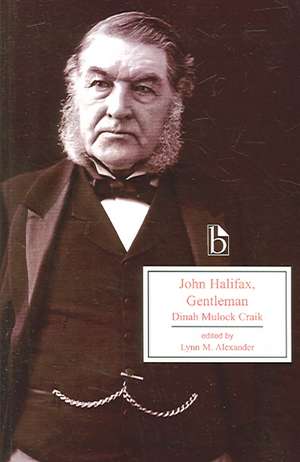
John Halifax, Gentleman
Autor Dinah Mulock Craik Editat de Lynn M. Alexanderen Limba Engleză Paperback – 26 oct 2005
This Broadview edition includes a critical introduction and full annotation; the idea of the “gentleman” in Victorian culture, labour unrest in the early nineteenth century, and women’s roles in Victorian England are explored in the broad selection of contextual documents.
Preț: 240.54 lei
Preț vechi: 305.73 lei
-21%
Puncte Express: 361
Carte disponibilă
Livrare economică 03-17 noiembrie
Livrare prin curier în România Termenul estimat este afișat lângă disponibilitate.
Transport gratuit de la 400.00 lei Plată online sau ramburs, în funcție de opțiunile comenzii.
Retur gratuit în 14 zile Comandă securizată și suport în română.
Specificații
ISBN-13: 9781551115009
ISBN-10: 155111500X
Pagini: 592
Dimensiuni: 140 x 216 x 29 mm
Greutate: 0.64 kg
Editura: BROADVIEW PR
Colecția Broadview Press
Locul publicării:Peterborough, Canada
ISBN-10: 155111500X
Pagini: 592
Dimensiuni: 140 x 216 x 29 mm
Greutate: 0.64 kg
Editura: BROADVIEW PR
Colecția Broadview Press
Locul publicării:Peterborough, Canada
V-ar putea interesa
-
 Robinson CrusoeDaniel DefoePreț: 28.01 lei
 -
 CLASSICS NORTH AND SOUTHElizabeth GaskellPreț: 28.01 lei
 -
 Becoming GraceHilary McKayPreț: 57.89 lei
 -
 Street ChildBerlie DohertyPreț: 57.30 lei
 -
 The Grapes of WrathJohn Steinbeck-25%Preț: 55.19 lei73.18 lei
 -
 The Runaway GirlsJacqueline Wilson-26%Preț: 47.77 lei64.59 lei
 -
 An Orphan's DreamJudy Summers-26%Preț: 58.73 lei78.91 lei
 -
 Preț: 61.47 leiRecomandat
 -
 Victorian LiteratureVictor SheaPreț: 271.12 lei
 -
 Classic Starts®: Oliver TwistCharles DickensPreț: 61.97 lei
 -
 The Pilgrim's ProgressJohn BunyanPreț: 46.43 lei
 -
 The Manual for Good WivesLola JayePreț: 72.63 lei
 -
 -26%Preț: 47.82 lei64.29 lei
 -
 Preț: 69.13 lei
 -
 The Ragged Trousered PhilanthropistsRobert TressellPreț: 28.01 lei
 -
 North and SouthElizabeth GaskellPreț: 58.22 lei
 -
 Oliver TwistCharles DickensPreț: 37.41 lei
Recenzii
This 1856 novel, one of the most beloved of the Victorian period, follows the life, from childhood to death, of an orphaned boy who grows to become a wealthy and powerful leader in his community. The young John Halifax is taken in by Abel Fletcher, a Quaker tanner, and forms a close friendship with Fletcher’s son, Phineas. Through hard work and integrity, John overcomes obstacles to find domestic happiness and material success. His achievements symbolize those of England in the early nineteenth century, and this novel captures the ambition and ebullient optimism of the growing Victorian middle class.
This Broadview edition includes a critical introduction and full annotation; the idea of the “gentleman” in Victorian culture, labour unrest in the early nineteenth century, and women’s roles in Victorian England are explored in the broad selection of contextual documents.
“An enormously useful and complete edition of an important and neglected Victorian novel. The editorial material is very helpful, pointing to and expanding upon the novel’s many contexts, from the role of women to industrial reform.” — Helena Michie, Rice University
This Broadview edition includes a critical introduction and full annotation; the idea of the “gentleman” in Victorian culture, labour unrest in the early nineteenth century, and women’s roles in Victorian England are explored in the broad selection of contextual documents.
“An enormously useful and complete edition of an important and neglected Victorian novel. The editorial material is very helpful, pointing to and expanding upon the novel’s many contexts, from the role of women to industrial reform.” — Helena Michie, Rice University
Cuprins
Acknowledgements
Introduction
Dinah Mulock Craik: A Brief Chronology
A Note on the Text
John Halifax, Gentleman
Appendix A: The Idea of the “Gentleman” in Victorian Culture
Select Bibliography
Introduction
Dinah Mulock Craik: A Brief Chronology
A Note on the Text
John Halifax, Gentleman
Appendix A: The Idea of the “Gentleman” in Victorian Culture
- From Lord Chesterfield, Letters to His Son and Others(1774)
- From Thomas Carlyle, Past and Present (1843)
- From John Henry Newman, The Idea of a University (1854)
- From Samuel Smiles, Self-Help (1859)
- From [James Fitzjames] F. Stephen, “Gentlemen,” Cornhill Magazine (March 1862)
- From J.E. Taylor, The Peterloo Massacre (1819)
- From William Cobbett, Rural Rides (1830)
- From Thomas Carlyle, “Signs of the Times,” Edinburgh Review (June 1829)
- From Parliamentary Reports (1832-33)
- from a speech by M.T. Sadler (1832)
- from a speech by Richard Oastler, “Yorkshire Slavery” (1831-32)
- from Parliamentary Papers, volume 20 (1833)
- From Peter Gaskell, The Manufacturing Population of England (1833)
- From John Fielden, The Curse of the Factory System (1836)
- From Friedrich Engels, The Condition of the Working Class in England in 1844 (1845)
- From Catherine Macaulay, Letters on Education (1790)
- From Sarah Ellis, The Women of England,Their Social Duties and Domestic Habits (1839)
- From Dinah Mulock Craik, A Woman’s Thoughts about Women (1858)
- From Isabella Beeton, The Book of Household Management (1861)
- From John Ruskin, Sesame and Lilies (1865)
- From John Stuart Mill, The Subjection of Women (1869)
- “New Novels: John Halifax, Gentleman,” Athenaeum (26 April 1856)
- From [Stopford Brooke], “Notes upon New Books: John Halifax,” Dublin University Magazine(October 1856)
- From [R.H. Hutton], “Novels by the Authoress of ‘John Halifax,’” North British Review (1858)
- From “The Author of John Halifax,” The British Quarterly Review (July 1866)
- From Robert Nourse, “An Old Book for New Readers,” The Dial (June 1883)
- From Frances Martin, “Mrs. Craik,” Athenaeum (22 October 1887)
- From S.M. Ellis, “Dinah Maria Mulock (Mrs. Craik),” The Bookman (April 1926)
- From George Fox, Journal (1694)
- From John Wesley, Sermons on Several Occasions (1746)
- From Charles Lamb, “A Quakers’ Meeting,” The Essays of Elia (1823)
- From John Henry Newman, Apologia Pro Vita Sua (1864)
- From Mary Howitt, An Autobiography (1889)
- From Harriet Martineau, A Manchester Strike (Illustrations ofPolitical Economy) (1832)
- From Charlotte Brontë, Shirley (1849)
- From Coventry Patmore, The Angel in the House(1654-62)
- From Elizabeth Gaskell, North and South (1855)
- From Charles Dickens, Great Expectations (1861)
Select Bibliography