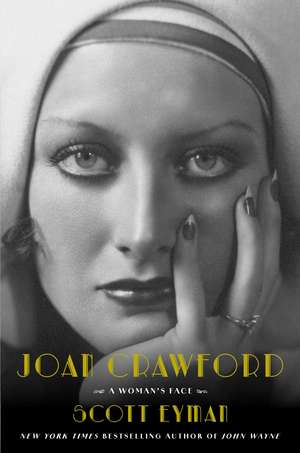
Joan Crawford: A Woman's Face
Autor Scott Eymanen Limba Engleză Hardback – 18 dec 2025
Joan Crawford burst out of her poverty-stricken youth to become a bright young movie star in the 1920’s, drawing the admiration of F. Scott Fitzgerald and the attention of audiences worldwide. She flourished for decades, working for multiple studios in every genre from romance to westerns (Mildred Pierce, Johnny Guitar), musicals to noir (Torch Song, A Woman’s Face), and being directed by a young Steven Spielberg in one of her last appearances. Along the way she accumulated four husbands, an Academy Award for Best Actress, and the undeniable status of a legend.
Joan Crawford: A Woman’s Face looks at the reality of this remarkable woman through the prism of groundbreaking primary research, interviews with friends and relatives, and with the same insightful analysis of character and motive that author Scott Eyman brought to John Wayne and Cary Grant, among others.
Joan Crawford was a woman like no other, and Joan Crawford: A Woman’s Face is the first full telling of her dazzling, turbulent life.
Preț: 133.56 lei
Preț vechi: 161.19 lei
-17%
Puncte Express: 200
Carte disponibilă
Livrare economică 20 noiembrie-02 decembrie
Livrare express 03-07 noiembrie pentru 68.43 lei
Livrare prin curier în România Termenul estimat este afișat lângă disponibilitate.
Transport gratuit de la 400.00 lei Plată online sau ramburs, în funcție de opțiunile comenzii.
Retur gratuit în 14 zile Comandă securizată și suport în română.
Specificații
ISBN-13: 9781668047309
ISBN-10: 1668047306
Pagini: 464
Ilustrații: 16-pg b-w insert; b-w part openers;
Dimensiuni: 152 x 229 x 30 mm
Greutate: 0.66 kg
Editura: Simon&Schuster
Colecția Simon & Schuster
ISBN-10: 1668047306
Pagini: 464
Ilustrații: 16-pg b-w insert; b-w part openers;
Dimensiuni: 152 x 229 x 30 mm
Greutate: 0.66 kg
Editura: Simon&Schuster
Colecția Simon & Schuster
V-ar putea interesa
-
 Elizabeth TaylorKate Andersen BrowerPreț: 95.03 lei
 -
 Let Me Tell You What I MeanJoan DidionPreț: 78.57 lei
 -
 The UncoolCameron CrowePreț: 123.39 lei
 -
 Notes to JohnJoan DidionPreț: 123.21 lei
 -
 EnchantmentDonald Spoto-18%Preț: 76.28 lei93.23 lei
 -
 ElizabethJ. Randy Taraborrelli-55%Preț: 65.45 lei147.02 lei
 -
 Joan CrawfordLawrence J. QuirkPreț: 198.93 lei
 -
 -17%Preț: 104.24 lei125.43 lei
 -
 John Wayne: The Life and LegendScott Eyman-15%Preț: 95.73 lei112.82 lei
 -
 Preț: 84.26 lei
 -
 Starring Joan CrawfordSamuel Garza Bernstein-31%Preț: 204.55 lei296.50 lei
 -
 Sofia Coppola: The Complete Unofficial GuideChristina Newland-24%Preț: 84.02 lei109.99 lei
 -
 -18%Preț: 100.69 lei122.29 leiRecomandat
 -
 My StoryMarilyn MonroePreț: 182.62 lei
 -
 It Girl: The Life and Legacy of Jane BirkinMarisa Meltzer-18%Preț: 116.67 lei142.99 leiRecomandat
 -
 Joan CrawfordFred Lawrence GuilesPreț: 147.10 lei
 -
 Wallis SimpsonPaul FrenchPreț: 79.66 lei
 -
 Dear MarilynSam ShawPreț: 406.68 lei
 -
 Dorothy Parker in HollywoodGail Crowther-17%Preț: 66.46 lei79.95 leiRecomandat
 -
 Marilyn MonroeChiara Pasqualetti JohnsonPreț: 217.97 lei
Notă biografică
Scott Eyman is the author or coauthor of eighteen books, including the bestseller John Wayne and Pieces of My Heart and You Must Remember This with actor Robert Wagner. Eyman, formerly the literary critic at The Palm Beach Post, also writes book reviews for The Wall Street Journal, and has written for The New York Times, The Washington Post, and the Chicago Tribune. He and his wife, Lynn, live in West Palm Beach.
Extras
Prologue PROLOGUE
THE FILM IS 16MM Kodachrome, so it has those “nice, bright colors” Paul Simon sang about. The cans were stacked in the back of Joan Crawford’s closet when she moved back to New York in 1955. After she died in 1977 they sat in the closets of her daughter Cathy, and of Casey LaLonde, her grandson.
The expectations were that they would be the usual movie star home movies—birthday parties with the kids in Brentwood, some behind-the-scenes shots from the studio, etc. There was some of that, but there were also several cans sealed with masking tape on which was written “Charles and Me.”
They were Joan Crawford home movies all right, but they weren’t what anybody had expected. From her look, and from the cars on view, the bulk of them were made in 1939 or 1940 outside New York City. There are shots of the Dakota apartment building, of Central Park in the winter as well as the spring, but mostly the atmosphere is country—a glamorous movie star on strangely unglamorous vacations: trudging through the woods, lugging a rifle on a hunt for pheasant, having a cigarette by a dying campfire.
The Kodachrome reveals Crawford’s russet hair, her freckles, even her impromptu dance moves, as she does an enchanting little sideways shuffle while playing with her dachshund. She’s relaxed, coquettish, glowing, completely unguarded. In one shot, she’s sunbathing nude.
There are two startling factors revealed by the footage. Most obviously, there is the way Crawford pops through the screen without the intervention of a script, editing, or even rudimentary lighting. She loves the camera and the favor is returned—she was born to be captured on film, any film, under any conditions. And the rifle, the earnest trooping through the woods, means she’s obviously shaping herself to fit in with her man’s predispositions.
Despite her reputation as an imperious diva, this was always Crawford’s pattern. When she was married to Douglas Fairbanks Jr., she immersed herself in fiction and philosophers, albeit with a singular lack of enjoyment, while her marriage to Franchot Tone meant a conversion to the gospel of Stanislavsky.
The man behind the camera some of the time, in front of the camera most of the time, is pushing middle age, has a widow’s peak, and sports a Bertie Wooster-ish set of hunting togs indicating a charge account with Hammacher Schlemmer. From Crawford’s body language and the intimacy of the footage it was obvious they were a couple.
Casey LaLonde asked me if I had any idea about the man’s identity, but I was stumped. He wasn’t a director, although he could have been a producer. But why meet up outside New York City when Palm Springs was only a few hours away from Crawford’s home in Brentwood?
I turned to A Portrait of Joan, Crawford’s autobiography, published in 1962. I didn’t expect much, but I found something dating to shortly after her divorce from Franchot Tone in April 1939: “In New York, I had met a marvelously mature man, one of the best people I’ve ever known. This man must be nameless because he was never able to get a divorce. He is a business executive, and I respect him thoroughly. Again I had to settle for a long and lovely friendship. He taught me to hunt and fish, we used to go on these expeditions with a whole group of men. The first time, I’m sure, their reaction was, Oh No, not a dame tagging along! Carried my own gun and my own camera, waded through streams in the vanguard, and at noon when we’d camp, I’d help fix lunch and surprise them with all sorts of snacks packed away in my knapsack just in case they didn’t catch any fish. This friend introduced me to politics, to banking, big business and public affairs.
“He says I taught him to be brave, to stand up for what he thought was right, to be considerate of other human beings, especially those with whom he was working, and to be generous in giving of himself. I didn’t teach him. Those were his instincts. He merely needed someone gently to remind him.”
That told us some of what the film had already told us, but it didn’t offer any hints about Charles’s last name. That came through the back door—an item in a Hedda Hopper column from 1940 that carried a whiff of sulfur, as many Hopper columns did. Hopper included the name of Charles McCabe in the cast list of an upcoming Crawford movie. Charles McCabe? Who the hell was Charles McCabe?
There were no actors in Hollywood with that name. Perhaps a New York actor? Nope. A quick glance at Wikipedia, and there he was—the same man with Crawford in the footage. Charles McCabe was the publisher of the New York Daily Mirror, a Hearst paper that Woody Allen called “a sparse rag that would have gone out of business were it not for the fact it housed Walter Winchell’s column.” Unfortunately, irrelevance can only be withstood for so long—the Daily Mirror died in October 1963.
Hedda Hopper had found out about the affair and wanted Crawford to know she knew.
Casey LaLonde called one of McCabe’s surviving sons, who told him that after their father’s death in 1970, his sons had gone through his papers and found letters from Crawford that made the relationship obvious. McCabe’s wife hadn’t known about the affair, or about any of McCabe’s numerous extramarital entanglements. In any case, McCabe had never asked his wife for a divorce. McCabe’s sons didn’t want their mother to find out about the affair, so they burned Crawford’s letters.
Joan Crawford died seven years after Charles McCabe; there were no letters from him in her papers.
A relationship with a public figure such as Crawford must have been risky for McCabe, but the footage clearly indicates neither of them cared, while the fact that Crawford kept the movies for the rest of her life indicates the affair was far more than a passing fling.
The home movies are a glimpse into the unexpected emotional accessibility of a woman often regarded as ferocious even by other ferocious movie stars. How did Crawford and McCabe meet? How long did the affair last? We can’t be sure, because Joan Crawford could keep a secret.
But not all of them.
THE FILM IS 16MM Kodachrome, so it has those “nice, bright colors” Paul Simon sang about. The cans were stacked in the back of Joan Crawford’s closet when she moved back to New York in 1955. After she died in 1977 they sat in the closets of her daughter Cathy, and of Casey LaLonde, her grandson.
The expectations were that they would be the usual movie star home movies—birthday parties with the kids in Brentwood, some behind-the-scenes shots from the studio, etc. There was some of that, but there were also several cans sealed with masking tape on which was written “Charles and Me.”
They were Joan Crawford home movies all right, but they weren’t what anybody had expected. From her look, and from the cars on view, the bulk of them were made in 1939 or 1940 outside New York City. There are shots of the Dakota apartment building, of Central Park in the winter as well as the spring, but mostly the atmosphere is country—a glamorous movie star on strangely unglamorous vacations: trudging through the woods, lugging a rifle on a hunt for pheasant, having a cigarette by a dying campfire.
The Kodachrome reveals Crawford’s russet hair, her freckles, even her impromptu dance moves, as she does an enchanting little sideways shuffle while playing with her dachshund. She’s relaxed, coquettish, glowing, completely unguarded. In one shot, she’s sunbathing nude.
There are two startling factors revealed by the footage. Most obviously, there is the way Crawford pops through the screen without the intervention of a script, editing, or even rudimentary lighting. She loves the camera and the favor is returned—she was born to be captured on film, any film, under any conditions. And the rifle, the earnest trooping through the woods, means she’s obviously shaping herself to fit in with her man’s predispositions.
Despite her reputation as an imperious diva, this was always Crawford’s pattern. When she was married to Douglas Fairbanks Jr., she immersed herself in fiction and philosophers, albeit with a singular lack of enjoyment, while her marriage to Franchot Tone meant a conversion to the gospel of Stanislavsky.
The man behind the camera some of the time, in front of the camera most of the time, is pushing middle age, has a widow’s peak, and sports a Bertie Wooster-ish set of hunting togs indicating a charge account with Hammacher Schlemmer. From Crawford’s body language and the intimacy of the footage it was obvious they were a couple.
Casey LaLonde asked me if I had any idea about the man’s identity, but I was stumped. He wasn’t a director, although he could have been a producer. But why meet up outside New York City when Palm Springs was only a few hours away from Crawford’s home in Brentwood?
I turned to A Portrait of Joan, Crawford’s autobiography, published in 1962. I didn’t expect much, but I found something dating to shortly after her divorce from Franchot Tone in April 1939: “In New York, I had met a marvelously mature man, one of the best people I’ve ever known. This man must be nameless because he was never able to get a divorce. He is a business executive, and I respect him thoroughly. Again I had to settle for a long and lovely friendship. He taught me to hunt and fish, we used to go on these expeditions with a whole group of men. The first time, I’m sure, their reaction was, Oh No, not a dame tagging along! Carried my own gun and my own camera, waded through streams in the vanguard, and at noon when we’d camp, I’d help fix lunch and surprise them with all sorts of snacks packed away in my knapsack just in case they didn’t catch any fish. This friend introduced me to politics, to banking, big business and public affairs.
“He says I taught him to be brave, to stand up for what he thought was right, to be considerate of other human beings, especially those with whom he was working, and to be generous in giving of himself. I didn’t teach him. Those were his instincts. He merely needed someone gently to remind him.”
That told us some of what the film had already told us, but it didn’t offer any hints about Charles’s last name. That came through the back door—an item in a Hedda Hopper column from 1940 that carried a whiff of sulfur, as many Hopper columns did. Hopper included the name of Charles McCabe in the cast list of an upcoming Crawford movie. Charles McCabe? Who the hell was Charles McCabe?
There were no actors in Hollywood with that name. Perhaps a New York actor? Nope. A quick glance at Wikipedia, and there he was—the same man with Crawford in the footage. Charles McCabe was the publisher of the New York Daily Mirror, a Hearst paper that Woody Allen called “a sparse rag that would have gone out of business were it not for the fact it housed Walter Winchell’s column.” Unfortunately, irrelevance can only be withstood for so long—the Daily Mirror died in October 1963.
Hedda Hopper had found out about the affair and wanted Crawford to know she knew.
Casey LaLonde called one of McCabe’s surviving sons, who told him that after their father’s death in 1970, his sons had gone through his papers and found letters from Crawford that made the relationship obvious. McCabe’s wife hadn’t known about the affair, or about any of McCabe’s numerous extramarital entanglements. In any case, McCabe had never asked his wife for a divorce. McCabe’s sons didn’t want their mother to find out about the affair, so they burned Crawford’s letters.
Joan Crawford died seven years after Charles McCabe; there were no letters from him in her papers.
A relationship with a public figure such as Crawford must have been risky for McCabe, but the footage clearly indicates neither of them cared, while the fact that Crawford kept the movies for the rest of her life indicates the affair was far more than a passing fling.
The home movies are a glimpse into the unexpected emotional accessibility of a woman often regarded as ferocious even by other ferocious movie stars. How did Crawford and McCabe meet? How long did the affair last? We can’t be sure, because Joan Crawford could keep a secret.
But not all of them.
Recenzii
"Scott Eyman elucidates Crawford’s life and work with passionate research, candid curiosity, analytical clarity, and uninhibited enthusiasm. The book is a trove of anecdotes, quotes, and insights, but, above all, it’s the energetic pursuit of an idea: Eyman presents the story of Crawford’s rise to fame as the story of Hollywood stardom itself."
—The New Yorker
An "elegant, intelligent, comprehensively researched, and thoroughly absorbing new biography... Kudos to Scott Eyman for writing a smart and sensitive account that captures Joan Crawford in all her humanity."
—The American Spectator
"Deft writing, archival research, critical thinking and cineaste’s eye for telling details."
—The Shepherd Express
“This well-written, balanced, and comprehensive review of Crawford’s life and career will appeal to her fans and those who enjoy a good, juicy Hollywood saga.”
—Library Journal, Starred Review
“Scott Eyman’s new biography pulls together the layers of invention and reinvention that transformed malnourished Texas tomboy Lucille LeSueur into screen legend Joan Crawford with so much immediacy and Hollywood-insider detail that reading it feels like a cinematic experience in itself… It renders studio politics, contract-negotiation minutiae, costuming conflicts and production-code headaches with thrilling immediacy, note-perfect dialogue and the perfect amount of attitude.”
—Salon
“I knew Joan Crawford, and this is the first book written about her that gives me a portrait I can recognize. It presents her humor, her intelligence, her work ethic, her generosity, and her determination as well as her insecurity. (Eyman) ... has done a masterful job.”
—Jeanine Basinger
"Hollywood’s leading biographer, Scott Eyman, has outdone himself in this scintillating, revealing story of the great Joan Crawford."
—Laurence Leamer
"Scott Eyman’s books always bring back the Hollywood that I lived in and loved, and Joan Crawford: A Woman’s Face might be his best. He completely captures her need, her talent and her generosity, as well as her absolute determination to be the best possible version of herself.
—Robert Wagner
"Joan Crawford fought for everything she ever had—and moviegoers identified with her struggle and achievements. With even-handedness and empathy, Scott Eyman reveals the deeply insecure woman beneath the movie star facade. I came away with a new regard for this Hollywood survivor."
—Leonard Maltin
"Knowledgeable biography of the actress whose film career ran from the silents through the ’60s [and a] fully fleshed portrait of a complicated woman."
—Kirkus Reviews
—The New Yorker
An "elegant, intelligent, comprehensively researched, and thoroughly absorbing new biography... Kudos to Scott Eyman for writing a smart and sensitive account that captures Joan Crawford in all her humanity."
—The American Spectator
"Deft writing, archival research, critical thinking and cineaste’s eye for telling details."
—The Shepherd Express
“This well-written, balanced, and comprehensive review of Crawford’s life and career will appeal to her fans and those who enjoy a good, juicy Hollywood saga.”
—Library Journal, Starred Review
“Scott Eyman’s new biography pulls together the layers of invention and reinvention that transformed malnourished Texas tomboy Lucille LeSueur into screen legend Joan Crawford with so much immediacy and Hollywood-insider detail that reading it feels like a cinematic experience in itself… It renders studio politics, contract-negotiation minutiae, costuming conflicts and production-code headaches with thrilling immediacy, note-perfect dialogue and the perfect amount of attitude.”
—Salon
“I knew Joan Crawford, and this is the first book written about her that gives me a portrait I can recognize. It presents her humor, her intelligence, her work ethic, her generosity, and her determination as well as her insecurity. (Eyman) ... has done a masterful job.”
—Jeanine Basinger
"Hollywood’s leading biographer, Scott Eyman, has outdone himself in this scintillating, revealing story of the great Joan Crawford."
—Laurence Leamer
"Scott Eyman’s books always bring back the Hollywood that I lived in and loved, and Joan Crawford: A Woman’s Face might be his best. He completely captures her need, her talent and her generosity, as well as her absolute determination to be the best possible version of herself.
—Robert Wagner
"Joan Crawford fought for everything she ever had—and moviegoers identified with her struggle and achievements. With even-handedness and empathy, Scott Eyman reveals the deeply insecure woman beneath the movie star facade. I came away with a new regard for this Hollywood survivor."
—Leonard Maltin
"Knowledgeable biography of the actress whose film career ran from the silents through the ’60s [and a] fully fleshed portrait of a complicated woman."
—Kirkus Reviews
Descriere
The life of Hollywood legend Joan Crawford, told by bestselling biographer and film historian Scott Eyman, drawing in part on letters and papers not available to previous biographers, with cooperation from the estate.