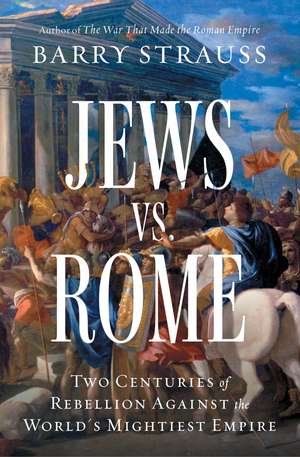
Jews vs. Rome: Two Centuries of Rebellion Against the World's Mightiest Empire
Autor Barry Straussen Limba Engleză Paperback – 24 sep 2026
Jews vs. Rome is a gripping account of one of the most momentous eras in human history: the two hundred years of ancient Israel’s battles against Rome that reshaped Judaism and gave rise to Christianity. Barry Strauss vividly captures the drama of this era, highlighting the courageous yet tragic uprisings, the geopolitical clash between the empires of Rome and Persia, and the internal conflicts among Jews.
Between 63 BCE and 136 CE, the Jewish people launched several revolts driven by deep-seated religious beliefs and resentment towards Roman rule. Judea, a province on Rome’s eastern fringe, became a focal point of tension and rebellion. Jews vs. Rome recounts the three major uprisings: the Great Revolt of 66–70 CE, which led to the destruction of Jerusalem and the Temple, culminating in the Siege of Masada, where defenders chose mass suicide over surrender; the Diaspora Revolt, ignited by heavy taxes across the Empire; and the Bar Kokhba Revolt. We meet pivotal figures such as Simon Bar Kokhba but also some of those lesser-known women of the era like Berenice, a Jewish princess who played a major role in the politics of the Great Revolt and was improbably the love of Titus—Rome’s future emperor and the man who destroyed Jerusalem and the Temple.
Today, echoes of those battles resonate as the Jewish nation faces new challenges and conflicts. Jews vs. Rome offers a captivating narrative that connects the past with the present, appealing to anyone interested in Rome, Jewish history, or the compelling true tales of resilience and resistance.
Preț: 66.68 lei
Preț vechi: 80.39 lei
-17% Nou
Puncte Express: 100
Carte disponibilă
Livrare economică 13-25 noiembrie
Livrare express 29 octombrie-04 noiembrie pentru 38.59 lei
Livrare prin curier în România Termenul estimat este afișat lângă disponibilitate.
Transport gratuit de la 400.00 lei Plată online sau ramburs, în funcție de opțiunile comenzii.
Retur gratuit în 14 zile Comandă securizată și suport în română.
Specificații
ISBN-13: 9781668009604
ISBN-10: 1668009609
Pagini: 384
Ilustrații: one 8-pg b-w insert; 3 b-w maps t-o;
Dimensiuni: 140 x 213 x 23 mm
Greutate: 0.32 kg
Editura: Simon&Schuster
Colecția Simon & Schuster
ISBN-10: 1668009609
Pagini: 384
Ilustrații: one 8-pg b-w insert; 3 b-w maps t-o;
Dimensiuni: 140 x 213 x 23 mm
Greutate: 0.32 kg
Editura: Simon&Schuster
Colecția Simon & Schuster
V-ar putea interesa
-
 Rome and JerusalemMartin Goodman-18%Preț: 113.31 lei137.97 lei
 -
 The Jewish WarFlavius JosephusPreț: 94.51 lei
 -
 The Jewish WarJosephus-17%Preț: 78.80 lei94.86 lei
 -
 For the Freedom of Zion: The Great Revolt of Jews against Romans, 66–74 CEGuy MacLean RogersPreț: 228.32 lei
 -
 Berenice: Queen in Roman JudeaBruce ChiltonPreț: 135.72 lei
 -
 Never Again: How the West Betrayed the Jews and ItselfJake Wallis Simons-27%Preț: 105.03 lei143.20 lei
 -
 Scourge of RomeDouglas Jackson-18%Preț: 77.94 lei94.64 lei
 -
 -14%Preț: 192.49 lei224.36 lei
 -
 Preț: 232.41 lei
 -
 Preț: 229.39 lei
 -
 -20%Preț: 56.24 lei70.41 lei
 -
 Revolts Against RomeJohn S MchughPreț: 192.27 lei
 -
 Rebellion (Eagles of the Empire 22)Simon Scarrow-26%Preț: 58.79 lei79.33 lei
 -
 Death to the Emperor (Eagles of the Empire 21)Simon Scarrow-24%Preț: 60.91 lei80.55 lei
 -
 -27%Preț: 89.48 lei121.82 lei
 -
 The Jewish Revolt AD 66–74Si Sheppard-31%Preț: 84.59 lei121.82 lei
 -
 Bar KokhbaLindsay PowellPreț: 197.74 lei
 -
 -23%Preț: 1644.03 lei2135.11 lei
 -
 -18%Preț: 1037.85 lei1265.67 lei
Notă biografică
Barry Strauss is a senior fellow at the Hoover Institution, the Bryce and Edith M. Bowmar Professor in Humanistic Studies Emeritus at Cornell University, and a leading expert on ancient military history. He has written or edited several books, including The Battle of Salamis, The Trojan War, The Spartacus War, Masters of Command, The Death of Caesar, and Ten Caesars. Visit BarryStrauss.com.
Extras
Prologue PROLOGUE
It was an age of unscrupulous intrigue and messianic longing, of empire and insurrection, and of geopolitical warfare that still has modern echoes.
The era from 63 BCE to 136 CE marked two centuries of violence and revolution. They witnessed the decline and fall of the Roman Republic, the rise of Rome of the Caesars and its continuing wars for dominance against the Iranian empire of Parthia, the only imperial rival to Rome left after the conquest of Carthage and the Hellenistic kingdoms. Caught in the middle, both geographically and politically, was the cauldron of tiny Judea—home of Rome’s most determined insurgencies and the soil from which the seedlings of both rabbinic Judaism and Christianity would begin to grow.
Judea was fighting for its survival as a religion, a people, and a nation. It was caught between countries and empires many times its size and strength, negotiating among ever-changing allies and enemies and facing mutual hostility with its neighbors. Because Judea was not a unified state it faced ethnic conflict within its own borders. Meanwhile, the dominant group in Judea, the Jewish people, fought among themselves for power, influence, and their own conceptions of a holy life.
For today’s reader, this story may seem painfully familiar. Certainly, the names of many battlefields are eerily the same in today’s news as in the pages of this book. The names of our story’s protagonists remain renowned, and the historical consequences of this era live on with us today. Nor were the challenges that confronted Judea two thousand years ago unique to that era. Small countries, and large countries, too, still face them in our time.
It is my hope that the history of this period, these people and these struggles, will offer context for the clash of civilizations we are witnessing today and forge a deeper understanding of the forces that propel them.
It would be hard to exaggerate the degree of excitement, anticipation, anxiety, and bloodlust that echoed in this era. What an explosion of creativity and destruction! These were two of the most dramatic and consequential centuries in history. And for the Jewish people in particular, these centuries were cataclysmic.
For the Jews, it was an era of revolution—many small uprisings during more than a century, culminating in an era of three great wars: the Great Revolt, also known as the Jewish War, 66 to 74 CE; the Diaspora Revolt, 116 to 117; and the Bar Kokhba Revolt, 132 to 136. And against whom did the Jews revolt? Only against perhaps the greatest empire in history: Rome.
From the Scottish Highlands to the Atlas Mountains, from the Atlantic Ocean to the Euphrates River, and for a moment, even to the Persian Gulf, Rome ruled a vast realm. It governed what a Roman writer called “the immeasurable majesty of the Roman peace.”1 Fifty million people lived under Roman rule in what was then, along with Han China, the largest empire on earth. Among its other achievements, Rome conquered all the people around the Mediterranean Sea and united them under one government for the first and only time in history.
And yet during the space of seventy years, the Jews, one of the many peoples under Roman rule, revolted not once but three times. No other people in the empire—and there were many other rebel nations—had such a record. Two of the rebellions took place in the Jewish homeland, Judea, the third in the Diaspora, the emigrant communities of Jews.
Today people argue over the names Israel and Palestine, but that is nothing new. They argued over the country’s name in antiquity as well, with both Israel and Palestine attested long before Rome came on the scene. In the Roman era the country was commonly called Judea. The more ancient Jewish name for the country, which some patriots preferred, was Israel. It is attested as early as the thirteenth century BCE.2
Most rebellions occurred in recently conquered provinces. Judea was different. It was not newly conquered. In fact, Rome subdued Judea in 63 BCE, more than 120 years before the Jewish revolt of 66 CE. And Judea had first became a Roman ally even earlier, in 160 BCE. Close observers should have seen the storm coming, what with so much unrest in Judea in earlier years. But in Rome, far away and preoccupied with other, bigger provinces, it came as a surprise.
The rebels of 66 CE humiliated the Roman legions. They first threatened, and then succeeded in contributing to a Roman defeat at the hands of the only rival empire that Rome still feared. They cost the legions a huge expenditure of blood and treasure before finally the rebellions were put down. A vengeful Rome responded with a savagery not seen since the destruction of Carthage two centuries earlier.
The rebels were freedom fighters, daring and heroic, and to that extent they deserve our admiration. But they were also murderous and deluded. The revolts were magnificent, but misguided. How could the rebels hope to defeat the mighty Romans? They represented a great tide of anger and violence that sometimes turned on itself, at least in the Great Revolt, because that Jewish war against Rome was also a war of Jew against Jew: it was a Jewish civil war.
For Jewish history, the rebellions against Rome mark a major turning point. They cost hundreds of thousands of Jewish lives and sent many of the survivors into slavery and exile. They reduced the Jewish people to secondary status in their own homeland. Indeed, the revolts put the future of Jewish survival there in question, although they did not end it. It’s a common misconception to think that the Romans finished the Jewish presence in the Land of Israel. They did not, but they did do an enormous amount of damage. Rome destroyed the Jewish capital, Jerusalem, and its crowning glory, the Temple. Rome ended the daily sacrifices that marked the heart of Judaism and ruined the priesthood who carried them out. Rome decimated the largest and most prestigious Jewish Diaspora community in the Roman Empire, the Jews of Egypt. As if to add insult to injury, the Romans changed the name of the country from Judea (“land of the Jews”) to Syria Palaestina, or simply Palestine (“land of the Philistines”). In no other case did the Romans punish a rebellious province by changing its name. Then again, no people had rebelled as often as the Jews.
There is a holy fire, burning in the hearts of warriors, that leads to glory or oblivion. For two centuries it burned in the hearts of the nation that is the subject of this book, the Jewish people. Messiahs added to the conflagration. Even priests, resistant at first, grew dazzled by the white-hot light. Sober men saw the fire’s destructiveness and tried to douse the flames. None succeeded. It was left to the Romans to drown the blaze in rivers of blood. Only then did a new generation of rabbis emerge from the ruins and turn the fire into light. At the same time, another offshoot from the Jewish experience of this turbulent era also began to grow: Christianity.
The Jewish people survived, learning how to become a religion without a state. Then, twenty centuries later, they created a sovereign state in their ancestral homeland, Israel. The survival of the Jews is one of history’s great cases of resilience. Paradoxically, the same spiritual fire that drove some men unwisely if bravely into an unequal contest against an unyielding empire was the same spirituality that inspired Jewish endurance over the millennia.
Rome was not the only empire in play: there was also Parthia. The shrewd descendants of horse-riding nomads created a mighty realm, originating in what is now Iran, that stretched from today’s Turkmenistan to Syria. The Parthian Empire stood astride the world’s wealthiest trade routes, between China, India, and Arabia on the one hand, and the Mediterranean world on the other. Parthia was the sole empire remaining in Rome’s orbit that could challenge its power. And challenge it, Parthia did: by the start of the Great Revolt, Parthia had inflicted a series of catastrophic defeats on Rome again and again. From time to time, Rome got revenge, but the defeats stung.
Judea, located near the eastern edge of Rome’s empire, looked both ways. To the west, the Jewish Diaspora stretched to Egypt, Libya, and all the way to Rome and beyond. To the north, it extended to Cyprus, Syria, and Asia Minor. The Diaspora also stretched eastward to Mesopotamia, where the Jewish population centered in the region of Babylonia. This was Parthian territory, and its inhabitants had close connections with Judea. The border between the empires was usually open, and Jews traveled back and forth as diplomats, soldiers, merchants, scholars, sages, and pilgrims. Rome fretted about Judea’s loyalty, and not without reason. It was a time-honored tradition for a small state to play one large party off the other. When Rome looked at Judea, it saw the shadow of Parthia.
Many books have been written on the Jewish revolts against Rome. The scholarship is superb, and I gratefully and humbly acknowledge my debt. This book’s contribution is to focus on the Jewish state’s unique position between East and West, between Parthia and Rome. The narrative weaves its way through a world whose inhabitants were equally at home with apocalypse and geostrategy. And it raises the ghosts of the often-forgotten men and women of the past, whose great and marvelous deeds should not be without glory—as Herodotus, the father of history, put it long ago.
Our story begins in 63 BCE, when Rome conquered Judea. At the time, Judea was an independent country and proud of its hard-won independence from its Greco-Syrian overlords, making it the first independent Jewish state in more than four centuries. Now Rome took that away. Most Jews greatly resented that loss. The result was a constant roiling discontent that occasionally broke out into outright rebellion—and this was before the Great Revolt began in 66 CE. There was a seemingly endless cycle of dissidents, rebels, and prophets of change. Messianism grew popular. To maintain control of Judea required constant vigilance by Rome, through the measured application of carrots and sticks, and via the help of local collaborators. It all worked until it didn’t.
In 63 BCE, the Great Revolt was over a century away, but all the elements were present in embryo: Roman aggression, Jewish division between acceptance and rebellion, Parthian intervention, power politics and messianic hopes, ethnic conflict between Jew and Gentile in Judea. The same themes would be sounded over and over again for the next two centuries. To understand them, we need to begin at the beginning.
It was an age of unscrupulous intrigue and messianic longing, of empire and insurrection, and of geopolitical warfare that still has modern echoes.
The era from 63 BCE to 136 CE marked two centuries of violence and revolution. They witnessed the decline and fall of the Roman Republic, the rise of Rome of the Caesars and its continuing wars for dominance against the Iranian empire of Parthia, the only imperial rival to Rome left after the conquest of Carthage and the Hellenistic kingdoms. Caught in the middle, both geographically and politically, was the cauldron of tiny Judea—home of Rome’s most determined insurgencies and the soil from which the seedlings of both rabbinic Judaism and Christianity would begin to grow.
Judea was fighting for its survival as a religion, a people, and a nation. It was caught between countries and empires many times its size and strength, negotiating among ever-changing allies and enemies and facing mutual hostility with its neighbors. Because Judea was not a unified state it faced ethnic conflict within its own borders. Meanwhile, the dominant group in Judea, the Jewish people, fought among themselves for power, influence, and their own conceptions of a holy life.
For today’s reader, this story may seem painfully familiar. Certainly, the names of many battlefields are eerily the same in today’s news as in the pages of this book. The names of our story’s protagonists remain renowned, and the historical consequences of this era live on with us today. Nor were the challenges that confronted Judea two thousand years ago unique to that era. Small countries, and large countries, too, still face them in our time.
It is my hope that the history of this period, these people and these struggles, will offer context for the clash of civilizations we are witnessing today and forge a deeper understanding of the forces that propel them.
It would be hard to exaggerate the degree of excitement, anticipation, anxiety, and bloodlust that echoed in this era. What an explosion of creativity and destruction! These were two of the most dramatic and consequential centuries in history. And for the Jewish people in particular, these centuries were cataclysmic.
For the Jews, it was an era of revolution—many small uprisings during more than a century, culminating in an era of three great wars: the Great Revolt, also known as the Jewish War, 66 to 74 CE; the Diaspora Revolt, 116 to 117; and the Bar Kokhba Revolt, 132 to 136. And against whom did the Jews revolt? Only against perhaps the greatest empire in history: Rome.
From the Scottish Highlands to the Atlas Mountains, from the Atlantic Ocean to the Euphrates River, and for a moment, even to the Persian Gulf, Rome ruled a vast realm. It governed what a Roman writer called “the immeasurable majesty of the Roman peace.”1 Fifty million people lived under Roman rule in what was then, along with Han China, the largest empire on earth. Among its other achievements, Rome conquered all the people around the Mediterranean Sea and united them under one government for the first and only time in history.
And yet during the space of seventy years, the Jews, one of the many peoples under Roman rule, revolted not once but three times. No other people in the empire—and there were many other rebel nations—had such a record. Two of the rebellions took place in the Jewish homeland, Judea, the third in the Diaspora, the emigrant communities of Jews.
Today people argue over the names Israel and Palestine, but that is nothing new. They argued over the country’s name in antiquity as well, with both Israel and Palestine attested long before Rome came on the scene. In the Roman era the country was commonly called Judea. The more ancient Jewish name for the country, which some patriots preferred, was Israel. It is attested as early as the thirteenth century BCE.2
Most rebellions occurred in recently conquered provinces. Judea was different. It was not newly conquered. In fact, Rome subdued Judea in 63 BCE, more than 120 years before the Jewish revolt of 66 CE. And Judea had first became a Roman ally even earlier, in 160 BCE. Close observers should have seen the storm coming, what with so much unrest in Judea in earlier years. But in Rome, far away and preoccupied with other, bigger provinces, it came as a surprise.
The rebels of 66 CE humiliated the Roman legions. They first threatened, and then succeeded in contributing to a Roman defeat at the hands of the only rival empire that Rome still feared. They cost the legions a huge expenditure of blood and treasure before finally the rebellions were put down. A vengeful Rome responded with a savagery not seen since the destruction of Carthage two centuries earlier.
The rebels were freedom fighters, daring and heroic, and to that extent they deserve our admiration. But they were also murderous and deluded. The revolts were magnificent, but misguided. How could the rebels hope to defeat the mighty Romans? They represented a great tide of anger and violence that sometimes turned on itself, at least in the Great Revolt, because that Jewish war against Rome was also a war of Jew against Jew: it was a Jewish civil war.
For Jewish history, the rebellions against Rome mark a major turning point. They cost hundreds of thousands of Jewish lives and sent many of the survivors into slavery and exile. They reduced the Jewish people to secondary status in their own homeland. Indeed, the revolts put the future of Jewish survival there in question, although they did not end it. It’s a common misconception to think that the Romans finished the Jewish presence in the Land of Israel. They did not, but they did do an enormous amount of damage. Rome destroyed the Jewish capital, Jerusalem, and its crowning glory, the Temple. Rome ended the daily sacrifices that marked the heart of Judaism and ruined the priesthood who carried them out. Rome decimated the largest and most prestigious Jewish Diaspora community in the Roman Empire, the Jews of Egypt. As if to add insult to injury, the Romans changed the name of the country from Judea (“land of the Jews”) to Syria Palaestina, or simply Palestine (“land of the Philistines”). In no other case did the Romans punish a rebellious province by changing its name. Then again, no people had rebelled as often as the Jews.
There is a holy fire, burning in the hearts of warriors, that leads to glory or oblivion. For two centuries it burned in the hearts of the nation that is the subject of this book, the Jewish people. Messiahs added to the conflagration. Even priests, resistant at first, grew dazzled by the white-hot light. Sober men saw the fire’s destructiveness and tried to douse the flames. None succeeded. It was left to the Romans to drown the blaze in rivers of blood. Only then did a new generation of rabbis emerge from the ruins and turn the fire into light. At the same time, another offshoot from the Jewish experience of this turbulent era also began to grow: Christianity.
The Jewish people survived, learning how to become a religion without a state. Then, twenty centuries later, they created a sovereign state in their ancestral homeland, Israel. The survival of the Jews is one of history’s great cases of resilience. Paradoxically, the same spiritual fire that drove some men unwisely if bravely into an unequal contest against an unyielding empire was the same spirituality that inspired Jewish endurance over the millennia.
Rome was not the only empire in play: there was also Parthia. The shrewd descendants of horse-riding nomads created a mighty realm, originating in what is now Iran, that stretched from today’s Turkmenistan to Syria. The Parthian Empire stood astride the world’s wealthiest trade routes, between China, India, and Arabia on the one hand, and the Mediterranean world on the other. Parthia was the sole empire remaining in Rome’s orbit that could challenge its power. And challenge it, Parthia did: by the start of the Great Revolt, Parthia had inflicted a series of catastrophic defeats on Rome again and again. From time to time, Rome got revenge, but the defeats stung.
Judea, located near the eastern edge of Rome’s empire, looked both ways. To the west, the Jewish Diaspora stretched to Egypt, Libya, and all the way to Rome and beyond. To the north, it extended to Cyprus, Syria, and Asia Minor. The Diaspora also stretched eastward to Mesopotamia, where the Jewish population centered in the region of Babylonia. This was Parthian territory, and its inhabitants had close connections with Judea. The border between the empires was usually open, and Jews traveled back and forth as diplomats, soldiers, merchants, scholars, sages, and pilgrims. Rome fretted about Judea’s loyalty, and not without reason. It was a time-honored tradition for a small state to play one large party off the other. When Rome looked at Judea, it saw the shadow of Parthia.
Many books have been written on the Jewish revolts against Rome. The scholarship is superb, and I gratefully and humbly acknowledge my debt. This book’s contribution is to focus on the Jewish state’s unique position between East and West, between Parthia and Rome. The narrative weaves its way through a world whose inhabitants were equally at home with apocalypse and geostrategy. And it raises the ghosts of the often-forgotten men and women of the past, whose great and marvelous deeds should not be without glory—as Herodotus, the father of history, put it long ago.
Our story begins in 63 BCE, when Rome conquered Judea. At the time, Judea was an independent country and proud of its hard-won independence from its Greco-Syrian overlords, making it the first independent Jewish state in more than four centuries. Now Rome took that away. Most Jews greatly resented that loss. The result was a constant roiling discontent that occasionally broke out into outright rebellion—and this was before the Great Revolt began in 66 CE. There was a seemingly endless cycle of dissidents, rebels, and prophets of change. Messianism grew popular. To maintain control of Judea required constant vigilance by Rome, through the measured application of carrots and sticks, and via the help of local collaborators. It all worked until it didn’t.
In 63 BCE, the Great Revolt was over a century away, but all the elements were present in embryo: Roman aggression, Jewish division between acceptance and rebellion, Parthian intervention, power politics and messianic hopes, ethnic conflict between Jew and Gentile in Judea. The same themes would be sounded over and over again for the next two centuries. To understand them, we need to begin at the beginning.
Descriere
A new history of two centuries of revolt by the Jews against the Roman Empire that draws on new scholarship, including recent archeological discoveries, by our leading historian of ancient Rome.
Recenzii
“Jews vs. Rome retells, with passion and immediacy, the Jews’ continuous confrontations with the great power of Rome and their own unceasing, often violent internal disputes, and ultimately indicates an enduring spiritual strength to explain their survival as a people. Behind the story of survival is a dire warning against disunity in perilous times.”
"Mr. Strauss is excellent at using modern archaeology to extract information from ancient battlefields. . . . Jews vs. Rome is packed with tales of assassins, mobs, agents provocateurs, zealots and traitors. . . . Without the Jews and their indomitable determination to resist Rome, this book argues powerfully, modern Judaism would look very different—and less heroically noble—than it does today."
"Barry Strauss, a leading authority on ancient military history, uses his considerable expertise to examine three major Jewish revolts against the Roman Empire. . . . [An] engaging and accessible narrative history."
"Judaism as we know it today is not the Judaism of the Bible—it is the Judaism that emerged from the destruction of the Second Jewish Commonwealth at the hands of the Romans. As Barry Strauss illustrates in this riveting account, this pivotal period was defined by conflicting values and visions among Jews, corruption of their religious institutions, infighting when they could least afford it and much more that our own time eerily echoes. This stunning account leaves us with a much deeper understanding of not only the Jews’ past, but their present as well, and perhaps even their future."
"Historian Strauss hits another home run with this thorough account of the tumultuous relations between Rome and its most contentious subjects, the Jews, in ancient times. . . . There is no better history of this important but little-known subject."
“Incisive, timely, and thought-provoking, Jews vs. Rome is an insightful history of the way implacable faith and resistance fueled two centuries of Judea’s doomed blows against the Empire. Barry Strauss is a master at illuminating the strong personalities, complex motives, and turbulence during Rome’s struggle to control the Middle East.”
"For two hundred years, the Jews fought the world’s greatest power–Imperial Rome–and by doing so, won their rightful place as one of history’s most consequential people. Told by the master historian of the ancient world, this is a wonderful and important read."
"Mr. Strauss is excellent at using modern archaeology to extract information from ancient battlefields. . . . Jews vs. Rome is packed with tales of assassins, mobs, agents provocateurs, zealots and traitors. . . . Without the Jews and their indomitable determination to resist Rome, this book argues powerfully, modern Judaism would look very different—and less heroically noble—than it does today."
"Barry Strauss, a leading authority on ancient military history, uses his considerable expertise to examine three major Jewish revolts against the Roman Empire. . . . [An] engaging and accessible narrative history."
"Judaism as we know it today is not the Judaism of the Bible—it is the Judaism that emerged from the destruction of the Second Jewish Commonwealth at the hands of the Romans. As Barry Strauss illustrates in this riveting account, this pivotal period was defined by conflicting values and visions among Jews, corruption of their religious institutions, infighting when they could least afford it and much more that our own time eerily echoes. This stunning account leaves us with a much deeper understanding of not only the Jews’ past, but their present as well, and perhaps even their future."
"Historian Strauss hits another home run with this thorough account of the tumultuous relations between Rome and its most contentious subjects, the Jews, in ancient times. . . . There is no better history of this important but little-known subject."
“Incisive, timely, and thought-provoking, Jews vs. Rome is an insightful history of the way implacable faith and resistance fueled two centuries of Judea’s doomed blows against the Empire. Barry Strauss is a master at illuminating the strong personalities, complex motives, and turbulence during Rome’s struggle to control the Middle East.”
"For two hundred years, the Jews fought the world’s greatest power–Imperial Rome–and by doing so, won their rightful place as one of history’s most consequential people. Told by the master historian of the ancient world, this is a wonderful and important read."