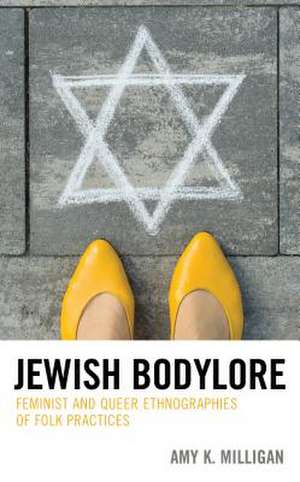
Jewish Bodylore
Autor Amy K. Milliganen Limba Engleză Hardback – 27 dec 2018
| Toate formatele și edițiile | Preț | Express |
|---|---|---|
| Paperback (1) | 241.97 lei 6-8 săpt. | |
| Bloomsbury Publishing – 19 apr 2021 | 241.97 lei 6-8 săpt. | |
| Hardback (1) | 522.87 lei 6-8 săpt. | |
| Lexington Books – 27 dec 2018 | 522.87 lei 6-8 săpt. |
Preț: 522.87 lei
Preț vechi: 789.74 lei
-34%
Puncte Express: 784
Preț estimativ în valută:
92.47€ • 109.22$ • 79.67£
92.47€ • 109.22$ • 79.67£
Carte tipărită la comandă
Livrare economică 20 martie-03 aprilie
Specificații
ISBN-13: 9781498595797
ISBN-10: 1498595790
Pagini: 142
Ilustrații: 2 tables;
Dimensiuni: 157 x 235 x 12 mm
Greutate: 0.37 kg
Editura: Lexington Books
Locul publicării:New York, United States
ISBN-10: 1498595790
Pagini: 142
Ilustrații: 2 tables;
Dimensiuni: 157 x 235 x 12 mm
Greutate: 0.37 kg
Editura: Lexington Books
Locul publicării:New York, United States
Cuprins
Acknowledgements Chapter 1: Introduction: Jews, Gender, and Bodylore
Chapter 2: The Subversive Jewish Feminist Body: Creating Spaces of Protest through Embodiment in Synagogue Life
Chapter 3: Renewing Her Body: Engaging Jewish Women's Bodies in Synagogue Life
Chapter 4: Rebellious Hair: Jewish Feminist Reinterpretations of the Orthodox Jewish Ritual of Upsherin
Chapter 5: The Rose Winkel: Jewish Navigation of the Reappropriation of a Nazi Symbol by LGBTQ Young Adults
Chapter 6: Queerly Stitched: Religious Garb and LGBTQ Jewish Pride Symbols
Chapter 7: Conclusion: Applications of Jewish Feminist Bodylore
Glossary BibliographyAbout the Author
Chapter 2: The Subversive Jewish Feminist Body: Creating Spaces of Protest through Embodiment in Synagogue Life
Chapter 3: Renewing Her Body: Engaging Jewish Women's Bodies in Synagogue Life
Chapter 4: Rebellious Hair: Jewish Feminist Reinterpretations of the Orthodox Jewish Ritual of Upsherin
Chapter 5: The Rose Winkel: Jewish Navigation of the Reappropriation of a Nazi Symbol by LGBTQ Young Adults
Chapter 6: Queerly Stitched: Religious Garb and LGBTQ Jewish Pride Symbols
Chapter 7: Conclusion: Applications of Jewish Feminist Bodylore
Glossary BibliographyAbout the Author
Recenzii
An interesting book based on original fieldwork. . . The book is well conceived and organized. . . . This reader will look forward to learning from Milligan and those informed by their work how to engage in transformative Jewish feminist and queer bodylore so that our images and experiences as, and of, Jews (such as that the child Lexi discussed in the closing anecdote) can be embodied without essentializing Jews as white, straight, cisgendered, able, Ashkenazi, and middle class.
Milligan takes an interdisciplinary approach in examining how female and LGBTQ Jews reconceptualize these religious and cultural symbols. . . . recommended for academic collections.
Amy Milligan's wonderful and clearly written book affirms how illuminating the discipline of folklore can be, with its attentiveness to embodied practice, gender, silenced voices, marginality, and the spiritual creativity of everyday people. Standing respectfully on the shoulders of a range of interdisciplinary scholars, Milligan forges her own contemporary methodologies that allow us to see new and emerging practices in a fresh light. I will surely assign this book in my classes in ethnography, ritual, feminism and religion, and contemporary Judaism.
Milligan traces the intersections of queer theory, feminist theory, and bodylore. The effect is not to assemble these discourses into an overarching theoretical approach but to make them bump up against each other, disturbing their essentialisms, assumptions, angles of entry, dominant concerns, and material underpinnings. In her unusually accessible writing, Milligan does not so much argue these juxtapositions and their displacements rhetorically as demonstrate them corporeally in, on, and through the bodies of Jews, queers, and women.
Milligan takes an interdisciplinary approach in examining how female and LGBTQ Jews reconceptualize these religious and cultural symbols. . . . recommended for academic collections.
Amy Milligan's wonderful and clearly written book affirms how illuminating the discipline of folklore can be, with its attentiveness to embodied practice, gender, silenced voices, marginality, and the spiritual creativity of everyday people. Standing respectfully on the shoulders of a range of interdisciplinary scholars, Milligan forges her own contemporary methodologies that allow us to see new and emerging practices in a fresh light. I will surely assign this book in my classes in ethnography, ritual, feminism and religion, and contemporary Judaism.
Milligan traces the intersections of queer theory, feminist theory, and bodylore. The effect is not to assemble these discourses into an overarching theoretical approach but to make them bump up against each other, disturbing their essentialisms, assumptions, angles of entry, dominant concerns, and material underpinnings. In her unusually accessible writing, Milligan does not so much argue these juxtapositions and their displacements rhetorically as demonstrate them corporeally in, on, and through the bodies of Jews, queers, and women.