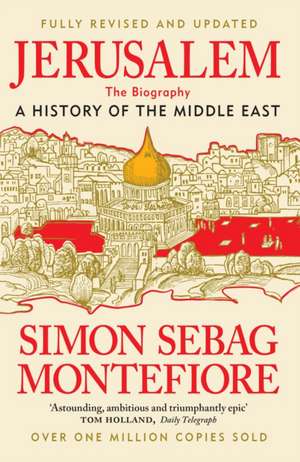
Jerusalem: The Biography - New and Updated 2024 edition
Autor Simon Sebag Montefioreen Limba Engleză Paperback – 5 sep 2024
The history of Jerusalem is the story of the world: Jerusalem is the universal city, the capital of two peoples, the shrine of three faiths. The Holy City and Holy Land are the battlefields for today's multifaceted conflicts and, for believers, the setting for Judgement Day and the Apocalypse.
How did this small, remote town become the Holy City, the 'centre of the world' and now the key to peace in the Middle East? Why is the Holy Land so important not just to the region and its many new players, but to the wider world too? Drawing on new archives and a lifetime's study, Montefiore reveals this ever-changing city and turbulent region through the wars, love affairs and revelations of the kings, empresses, amirs, sultans, caliphs, presidents, autocrats, imperialists and warlords, poets, prophets, saints and rabbis, conquerors and whores who created, destroyed, chronicled, and believed in Jerusalem and the Holy Land.
A classic of modern literature, this is not only the epic story of 3,000 years of faith, slaughter, fanaticism, co-existence, power and myth, but also a freshly updated, carefully balanced history of the Middle East, from King David to the new players and powers of the twenty-first century, from the birth of Judaism, Christianity and Islam to the Israel-Palestine conflict and the mayhem of today.
This is how today's Middle East was forged, how the Holy Land became sacred and how Jerusalem became Jerusalem - the only city that exists twice - in heaven and on earth.
Preț: 87.08 lei
Preț vechi: 112.54 lei
-23%
Puncte Express: 131
Carte disponibilă
Livrare economică 07-21 noiembrie
Livrare express 24-30 octombrie pentru 66.87 lei
Livrare prin curier în România Termenul estimat este afișat lângă disponibilitate.
Transport gratuit de la 400.00 lei Plată online sau ramburs, în funcție de opțiunile comenzii.
Retur gratuit în 14 zile Comandă securizată și suport în română.
Specificații
ISBN-13: 9781399628570
ISBN-10: 1399628577
Pagini: 848
Dimensiuni: 128 x 196 x 52 mm
Greutate: 0.67 kg
Editura: Orion Publishing Group
Colecția W&N
Locul publicării:London, United Kingdom
ISBN-10: 1399628577
Pagini: 848
Dimensiuni: 128 x 196 x 52 mm
Greutate: 0.67 kg
Editura: Orion Publishing Group
Colecția W&N
Locul publicării:London, United Kingdom
V-ar putea interesa
-
 Rome and JerusalemMartin Goodman-18%Preț: 113.31 lei137.97 lei
 -
 -10%Preț: 279.71 lei309.29 lei
 -
 Jerusalem Transformed: Politics, Culture, and Hidden CornersRichard I. Cohen-29%Preț: 589.11 lei828.94 lei
 -
 The Oxford Illustrated History of the Holy LandRobert G. Hoyland-21%Preț: 152.86 lei194.01 lei
 -
 JerusalemGuy Delisle-15%Preț: 126.45 lei148.66 lei
 -
 Jerusalem Falls: Seven Centuries of War and PeaceJohn D. HoslerPreț: 221.17 lei
 -
 O JerusalemLarry CollinsPreț: 157.23 lei
 -
 -20%Preț: 56.24 lei70.41 lei
 -
 Preț: 108.44 leiRecomandat
 -
 The History of JerusalemVincent LemirePreț: 169.87 lei
 -
 The House of War: The Struggle between Christendom and the CaliphateSir Simon Mayall-30%Preț: 131.85 lei188.46 lei
 -
 The House of War: The Struggle between Christendom and the CaliphateSir Simon Mayall-27%Preț: 67.18 lei92.11 lei
 -
 -50%Preț: 133.32 lei267.87 lei
 -
 Jerusalem in HistoryK.J. AsaliPreț: 106.12 lei
 -
 My Jerusalem: Essays, Reminiscences, and PoemsSalma Khadra JayyusiPreț: 112.68 lei
 -
 -33%Preț: 550.60 lei819.04 lei
 -
 -17%Preț: 120.76 lei146.13 leiRecomandat
 -
 Nine Quarters of Jerusalem: A New Biography of the Old CityMatthew Teller-18%Preț: 77.29 lei94.23 lei
 -
 Holy Places: How Pilgrimage Changed the WorldKathryn HurlockPreț: 161.60 lei
 -
 -16%Preț: 178.95 lei213.01 lei
Recenzii
A brilliant and balanced narrative that consistently views Jerusalem as the capital city of two peoples and three faiths
Astounding, ambitious and triumphantly epic
Magisterial . . . Montefiore has been preparing all his life to write this particular book. He steers a clear path through the religious animosities and political intrigues, adopting a strikingly apolitical tone
Excellent . . . It explains beautifully the competition for cramped real estate of the three monotheistic religions in this place that feels once again like the vexed navel of the world. It will make you appreciate the blessing and the curse of this city
Spectacular. Montefiore really tells you what the life of the city has been like and why it means to much to everyone . . . You fall in the love with the city and it breaks your heart that people can't make peace over it . . . It's a treasure. It's a wonderful book
An epic and utterly absorbing study of a city whose modern religious, political and ethnic rivalries can be understood only in the context of its preceding 3,000 years of history. Montefiore writes with tremendous verve, sensitivity to historical controversy and an exceptional eye for the entertaining detail
A wonderfully vibrant account . . . Balanced, fair and above all colourful, Montefiore's narrative does justice to every religious tradition and confirms his reputation as one of our finest popular historians
The must-read history . . . a master work
Packed with fascinating and grisly detail, a gripping account of war, betrayal, rape, massacre, sadistic torture, fanaticism, feuds, corruption, hypocrisy and spirituality. Montefiore's narrative is remarkably objective. A reliable and compelling account
Read the book from cover to cover. There is never a dull page
Ambitious and arresting . . . A powerful achievement, erudite without pedantry, and intimate with the complex archaeology . . . at once a scholarly record and an exuberantly written popular tour de force
A fittingly vast and dazzling portrait of Jerusalem, utterly compelling from start to finish
Outstanding, superbly objective, elegantly written and highly entertaining
Simon Sebag Montefiore's history of Jerusalem is a labour of love and scholarship... a considerable achievement... he has a wonderful ear for the absurdities and adventurers of the past... totally gripping... vivid compelling, engaged, engrossing, knowledgeable
Compelling and thought-provoking...Working on an immense chronological and thematic canvas Sebag Montefiore does his subject more than justice. He narrates the terrible history of Jerusalem vividly and graphically... fascinating but ghastly.
It is a gripping read, told with verve and fluency, and explains why Jerusalem, like a living person, has touched the heart of so many cultures, East and West, for so long
Never a dull moment
Full of faith, power, slaughter and fanaticism; this is a unique chronicle, balanced and critical and wonderfully entertaining.
This is a city that has survived Hell, and Montefiore takes you to the heart of it
A brilliantly detailed history... as entertaining as it is erudite
Anyone with an interest in history should read this, if only to be reminded of just how much history has rolled back and forth over this pile of stones between 1458 and today. In fact, when compared with the carnage visited on it by the Romans, Crusaders, Albanians and, in the 12th century, the teenage King of Norway, the last 100 years there have been relatively peaceful.
A scintillating portrait of Jerusalem. Utterly compelling and a moving picture of the city which has one way or another affected civilisation for thousands of years. Sebag Montefiore has become one of the greatest historians of his generation.
As entertaining as it is elucidating. It's a history that is sharply paced as a novel and fairly brims over with sparkling writing
Heterogenous, sprawling, erudite and touched by genius
Jerusalem: The Biography reads like a novel, it moves at a blistering pace ... It opens like a movie, stories of gore, and death and destruction
For any strident virtue-signallers who think the issues in the Middle East can be reduced to a slogan or easy labels, a definitive, apolitical, mesmerising account of the most invaded and occupied city on Earth and the carnage that built today's headlines.
Astounding, ambitious and triumphantly epic
Magisterial . . . Montefiore has been preparing all his life to write this particular book. He steers a clear path through the religious animosities and political intrigues, adopting a strikingly apolitical tone
Excellent . . . It explains beautifully the competition for cramped real estate of the three monotheistic religions in this place that feels once again like the vexed navel of the world. It will make you appreciate the blessing and the curse of this city
Spectacular. Montefiore really tells you what the life of the city has been like and why it means to much to everyone . . . You fall in the love with the city and it breaks your heart that people can't make peace over it . . . It's a treasure. It's a wonderful book
An epic and utterly absorbing study of a city whose modern religious, political and ethnic rivalries can be understood only in the context of its preceding 3,000 years of history. Montefiore writes with tremendous verve, sensitivity to historical controversy and an exceptional eye for the entertaining detail
A wonderfully vibrant account . . . Balanced, fair and above all colourful, Montefiore's narrative does justice to every religious tradition and confirms his reputation as one of our finest popular historians
The must-read history . . . a master work
Packed with fascinating and grisly detail, a gripping account of war, betrayal, rape, massacre, sadistic torture, fanaticism, feuds, corruption, hypocrisy and spirituality. Montefiore's narrative is remarkably objective. A reliable and compelling account
Read the book from cover to cover. There is never a dull page
Ambitious and arresting . . . A powerful achievement, erudite without pedantry, and intimate with the complex archaeology . . . at once a scholarly record and an exuberantly written popular tour de force
A fittingly vast and dazzling portrait of Jerusalem, utterly compelling from start to finish
Outstanding, superbly objective, elegantly written and highly entertaining
Simon Sebag Montefiore's history of Jerusalem is a labour of love and scholarship... a considerable achievement... he has a wonderful ear for the absurdities and adventurers of the past... totally gripping... vivid compelling, engaged, engrossing, knowledgeable
Compelling and thought-provoking...Working on an immense chronological and thematic canvas Sebag Montefiore does his subject more than justice. He narrates the terrible history of Jerusalem vividly and graphically... fascinating but ghastly.
It is a gripping read, told with verve and fluency, and explains why Jerusalem, like a living person, has touched the heart of so many cultures, East and West, for so long
Never a dull moment
Full of faith, power, slaughter and fanaticism; this is a unique chronicle, balanced and critical and wonderfully entertaining.
This is a city that has survived Hell, and Montefiore takes you to the heart of it
A brilliantly detailed history... as entertaining as it is erudite
Anyone with an interest in history should read this, if only to be reminded of just how much history has rolled back and forth over this pile of stones between 1458 and today. In fact, when compared with the carnage visited on it by the Romans, Crusaders, Albanians and, in the 12th century, the teenage King of Norway, the last 100 years there have been relatively peaceful.
A scintillating portrait of Jerusalem. Utterly compelling and a moving picture of the city which has one way or another affected civilisation for thousands of years. Sebag Montefiore has become one of the greatest historians of his generation.
As entertaining as it is elucidating. It's a history that is sharply paced as a novel and fairly brims over with sparkling writing
Heterogenous, sprawling, erudite and touched by genius
Jerusalem: The Biography reads like a novel, it moves at a blistering pace ... It opens like a movie, stories of gore, and death and destruction
For any strident virtue-signallers who think the issues in the Middle East can be reduced to a slogan or easy labels, a definitive, apolitical, mesmerising account of the most invaded and occupied city on Earth and the carnage that built today's headlines.
Notă biografică
Simon Sebag Montefiore read history at Cambridge University. His books are international bestsellers, and have been published in more than thirty-five languages. Young Stalin won the Los Angeles Times Book Prize for Biography, the Costa Biography Prize (UK), and Le Grand Prix de Biographie (France). He is a Fellow of the Royal Society of Literature and is married to the novelist Santa Montefiore with whom he has two children.
Extras
Excerpted from the Preface
The history of Jerusalem is the history of the world, but it is also the chronicle of an often penurious provincial town amid the Judaean hills. Jerusalem was once regarded as the centre of the world and today that is more true than ever: the city is the focus of the struggle between the Abrahamic religions, the shrine for increasingly popular Christian, Jewish and Islamic fundamentalism, the strategic battlefield of clashing civilizations, the front line between atheism and faith, the cynosure of secular fascination, the object of giddy conspiracism and internet mythmaking, and the illuminated stage for the cameras of the world in the age of twenty-four-hour news. religious, political and media interest feed on each other to make Jerusalem more intensely scrutinized today than ever before.
Jerusalem is the Holy City, yet it has always been a den of superstition, charlatanism and bigotry; the desire and prize of empires, yet of no strategic value; the cosmopolitan home of many sects, each of which believes the city belongs to them alone; a city of many names—yet each tradition is so sectarian it excludes any other. This is a place of such delicacy that it is described in Jewish sacred literature in the feminine— always a sensual, living woman, always a beauty, but sometimes a shameless harlot, sometimes a wounded princess whose lovers have forsaken her. Jerusalem is the house of the one God, the capital of two peoples, the temple of three religions and she is the only city to exist twice—in heaven and on earth: the peerless grace of the terrestrial is as nothing to the glories of the celestial. The very fact that Jerusalem is both terrestrial and celestial means that the city can exist anywhere: new Jerusalems have been founded all over the world and everyone has their own vision of Jerusalem. Prophets and patriarchs, Abraham, David, Jesus and Muhammad are said to have trodden these stones. The Abrahamic religions were born there and the world will also end there on the Day of Judgement. Jerusalem, sacred to the Peoples of the Book, is the city of the Book: the Bible is, in many ways, Jerusalem’s own chronicle and its readers, from the Jews and early Christians via the Muslim conquerors and the Crusaders to today’s American evangelists, have repeatedly altered her history to fulfil biblical prophecy.
When the Bible was translated into Greek then Latin and English, it became the universal book and it made Jerusalem the universal city. Every great king became a David, every special people were the new Israelites and every noble civilization a new Jerusalem, the city that belongs to no one and exists for everyone in their imagination. And this is the city’s tragedy as well as her magic: every dreamer of Jerusalem, every visitor in all ages from Jesus’ Apostles to Saladin’s soldiers, from Victorian pilgrims to today’s tourists and journalists, arrives with a vision of the authentic Jerusalem and then is bitterly disappointed by what they find, an ever-changing city that has thrived and shrunk, been rebuilt and destroyed many times. But since this is Jerusalem, property of all, only their image is the right one; the tainted, synthetic reality must be changed; everyone has the right to impose their “Jerusalem” on Jerusalem—and, with sword and fire, they often have.
Ibn Khaldun, the fourteenth-century historian who is both participant and source for some of the events related in this book, noted that history is so “eagerly sought after. The men in the street aspire to know it. Kings and leaders vie for it.” This is especially true for Jerusalem. It is impossible to write a history of this city without acknowledging that Jerusalem is also a theme, a fulcrum, a spine even, of world history. At a time when the power of Internet mythology means that the hi-tech mouse and the curved sword can both be weapons in the same fundamentalist arsenal, the quest for historical facts is even more important now than it was for Ibn Khaldun.
A history of Jerusalem must be a study of the nature of holiness. The phrase “Holy City” is constantly used to describe the reverence for her shrines, but what it really means is that Jerusalem has become the essential place on earth for communication between God and man.
We must also answer the question: Of all the places in the world, why Jerusalem? The site was remote from the trade routes of the Mediterranean coast; it was short of water, baked in the summer sun, chilled by winter winds, its jagged rocks blistered and inhospitable. But the selection of Jerusalem as the Temple city was partly decisive and personal, partly organic and evolutionary: the sanctity became ever more intense because she had been holy for so long. Holiness requires not just spirituality and faith but also legitimacy and tradition. A radical prophet presenting a new vision must explain the centuries that have gone before and justify his own revelation in the accepted language and geography of holiness—the prophecies of earlier revelations and the sites already long revered. Nothing makes a place holier than the competition of another religion.
Many atheistic visitors are repelled by this holiness, seeing it as infectious superstition in a city suffering a pandemic of righteous bigotry. But that is to deny the profound human need for religion without which it is impossible to understand Jerusalem. Religions must explain the fragile joys and perpetual anxieties that mystify and frighten humanity: we need to sense a greater force than ourselves. We respect death and long to find meaning in it. As the meeting-place of God and man, Jerusalem is where these questions are settled at the Apocalypse—the End of Days, when there will be war, a battle between Christ and anti-Christ, when the Kaaba will come from Mecca to Jerusalem, when there will be judgment, resurrection of the dead and the reign of the Messiah and the Kingdom of Heaven, the New Jerusalem. All three Abrahamic religions believe in the Apocalypse, but the details vary by faith and sect. Secularists may regard all this as antique gobbledegook, but, on the contrary, such ideas are all too current. In this age of Jewish, Christian and Muslim fundamentalism, the Apocalypse is a dynamic force in the world’s febrile politics.
Death is our constant companion: pilgrims have long come to Jerusalem to die and be buried around the Temple Mount to be ready to rise again in the Apocalypse, and they continue to come. The city is surrounded by and founded upon cemeteries; the wizened body-parts of ancient saints are revered—the desiccated blackened right hand of Mary Magdalene is still displayed in the Greek Orthodox Superior’s Room in the Church of the Holy Sepulchre. Many shrines, even many private houses, are built around tombs. The darkness of this city of the dead stems not just from a sort of necrophilia, but also from necromancy: the dead here are almost alive, even as they await resurrection. The unending struggle for Jerusalem—massacres, mayhem, wars, terrorism, sieges and catastrophes—have made this place into a battlefield, in Aldous Huxley’s words the “slaughterhouse of the religions,” in Flaubert’s a “charnel-house.” Melville called the city a “skull” besieged by “armies of the dead”; while Edward Said remembered that his father had hated Jerusalem because it “reminded him of death.”
The history of Jerusalem is the history of the world, but it is also the chronicle of an often penurious provincial town amid the Judaean hills. Jerusalem was once regarded as the centre of the world and today that is more true than ever: the city is the focus of the struggle between the Abrahamic religions, the shrine for increasingly popular Christian, Jewish and Islamic fundamentalism, the strategic battlefield of clashing civilizations, the front line between atheism and faith, the cynosure of secular fascination, the object of giddy conspiracism and internet mythmaking, and the illuminated stage for the cameras of the world in the age of twenty-four-hour news. religious, political and media interest feed on each other to make Jerusalem more intensely scrutinized today than ever before.
Jerusalem is the Holy City, yet it has always been a den of superstition, charlatanism and bigotry; the desire and prize of empires, yet of no strategic value; the cosmopolitan home of many sects, each of which believes the city belongs to them alone; a city of many names—yet each tradition is so sectarian it excludes any other. This is a place of such delicacy that it is described in Jewish sacred literature in the feminine— always a sensual, living woman, always a beauty, but sometimes a shameless harlot, sometimes a wounded princess whose lovers have forsaken her. Jerusalem is the house of the one God, the capital of two peoples, the temple of three religions and she is the only city to exist twice—in heaven and on earth: the peerless grace of the terrestrial is as nothing to the glories of the celestial. The very fact that Jerusalem is both terrestrial and celestial means that the city can exist anywhere: new Jerusalems have been founded all over the world and everyone has their own vision of Jerusalem. Prophets and patriarchs, Abraham, David, Jesus and Muhammad are said to have trodden these stones. The Abrahamic religions were born there and the world will also end there on the Day of Judgement. Jerusalem, sacred to the Peoples of the Book, is the city of the Book: the Bible is, in many ways, Jerusalem’s own chronicle and its readers, from the Jews and early Christians via the Muslim conquerors and the Crusaders to today’s American evangelists, have repeatedly altered her history to fulfil biblical prophecy.
When the Bible was translated into Greek then Latin and English, it became the universal book and it made Jerusalem the universal city. Every great king became a David, every special people were the new Israelites and every noble civilization a new Jerusalem, the city that belongs to no one and exists for everyone in their imagination. And this is the city’s tragedy as well as her magic: every dreamer of Jerusalem, every visitor in all ages from Jesus’ Apostles to Saladin’s soldiers, from Victorian pilgrims to today’s tourists and journalists, arrives with a vision of the authentic Jerusalem and then is bitterly disappointed by what they find, an ever-changing city that has thrived and shrunk, been rebuilt and destroyed many times. But since this is Jerusalem, property of all, only their image is the right one; the tainted, synthetic reality must be changed; everyone has the right to impose their “Jerusalem” on Jerusalem—and, with sword and fire, they often have.
Ibn Khaldun, the fourteenth-century historian who is both participant and source for some of the events related in this book, noted that history is so “eagerly sought after. The men in the street aspire to know it. Kings and leaders vie for it.” This is especially true for Jerusalem. It is impossible to write a history of this city without acknowledging that Jerusalem is also a theme, a fulcrum, a spine even, of world history. At a time when the power of Internet mythology means that the hi-tech mouse and the curved sword can both be weapons in the same fundamentalist arsenal, the quest for historical facts is even more important now than it was for Ibn Khaldun.
A history of Jerusalem must be a study of the nature of holiness. The phrase “Holy City” is constantly used to describe the reverence for her shrines, but what it really means is that Jerusalem has become the essential place on earth for communication between God and man.
We must also answer the question: Of all the places in the world, why Jerusalem? The site was remote from the trade routes of the Mediterranean coast; it was short of water, baked in the summer sun, chilled by winter winds, its jagged rocks blistered and inhospitable. But the selection of Jerusalem as the Temple city was partly decisive and personal, partly organic and evolutionary: the sanctity became ever more intense because she had been holy for so long. Holiness requires not just spirituality and faith but also legitimacy and tradition. A radical prophet presenting a new vision must explain the centuries that have gone before and justify his own revelation in the accepted language and geography of holiness—the prophecies of earlier revelations and the sites already long revered. Nothing makes a place holier than the competition of another religion.
Many atheistic visitors are repelled by this holiness, seeing it as infectious superstition in a city suffering a pandemic of righteous bigotry. But that is to deny the profound human need for religion without which it is impossible to understand Jerusalem. Religions must explain the fragile joys and perpetual anxieties that mystify and frighten humanity: we need to sense a greater force than ourselves. We respect death and long to find meaning in it. As the meeting-place of God and man, Jerusalem is where these questions are settled at the Apocalypse—the End of Days, when there will be war, a battle between Christ and anti-Christ, when the Kaaba will come from Mecca to Jerusalem, when there will be judgment, resurrection of the dead and the reign of the Messiah and the Kingdom of Heaven, the New Jerusalem. All three Abrahamic religions believe in the Apocalypse, but the details vary by faith and sect. Secularists may regard all this as antique gobbledegook, but, on the contrary, such ideas are all too current. In this age of Jewish, Christian and Muslim fundamentalism, the Apocalypse is a dynamic force in the world’s febrile politics.
Death is our constant companion: pilgrims have long come to Jerusalem to die and be buried around the Temple Mount to be ready to rise again in the Apocalypse, and they continue to come. The city is surrounded by and founded upon cemeteries; the wizened body-parts of ancient saints are revered—the desiccated blackened right hand of Mary Magdalene is still displayed in the Greek Orthodox Superior’s Room in the Church of the Holy Sepulchre. Many shrines, even many private houses, are built around tombs. The darkness of this city of the dead stems not just from a sort of necrophilia, but also from necromancy: the dead here are almost alive, even as they await resurrection. The unending struggle for Jerusalem—massacres, mayhem, wars, terrorism, sieges and catastrophes—have made this place into a battlefield, in Aldous Huxley’s words the “slaughterhouse of the religions,” in Flaubert’s a “charnel-house.” Melville called the city a “skull” besieged by “armies of the dead”; while Edward Said remembered that his father had hated Jerusalem because it “reminded him of death.”