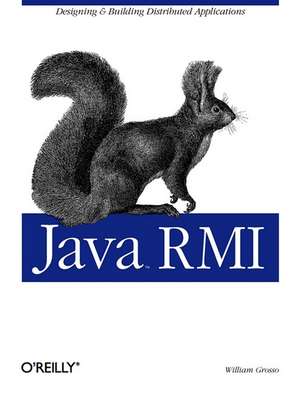
Java RMI
Autor William Grossoen Limba Engleză Paperback – 27 noi 2001
Preț: 341.95 lei
Preț vechi: 427.44 lei
-20%
Puncte Express: 513
Carte tipărită la comandă
Livrare economică 26 noiembrie-10 decembrie
Livrare prin curier în România Termenul estimat este afișat lângă disponibilitate.
Transport gratuit de la 400.00 lei Plată online sau ramburs, în funcție de opțiunile comenzii.
Retur gratuit în 14 zile Comandă securizată și suport în română.
Specificații
ISBN-13: 9781565924529
ISBN-10: 1565924525
Pagini: 572
Dimensiuni: 177 x 233 x 29 mm
Greutate: 0.82 kg
Editura: O'Reilly
Locul publicării:United States
ISBN-10: 1565924525
Pagini: 572
Dimensiuni: 177 x 233 x 29 mm
Greutate: 0.82 kg
Editura: O'Reilly
Locul publicării:United States
V-ar putea interesa
-
 Future Generation GridsVladimir Getov-20%Preț: 1030.93 lei1288.67 lei
 -
 Fundamental Data CompressionIda Mengyi Pu-20%Preț: 237.92 lei297.39 lei
 -
 New Directions in Human Information BehaviorAmanda Spink-20%Preț: 669.73 lei837.16 lei
 -
 New Directions in Cognitive Information RetrievalAmanda Spink-20%Preț: 641.03 lei801.28 lei
 -
 Consuming Music TogetherKenton O'Hara-20%Preț: 681.01 lei851.26 lei
 -
 Hci Related Papers of Interacción 2004Raquel Navarro-Prieto-20%Preț: 1293.75 lei1617.19 lei
 -
 Head First AgileAndrew Stellman-20%Preț: 343.20 lei429.00 lei
 -
 Table Layout in CSSEric Meyer-20%Preț: 46.50 lei58.12 lei
 -
 Building Maintainable Software, C# EditionJoost Visser-20%Preț: 146.03 lei182.54 lei
 -
 Microservice ArchitectureIrakli Nadareishvili-20%Preț: 201.34 lei251.68 lei
 -
 The SEO BattlefieldAnne Ahola WardPreț: 266.96 lei
 -
 Type Inheritance and Relational TheoryChris J Date-20%Preț: 292.41 lei365.51 lei
 -
 Cloud FoundryDuncan C E Winn-20%Preț: 85.21 lei106.52 lei
 -
 Make: ToolsCharles PlattPreț: 147.54 lei
 -
 -20%Preț: 635.06 lei793.83 lei
 -
 Concurrency TheoryHoward Bowman-20%Preț: 1005.32 lei1256.64 lei
 -
 Rule-Based Evolutionary Online Learning SystemsMartin V. Butz-20%Preț: 671.93 lei839.90 lei
 -
 Web CommunitiesYanchun Zhang-20%Preț: 344.91 lei431.14 lei
 -
 Network and Parallel ComputingHai Jin-20%Preț: 693.95 lei867.44 lei
 -
 Integrated Formal MethodsJudi M. T. Romijn-20%Preț: 328.49 lei410.62 lei
 -
 Advances in Computer Science - ASIAN 2005. Data Management on the WebStephane Grumbach-20%Preț: 322.80 lei403.50 lei
 -
 -20%Preț: 324.03 lei405.04 lei
 -
 Distributed Computing - IWDC 2005Ajit Pal-20%Preț: 640.08 lei800.10 lei
 -
 Graph-Theoretic Concepts in Computer ScienceDieter Kratsch-20%Preț: 332.01 lei415.02 lei
 -
 -20%Preț: 334.04 lei417.55 lei
Cuprins
Dedication; Preface; About This Book; About the Example Code; Conventions Used in This Book; For Further Information; How to Contact Us; Acknowledgments; Designing and Building: The Basics of RMI Applications; Chapter 1: Streams; 1.1 The Core Classes; 1.2 Viewing a File; 1.3 Layering Streams; 1.4 Readers and Writers; Chapter 2: Sockets; 2.1 Internet Definitions; 2.2 Sockets; 2.3 ServerSockets; 2.4 Customizing Socket Behavior; 2.5 Special-Purpose Sockets; 2.6 Using SSL; Chapter 3: A Socket-Based Printer Server; 3.1 A Network-Based Printer; 3.2 The Basic Objects; 3.3 The Protocol; 3.4 The Application Itself; 3.5 Evolving the Application; Chapter 4: The Same Server, Written Using RMI; 4.1 The Basic Structure of RMI; 4.2 The Architecture Diagram Revisited; 4.3 Implementing the Basic Objects; 4.4 The Rest of the Server; 4.5 The Client Application; 4.6 Summary; Chapter 5: Introducing the Bank Example; 5.1 The Bank Example; 5.2 Sketching a Rough Architecture; 5.3 The Basic Use Case; 5.4 Additional Design Decisions; 5.5 A Distributed Architecturefor the Bank Example; 5.6 Problems That Arise in Distributed Applications; Chapter 6: Deciding on the Remote Server; 6.1 A Little Bit of Bias; 6.2 Important Questions WhenThinking About Servers; 6.3 Should We Implement Bank or Account?; Chapter 7: Designing the Remote Interface; 7.1 Important Questions When Designing Remote Interfaces; 7.2 Building the Data Objects; 7.3 Accounting for Partial Failure; Chapter 8: Implementing the Bank Server; 8.1 The Structure of a Server; 8.2 Implementing the Server; 8.3 Generating Stubs and Skeletons; Chapter 9: The Rest of the Application; 9.1 The Need for Launch Code; 9.2 Our Actual Launch Code; 9.3 Build Test Applications; 9.4 Build the Client Application; 9.5 Deploying the Application; Drilling Down: Scalability; Chapter 10: Serialization; 10.1 The Need for Serialization; 10.2 Using Serialization; 10.3 How to Make a Class Serializable; 10.4 The Serialization Algorithm; 10.5 Versioning Classes; 10.6 Performance Issues; 10.7 The Externalizable Interface; Chapter 11: Threads; 11.1 More Than One Client; 11.2 Basic Terminology; 11.3 Threading Concepts; 11.4 Support for Threads in Java; 11.5 Deadlock; 11.6 Threading and RMI; Chapter 12: Implementing Threading; 12.1 The Basic Task; 12.2 Guidelines for Threading; 12.3 Pools: An Extended Example; 12.4 Some Final Words on Threading; Chapter 13: Testing a Distributed Application; 13.1 Testing the Bank Application; Chapter 14: The RMI Registry; 14.1 Why Use a Naming Service?; 14.2 The RMI Registry; 14.3 The RMI Registry Is an RMI Server; 14.4 Examining the Registry; 14.5 Limitations of the RMI Registry; 14.6 Security Issues; Chapter 15: Naming Services; 15.1 Basic Design, Terminology,and Requirements; 15.2 Requirements for Our Naming Service; 15.3 Federation and Threading; 15.4 The Context Interface; 15.5 The Value Objects; 15.6 ContextImpl; 15.7 Switching Between Naming Services; 15.8 The Java Naming and Directory Interface (JNDI); Chapter 16: The RMI Runtime; 16.1 Reviewing the Mechanics of a Remote Method Call; 16.2 Distributed Garbage Collection; 16.3 RMI's Logging Facilities; 16.4 Other JVM Parameters; Chapter 17: Factories and the Activation Framework; 17.1 Resource Management; 17.2 Factories; 17.3 Implementing a Generic Factory; 17.4 A Better Factory; 17.5 Persistence and the Server Lifecycle; 17.6 Activation; 17.7 A Final Word About Factories; Advanced Topics; Chapter 18: Using Custom Sockets; 18.1 Custom Socket Factories; 18.2 Incorporating a Custom Socket into an Application; Chapter 19: Dynamic Classloading; 19.1 Deploying Can Be Difficult; 19.2 Classloaders; 19.3 How Dynamic Classloading Works; 19.4 The Class Server; 19.5 Using Dynamic Classloadingin an Application; Chapter 20: Security Policies; 20.1 A Different Kind of Security Problem; 20.2 Permissions; 20.3 Security Managers; 20.4 Setting Up a Security Policy; Chapter 21: Multithreaded Clients; 21.1 Different Types of Remote Methods; 21.2 Handling Printer-Type Methods; 21.3 Handling Report-Type Methods; 21.4 Generalizing from These Examples; Chapter 22: HTTP Tunneling; 22.1 Firewalls; 22.2 CGI and Dynamic Content; 22.3 HTTP Tunneling; 22.4 A Servlet Implementationof HTTP Tunneling; 22.5 Modifying the Tunneling Mechanism; 22.6 The Bank via HTTP Tunneling; 22.7 Drawbacks of HTTP Tunneling; 22.8 Disabling HTTP Tunneling; Chapter 23: RMI, CORBA, and RMI/IIOP; 23.1 How CORBA Works; 23.2 The Bank Example in CORBA; 23.3 A Quick Comparison of CORBA and RMI; 23.4 RMI on Top of CORBA; 23.5 Converting the Bank Example to RMI/IIOP; Colophon;
Descriere
This text focuses on designing and implementing Java's Remote Method Invocation. Novice readers can learn why RMI is such a powerful yet easy to use tool for distributed programming, while experts can gain valuable experience for constructing their own enterprise and distributed systems.