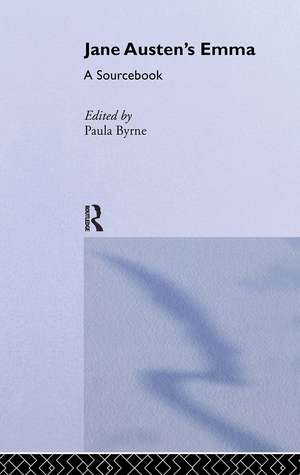
Jane Austen's Emma: A Routledge Study Guide and Sourcebook: Routledge Guides to Literature
Editat de Paula Byrneen Limba Engleză Hardback – 20 mai 2004
This sourcebook introduces readers not only to Jane Austen's text, but also to the literary and historical contexts within which the novel was written, and to the many different critical readings that it has generated, from the time of its publication to the twenty-first century. Each extract is fully introduced and analyzed, with a concluding section on recommended editions and further reading to prepare the reader for further study of this incomparable English novel.
Din seria Routledge Guides to Literature
-
 Preț: 224.10 lei
 -
 Preț: 213.45 lei
 -
 Preț: 214.44 lei
 -
 Preț: 229.19 lei
 -
 Preț: 172.52 lei
 -
 Preț: 405.75 lei
 -
 Preț: 312.78 lei
 -
 Preț: 403.30 lei
 -
 Preț: 214.17 lei
 -
 Preț: 313.24 lei
 -
 Preț: 325.43 lei
 -
 Preț: 223.63 lei
 -
 Preț: 342.59 lei
 -
 Preț: 379.42 lei
 -
 Preț: 249.17 lei
 -
 Preț: 396.69 lei
 -
 Preț: 213.22 lei
 -
 Preț: 215.43 lei
 - 18%
 Preț: 1112.72 lei
 -
 Preț: 240.35 lei
 -
 Preț: 227.51 lei
 - 18%
 Preț: 923.00 lei
 - 18%
 Preț: 925.10 lei
 -
 Preț: 400.40 lei
 -
 Preț: 329.25 lei
 -
 Preț: 380.12 lei
 -
 Preț: 250.03 lei
 - 18%
 Preț: 714.40 lei
 -
 Preț: 402.32 lei
 - 18%
 Preț: 1111.68 lei
 - 18%
 Preț: 1109.54 lei
 -
 Preț: 419.80 lei
 -
 Preț: 389.03 lei
 - 18%
 Preț: 716.83 lei
Preț: 922.65 lei
Preț vechi: 1125.18 lei
-18%
Puncte Express: 1384
Carte tipărită la comandă
Livrare economică 18 noiembrie-02 decembrie
Livrare prin curier în România Termenul estimat este afișat lângă disponibilitate.
Transport gratuit pentru acest produs Plată online sau ramburs, în funcție de opțiunile comenzii.
Retur gratuit în 14 zile Comandă securizată și suport în română.
Specificații
ISBN-13: 9780415286503
ISBN-10: 0415286506
Pagini: 176
Dimensiuni: 138 x 216 x 18 mm
Greutate: 0.49 kg
Ediția:1
Editura: Taylor & Francis
Colecția Routledge
Seria Routledge Guides to Literature
Locul publicării:Oxford, United Kingdom
ISBN-10: 0415286506
Pagini: 176
Dimensiuni: 138 x 216 x 18 mm
Greutate: 0.49 kg
Ediția:1
Editura: Taylor & Francis
Colecția Routledge
Seria Routledge Guides to Literature
Locul publicării:Oxford, United Kingdom
V-ar putea interesa
-
 The Poets DaughtersKatie WaldegravePreț: 122.82 lei
 -
 -31%Preț: 724.11 lei1052.74 lei
 -
 -31%Preț: 787.31 lei1145.34 lei
 -
 Robert Browning: 21st-Century Oxford AuthorsRichard Cronin-36%Preț: 1133.70 lei1772.02 lei
 -
 -31%Preț: 870.78 lei1263.82 lei
 -
 Clare's Lyric: John Clare and Three Modern PoetsStephanie Kuduk Weiner-31%Preț: 801.76 lei1167.66 lei
 -
 La Folie BaudelaireRoberto CalassoPreț: 92.71 lei
 -
 Irish Dramatic MovementM. FitzgeraldPreț: 458.59 lei
 -
 -18%Preț: 890.11 lei1085.50 lei
 -
 -15%Preț: 421.37 lei495.73 lei
 -
 The American Short Story HandbookJames NagelPreț: 336.65 lei
 -
 RomanticismFrederick Burwick-23%Preț: 610.73 lei793.16 lei
 -
 Marking Maternity in Middle English RomanceA. FlorschuetzPreț: 399.82 lei
 -
 Preț: 462.35 lei
 -
 Mirror of MindsGeoffrey BulloughPreț: 325.84 lei
 -
 Transformations of Electricity in Nineteenth-Century Literature and ScienceStella Pratt-Smith-18%Preț: 787.20 lei960.01 lei
 -
 -18%Preț: 1253.42 lei1528.56 lei
 -
 Contributors to the Quarterly Review: A History, 1809-25Jonathan Cutmore-18%Preț: 759.91 lei926.72 lei
 -
 -23%Preț: 756.74 lei982.78 lei
 -
 Gustav Mahler and the Symphony of the 19th CenturyConstantin Floros-23%Preț: 595.18 lei772.96 lei
 -
 Meeting Places: Locating Desert Consciousness in PerformanceMary Elizabeth Anderson-51%Preț: 280.25 lei576.55 lei
Public țintă
UndergraduateRecenzii
'I applaud genuine footnotes and a sturdy critical survey ... [this book] offers a catalogue of resources.' - British Association for Romantic Studies
Cuprins
Introduction 1: Contexts, Contextual Overview. Chronology, Contemporary Documents: From Opinions of Emma: collected and transcribed by Jane Austen (1816) From Jane Austen, ‘Love and Friendship’ [sic] (1790) From Jane Austen, ‘The Watsons’ (1804) From Oliver Goldsmith, The Vicar of Wakefield (1766) From John Gregory, A Father’s Legacy to his Daughters (1774) From James Fordyce, The Character and Conduct of the Female Sex (1776) From Mary Wollstonecraft, A Vindication of the Rights of Woman (1792) From Fanny Burney, Camilla; or A Picture of Youth (1796) From Thomas Dibdin, The Birth-Day, translated and adapted from August von Kotzebue (1799) From Hannah More, Strictures on the Modern System of Female Education (1799) 2: Interpretations Early Critical Reception: From Walter Scott, unsigned review of Emma in Quarterly Review (1816) From Walter Scott on Jane Austen, journal entry (1826) From Unsigned review of Emma in The Champion (1816) From Unsigned notice in the Gentleman’s Magazine (1816) From Charlotte Brontë on Jane Austen (1850) From George Henry Lewes, ‘The Novels of Jane Austen’ (1859) From Richard Simpson, unsigned review of A Memoir of Jane Austen (1870) Modern Criticism: From Henry James, ‘The Lesson of Balzac’ (1905) From A. C. Bradley, ‘Jane Austen’ (1911) From Reginald Farrer, ‘Jane Austen, ob. July 18, 1817’ (1917) From D. W. Harding, ‘Regulated Hatred: An Aspect of the Work of Jane Austen’ (1940) From Edmund Wilson, ‘A Long Talk about Jane Austen’ (1945) From F. R. Leavis, The Great Tradition (1948) From Arnold Kettle, ‘Jane Austen: Emma’ (1951) From Marvin Mudrick, ‘Irony as Form: Emma’ (1952) From Lionel Trilling, ‘Emma and the Legend of Jane Austen’ (1957) From Mark Schorer, ‘The Humiliation of Emma Woodhouse’ (1959) From Wayne Booth, ‘Control of Distance in Jane Austen’s Emma’ (1961) From Alistair Duckworth, ‘Emma and the Dangers of Individualism’ (1971) From Marilyn Butler, ‘Emma’ (1975) From Julia Prewitt Brown, ‘Civilization and the Contentment of Emma’ (1979) From Sandra M. Gilbert and Susan Gubar, ‘Jane Austen’s Cover Story (and its Secret Agents)’ (1979) From Jane Nardin, ‘Jane Austen and the Problem of Leisure’ (1981) From David Aers, ‘Community and Morality: Towards Reading Jane Austen’ (1981) From Joseph Litvak, ‘Reading Characters: Self, Society, and Text in Emma’ (1985) From Nancy Armstrong, ‘The Self-Contained: Emma’ (1987) From James Thompson, Between Self and World: The Novels of Jane Austen (1988) From Claudia L. Johnson, ‘Emma: “Woman, Lovely Woman Reigns Alone” ’ (1988) From John Wiltshire, ‘Emma: “the Picture of Health” ’ (1992) From Valentine Cunningham, ‘Games Texts Play’ (1994) From Claudia L. Johnson, ‘ “Not at all what a man should be!”: Remaking English Manhood in Emma’ (1995) From Juliet McMaster, ‘Class’ (1997) From Edward Copeland, ‘Money’ (1997) From Jonathan Bate, ‘Culture and Environment: from Austen to Hardy’ (1999) From Brian Southam, ‘Emma: England, Peace and Patriotism’ (2000) From Miranda J. Burgess, ‘Austen, Radcliffe, and the Circulation of Britishness’ (2000) The Work in Performance: From Nora Nachumi, “As if!” Translating Austen’s Ironic Narrator to Film’ (1998) 3: Key Passages, Introduction Volume 1, Chapter 1 Volume 1, Chapter 3 Volume 1, Chapter 5 Volume 1, Chapter 6 Volume 1, Chapter 7 Volume 1, Chapter 8 Volume 1, Chapter 9 Volume 1, Chapter 10 Volume 1, Chapter 12 Volume 1, Chapter 15 Volume 1, Chapter 16 Volume 1, Chapter 18 Volume 2, Chapter 7 Volume 2, Chapter 9 Volume 2, Chapter 10 Volume 2, Chapter 12 Volume 2, Chapter 17 Volume 3, Chapter 2 Volume 3, Chapter 3 Volume 3, Chapter 4 Volume 3, Chapter 5 Volume 3, Chapter 6 Volume 3, Chapter 7 Volume 3, Chapter 11 Volume 3, Chapter 13 Volume 3, Chapter 18 4: Further Reading.
Notă biografică
Paula Byrne has a PhD from the University of Liverpool and is the author of a highly acclaimed study of Jane Austen and the Theatre (2002). She is now a full□time critic and biographer and is writing a life of Austen’s near contemporary, the actress, novelist and poet Mary ‘Perdita’ Robinson.
Descriere
This sourcebook introduces not only Jane Austen's text, but also the literary and historical contexts and the many different critical readings that it has generated, from the time of its publication to the twenty-first century.