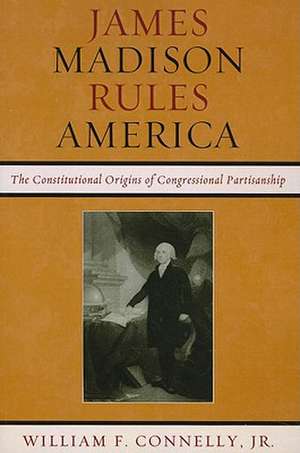
James Madison Rules America: The Constitutional Origins of Congressional Partisanship
Autor William F. Connelly, Jr.en Limba Engleză Paperback – 16 iun 2011
Preț: 286.24 lei
Preț vechi: 391.12 lei
-27%
Puncte Express: 429
Carte tipărită la comandă
Livrare economică 23 noiembrie-07 decembrie
Livrare prin curier în România Termenul estimat este afișat lângă disponibilitate.
Transport gratuit de la 400.00 lei Plată online sau ramburs, în funcție de opțiunile comenzii.
Retur gratuit în 14 zile Comandă securizată și suport în română.
Specificații
ISBN-13: 9780742599666
ISBN-10: 0742599663
Pagini: 339
Dimensiuni: 148 x 228 x 20 mm
Greutate: 0.52 kg
Editura: Bloomsbury Publishing
Colecția Rowman & Littlefield
Locul publicării:New York, United States
ISBN-10: 0742599663
Pagini: 339
Dimensiuni: 148 x 228 x 20 mm
Greutate: 0.52 kg
Editura: Bloomsbury Publishing
Colecția Rowman & Littlefield
Locul publicării:New York, United States
V-ar putea interesa
-
 Panchayati Raj: Oxford India Short IntroductionsKuldeep MathurPreț: 95.95 lei
 -
 After the SheikhsChristopher DavidsonPreț: 211.29 lei
 -
 Social Versus Corporate WelfareK. FarnsworthPreț: 392.97 lei
 -
 Social Work with Disabled PeopleMichael Oliver-21%Preț: 246.75 lei312.25 lei
 -
 Preț: 384.05 lei
 -
 Performing South Africa's Truth CommissionCatherine M. ColePreț: 215.04 lei
 -
 Citizenship Across the CurriculumMichael B. SmithPreț: 199.11 lei
 -
 Neoclassical Realism, the State, and Foreign PolicySteven E. LobellPreț: 296.04 lei
 -
 The UK ParliamentMoyra Grant-9%Preț: 137.12 lei150.87 lei
 -
 Inside the New Mexico SenateDede FeldmanPreț: 145.38 lei
 -
 Enterprise Risk ManagementKaren Hardy-8%Preț: 376.13 lei408.85 lei
 -
 Preț: 217.56 lei
 -
 The Soul at WorkFranco "Bifo" Berardi-16%Preț: 98.95 lei117.39 lei
 -
 The Food WarsWalden BelloPreț: 136.30 lei
 -
 The Conservative Party and social policyHugh BochelPreț: 278.04 lei
 -
 How to be an MPPaul FlynnPreț: 93.88 lei
 -
 -22%Preț: 41.70 lei53.54 lei
Cuprins
Dedication
Acknowledgments
Chapter 1: Congressional Party Strategy
Chapter 2: House Democrats: The Wilderness Years
Chapter 3: House Republicans: Newt the Anti-Federalist?
Chapter 4: Woodrow Wilson's Congressional Government
Chapter 5: Alexis de Tocqueville's Congress
Chapter 6: The Federalist Revisited
Chapter 7: Practical Consequences of Constitutional Principle: The 1790s
Chapter 8: Practical Consequences of Constitutional Principle: The 1980s and 1990s
Chapter 9: The Constitution Governs: Partisanship and Bipartisanship
Bibliography
Index
About the Author
Acknowledgments
Chapter 1: Congressional Party Strategy
Chapter 2: House Democrats: The Wilderness Years
Chapter 3: House Republicans: Newt the Anti-Federalist?
Chapter 4: Woodrow Wilson's Congressional Government
Chapter 5: Alexis de Tocqueville's Congress
Chapter 6: The Federalist Revisited
Chapter 7: Practical Consequences of Constitutional Principle: The 1790s
Chapter 8: Practical Consequences of Constitutional Principle: The 1980s and 1990s
Chapter 9: The Constitution Governs: Partisanship and Bipartisanship
Bibliography
Index
About the Author
Recenzii
Bill Connelly connects the dots on our seemingly scattershot political panorama and reveals a pattern of recurring conflict and gridlock traceable to the scheme's designer, James Madison. Connelly affirms Madison's wisdom and in so doing gives us a better appreciation for it.
In this outstanding book, William F. Connelly, Jr. reminds us that the Constitution continues to shape national politics. Drawing on his deep knowledge of the theory and practice of American government, he cogently explains that compromise and conflict are both part of our country's genetic code. James Madison Rules America is a timely treatment of a timeless topic. Full of unexpected insights and subtle wisdom, it asks us to look beyond Internet headlines and intellectual fads to the things that really matter: the structures that the Founders put in place more than two centuries ago. This book is a remarkable intellectual achievement, handling profound issues with clarity and erudition. It would be a valuable addition to courses on Congress and American national politics..
Mandatory reading for all involved or interested in politics today so they will understand the foundations of our system.
No author has done more than William Connelly to show how the Constitution guides, structures, and influences the hard realities of Congressional politics. Past and present, theory and practice, and law and politics are joined in this fine volume to reveal the strategies and dilemmas that have confronted congressional party leaders from James Madison and Henry Clay to Newt Gingrich and Nancy Pelosi.
In this lively and provocative interpretation of James Madison's political thought, Bill Connelly brings a fresh understanding to U.S. Congress today. Congress, he argues, is not broken. Despite its real and apparent imperfections, Madisonian pluralism shapes congressional politics and always has. James Madison Rules America lowers the fever-pitch criticism of Congress and applies a skeptical intelligence to popular ideas for reform. Connelly shows that much of the current hand-wringing about Congress may stem from too little appreciation of Madison's constitutional handiwork and of politics in general.
In James Madison Rules America, William F. Connelly explains the interplay of political and constitutional forces that shape politics and public policy making in the United States. Connelly finds that the underlying constitutional structure frames the possibilities our political process may contemplate. Viewed through the lens of constitutional theory, the American political system manages to channel partisan forces into public policy outcomes. Every American should read this book.
We are hearing a great deal about the role of the Constitution and the significance of congressional parties. In James Madison Rules America, William F. Connelly Jr. explains their connection. Drawing on his vast knowledge of contemporary politics and the Founding era, Connelly shows how Madison's handiwork shapes congressional behavior. Under the separation of powers, he argues persuasively, neither party is ever simply the "government" or the 'opposition'.... [A] lucidly written and thoroughly documented analysis.
Connelly offers an important new contribution to the study of congressional partisanship. The author, a well-regarded scholar of Congress, political parties, and interest groups, argues that much of the prevailing scholarship and public opinion about Congress as an institution is misinformed because it has not been properly grounded in an understanding of how the Constitution shapes the behavior of the institution. Relying on an extensive array of sources ranging from personal interviews to political theory, Connelly challenges a great deal of the conventional wisdom about Congress. Specifically, he takes exception to the belief that Congress today is defined more by dysfunction than competence and that the cause of this dysfunction stems principally from behavioral
sources-namely, the self-interest of elected officials. He counters this perception by arguing that contemporary congressional politics is shaped by constitutional design and that partisanship and conflict are simply by-products of the constitutional system. The choices made by congressional leaders to pursue compromise or conflict, partisanship or pluralism, are influenced by Madisonian design and do not represent a defect of politics that requires remedy. Summing Up: Highly recommended.
The book is an important work of scholarship on Congress, the separation of powers, and American political parties. Connelly carefully weaves virtually all major works on Congress into his analysis and thoroughly explains to the reader why James Madison still rules America.
In this outstanding book, William F. Connelly, Jr. reminds us that the Constitution continues to shape national politics. Drawing on his deep knowledge of the theory and practice of American government, he cogently explains that compromise and conflict are both part of our country's genetic code. James Madison Rules America is a timely treatment of a timeless topic. Full of unexpected insights and subtle wisdom, it asks us to look beyond Internet headlines and intellectual fads to the things that really matter: the structures that the Founders put in place more than two centuries ago. This book is a remarkable intellectual achievement, handling profound issues with clarity and erudition. It would be a valuable addition to courses on Congress and American national politics..
Mandatory reading for all involved or interested in politics today so they will understand the foundations of our system.
No author has done more than William Connelly to show how the Constitution guides, structures, and influences the hard realities of Congressional politics. Past and present, theory and practice, and law and politics are joined in this fine volume to reveal the strategies and dilemmas that have confronted congressional party leaders from James Madison and Henry Clay to Newt Gingrich and Nancy Pelosi.
In this lively and provocative interpretation of James Madison's political thought, Bill Connelly brings a fresh understanding to U.S. Congress today. Congress, he argues, is not broken. Despite its real and apparent imperfections, Madisonian pluralism shapes congressional politics and always has. James Madison Rules America lowers the fever-pitch criticism of Congress and applies a skeptical intelligence to popular ideas for reform. Connelly shows that much of the current hand-wringing about Congress may stem from too little appreciation of Madison's constitutional handiwork and of politics in general.
In James Madison Rules America, William F. Connelly explains the interplay of political and constitutional forces that shape politics and public policy making in the United States. Connelly finds that the underlying constitutional structure frames the possibilities our political process may contemplate. Viewed through the lens of constitutional theory, the American political system manages to channel partisan forces into public policy outcomes. Every American should read this book.
We are hearing a great deal about the role of the Constitution and the significance of congressional parties. In James Madison Rules America, William F. Connelly Jr. explains their connection. Drawing on his vast knowledge of contemporary politics and the Founding era, Connelly shows how Madison's handiwork shapes congressional behavior. Under the separation of powers, he argues persuasively, neither party is ever simply the "government" or the 'opposition'.... [A] lucidly written and thoroughly documented analysis.
Connelly offers an important new contribution to the study of congressional partisanship. The author, a well-regarded scholar of Congress, political parties, and interest groups, argues that much of the prevailing scholarship and public opinion about Congress as an institution is misinformed because it has not been properly grounded in an understanding of how the Constitution shapes the behavior of the institution. Relying on an extensive array of sources ranging from personal interviews to political theory, Connelly challenges a great deal of the conventional wisdom about Congress. Specifically, he takes exception to the belief that Congress today is defined more by dysfunction than competence and that the cause of this dysfunction stems principally from behavioral
sources-namely, the self-interest of elected officials. He counters this perception by arguing that contemporary congressional politics is shaped by constitutional design and that partisanship and conflict are simply by-products of the constitutional system. The choices made by congressional leaders to pursue compromise or conflict, partisanship or pluralism, are influenced by Madisonian design and do not represent a defect of politics that requires remedy. Summing Up: Highly recommended.
The book is an important work of scholarship on Congress, the separation of powers, and American political parties. Connelly carefully weaves virtually all major works on Congress into his analysis and thoroughly explains to the reader why James Madison still rules America.