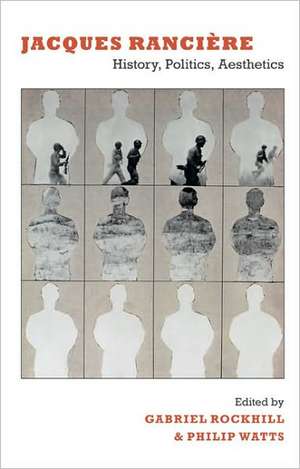
Jacques Rancière
Editat de Gabriel Rockhillen Limba Engleză Paperback – 21 aug 2009
Această lucrare colectivă, coordonată de Gabriel Rockhill și Phil Watts, aduce o perspectivă critică esențială asupra operei unuia dintre cei mai influenți filosofi francezi contemporani. Față de literatura existentă, volumul se distinge prin dialogul direct și adesea polemic dintre Jacques Rancière și un grup de savanți de elită, oferind nu doar o exegeză, ci și o testare a limitelor conceptelor sale în contexte actuale. Credem că valoarea acestui titlu rezidă în capacitatea de a clarifica legăturile complexe dintre cercetările de arhivă ale lui Rancière și teoriile sale despre egalitatea politică. Structura volumului reflectă riguros triada preocupărilor autorului. Prima secțiune, dedicată Istoriei, explorează modul în care Rancière subminează temporalitatea instituțională. Partea a doua se concentrează pe Politică, definită aici ca o perturbare a ierarhiilor sociale, în timp ce a treia secțiune investighează Estetica și regimurile vizibilității. Cititorii familiarizați cu Jacques Ranciere: An Introduction de Joseph Tanke vor aprecia modul în care acest volum trece de la prezentarea generală la o analiză aplicată, implicând perspective contrastante de la Alain Badiou sau Jean-Luc Nancy. În contextul operei editorului Gabriel Rockhill, acest volum completează demersurile sale din Interventions in Contemporary Thought, rafinând abordarea conjuncturală asupra teoriei critice. Reținem ca element de o importanță deosebită eseul de încheiere, unde însuși Rancière intervine pentru a-și clarifica poziția față de interogațiile colegilor săi, oferind astfel o rară privire asupra laboratorului său de gândire.
Preț: 220.83 lei
Carte tipărită la comandă
Livrare economică 23 noiembrie-07 decembrie
Specificații
ISBN-10: 0822345064
Pagini: 368
Dimensiuni: 151 x 228 x 29 mm
Greutate: 0.5 kg
Ediția:New.
Editura: Duke University Press
Locul publicării:United States
V-ar putea interesa
-
 Mute Speech – Literature, Critical Theory and PoliticsJacques RancièrePreț: 240.75 lei
 -
 Constitutional TheoryCarl SchmittPreț: 221.17 lei
 -
 Vibrant MatterJane BennettPreț: 164.66 lei
 -
 A World of BecomingWilliam E. ConnollyPreț: 193.25 lei
 -
 Arts of the Political – New Openings for the LeftNigel ThriftPreț: 238.52 lei
 -
 The Politics of AestheticsGabriel Rockhill-25%Preț: 141.66 lei189.00 lei
 -
 And the Weak Suffer What They Must?Yanis Varoufakis-31%Preț: 64.28 lei93.11 lei
 -
 Once Upon a Time in RussiaBen Mezrich-33%Preț: 51.94 lei77.56 lei
 -
 Preț: 93.78 lei
 -
 Preț: 89.72 lei
 -
 Maher, S: Salafi-JihadismShiraz Maher-21%Preț: 198.12 lei251.17 lei
De ce să citești această carte
Această carte este indispensabilă pentru cercetătorii și studenții la științe politice, filosofie sau studii culturale care doresc să înțeleagă mecanismele puterii și ale esteticii moderne. Cititorul câștigă o viziune de ansamblu asupra conceptului de „distribuție a sensibilului” și beneficiază de o critică riguroasă semnată de cele mai importante voci ale filosofiei continentale, totul într-un singur volum de referință.
Despre autor
Gabriel Rockhill este un filosof și teoretician cultural recunoscut pentru analizele sale asupra intersecției dintre politică, istorie și estetică. Editor al acestui volum și autor al unor lucrări precum The Politics of Aesthetics (traducere și introducere) sau Counter–History of the Present, Rockhill s-a impus ca unul dintre principalii mediatori ai gândirii franceze contemporane în spațiul anglo-saxon. Opera sa explorează adesea modul în care structurile ideologice modelează percepția realității sociale, temă centrală și în dialogul său continuu cu Jacques Rancière.
Descriere scurtă
Cuprins
Recenzii
"It contextualises Rancière's work in a way that one cannot achieve through reading him directly, offering a companion to his core writings. In addition nearly all of the pieces infuse Rancière's work with a sense of urgency and timelessness that can often be lost in volumes focused on a single thinker.... Impressive and much-needed discussion of Rancière's thought and should prove invaluable to those with an interest in his work." Roger Glover, Political Studies Review, January 2012
What makes this volume the book that everyone interested in Jacques Rancière has to have is its incomparable roster of contributors. Rancière himself sets a standard of intellectual seriousness, and the contributors honour him by wrestling strenuously with his thought. They illuminate the trajectory of that thought and the connections between the historian of class and the philosopher of equality, the thinker of politics and the thinker of aesthetics. You can see why Rancière is one of the few French thinkers creating an ever greater excitement in North America. Bruce Robbins, author of Upward Mobility and the Common Good: Toward a Literary History of the Welfare State
This timely collection of essays should finally jump-start the English-speaking conversation about the work of Jacques Rancière, one of the most innovative political philosophers now writing. His method of equality, his contrast of a stable police order with the political as an interruption of that order by those invisible within it, and his idea that both politics and art involve modes of distributing/partitioning the sensible together form a unique constellation of radical political thinking.--J. M. Bernstein, New School for Social Research
"In his contribution to this excellent edited volume, Alain Badiou situates the development of Jacques Rancie're's thought in the intellectual milieu of 1960s France. The defining issue that had emerged in this context concerned the relation between intellectual authority and social action, that is, the problem of transmission of revolutionary experience. Badiou outlines how Rancie're has engaged in a 'struggle on two fronts' in developing a response to this problem... This book draws together 16 critical responses to Rancie' re's work, which emerged from conferences held at the University of Pittsburgh and the Centre Culturel International de Cerisy la Salle in 2005. The book is organized around Ranciere's contribution to history, politics and aesthetics." - Andrew Schaap, Contemporary Political Theory "It contextualises Ranciere's work in a way that one cannot achieve through reading him directly, offering a companion to his core writings. In addition nearly all of the pieces infuse Ranciere's work with a sense of urgency and timelessness that can often be lost in volumes focused on a single thinker... Impressive and much-needed discussion of Ranciere's thought and should prove invaluable to those with an interest in his work." Roger Glover, Political Studies Review, January 2012 "What makes this volume the book that everyone interested in Jacques Ranciere has to have is its incomparable roster of contributors. Ranciere himself sets a standard of intellectual seriousness, and the contributors honour him by wrestling strenuously with his thought. They illuminate the trajectory of that thought and the connections between the historian of class and the philosopher of equality, the thinker of politics and the thinker of aesthetics. You can see why Ranciere is one of the few French thinkers creating an ever greater excitement in North America." Bruce Robbins, author of Upward Mobility and the Common Good: Toward a Literary History of the Welfare State "This timely collection of essays should finally jump-start the English-speaking conversation about the work of Jacques Ranciere, one of the most innovative political philosophers now writing. His method of equality, his contrast of a stable 'police' order with 'the political' as an interruption of that order by those invisible within it, and his idea that both politics and art involve modes of distributing/partitioning the sensible together form a unique constellation of radical political thinking."--J. M. Bernstein, New School for Social Research