Cantitate/Preț
Produs

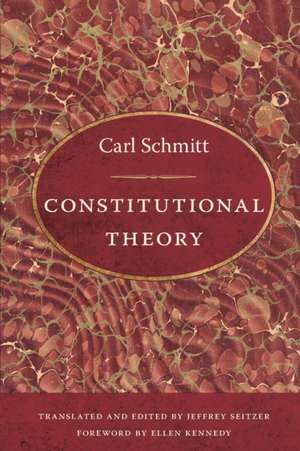
Constitutional Theory

Autor Carl Schmitt
en Limba Engleză Paperback – 23 ian 2008

Putem afirma că eroarea fundamentală pe care Carl Schmitt o demontează în Constitutional Theory este iluzia că o constituție derivă dintr-un set de norme juridice neutre sau dintr-o procedură pur administrativă. Reținem că, pentru Schmitt, la baza oricărei ordini legale nu stă un text, ci o decizie politică fundamentală luată de un popor conștient de identitatea sa. Această perspectivă transformă actul de constituire dintr-o simplă formalitate juridică într-un exercițiu de suveranitate brută.

Spre deosebire de lucrările sale mai polemice din epoca Weimar, cum este The Concept of the Political, acest volum adoptă un ton moderat și o metodologie riguroasă de istorie comparată. Credem că importanța lucrării rezidă în modul în care autorul reconciliază constituționalismul liberal cu nevoia unui stat puternic și independent. Complementar volumului Legality and Legitimacy, care explorează criza democrației parlamentare, Constitutional Theory acoperă arhitectura sistematică a dreptului public, oferind fundamentul teoretic pe care se sprijină restul operei sale. Dacă în Dictatorship Schmitt investiga excepția, aici el analizează regula și structura statului de drept.

Cititorul va învăța să identifice tensiunile dintre democrație și liberalism și va înțelege de ce constituțiile nu sunt doar documente tehnice, ci expresii ale puterii politice. Ediția de față, publicată de Duke University Press, este esențială pentru înțelegerea modului în care teoria decizionistă a influențat designul constituțional nu doar în Europa, ci și în Asia sau America Latină.

Citește tot Restrânge

Preț: 21360 lei

Puncte Express: 320

Carte disponibilă

Livrare economică 07-21 mai
Livrare express 22-28 aprilie pentru 4519 lei


Specificații

ISBN-13: 9780822340706
ISBN-10: 0822340704
Pagini: 490
Dimensiuni: 156 x 235 x 26 mm
Greutate: 0.74 kg
Editura: Duke University Press
Locul publicării:United States

De ce să citești această carte

Recomandăm această carte cercetătorilor în drept și științe politice care doresc să înțeleagă rădăcinile crizei democrației liberale. Cititorul câștigă o perspectivă profundă asupra conceptului de suveranitate și a modului în care se construiește legitimitatea politică reală. Este o lectură fundamentală pentru a înțelege de ce cadrul legal nu poate fi separat de voința politică care l-a generat.


Despre autor

Carl Schmitt (1888–1985) a fost un jurist și teoretician politic german, a cărui carieră a rămas marcată de colaborarea sa controversată cu regimul nazist. În ciuda acestui fapt, analizele sale asupra puterii politice, a suveranității și a limitelor liberalismului au exercitat o influență imensă asupra filozofiei contemporane, fiind studiate de gânditori precum Hannah Arendt sau Giorgio Agamben. Opera sa se concentrează pe critica democrației parlamentare și pe necesitatea unei autorități statale capabile să ia decizii în stări de excepție.


Descriere scurtă

Carl Schmitt's magnum opus, "Constitutional Theory," was originally published in 1928 and has been in print in German ever since. This volume makes Schmitt's masterpiece of comparative constitutionalism available to English-language readers for the first time. Schmitt is considered by many to be one of the most original--and, because of his collaboration with the Nazi party, controversial--political thinkers of the twentieth century. In "Constitutional Theory," Schmitt provides a highly distinctive and provocative interpretation of the Weimar Constitution. At the center of this interpretation lies his famous argument that the legitimacy of a constitution depends on a sovereign decision of the people. In addition to being subject to long-standing debate among legal and political theorists in Western Europe and the United States, this theory of constitution-making as decision has profoundly influenced constitutional theorists and designers in Asia, Latin America, and Eastern Europe. "Constitutional Theory" is a significant departure from Schmitt's more polemical Weimar-era works not just in terms of its moderate tone. Through a comparative history of constitutional government in Europe and the United States, Schmitt develops an understanding of liberal constitutionalism that makes room for a strong, independent state. This edition includes an introduction by Jeffrey Seitzer and Christopher Thornhill outlining the cultural, intellectual, and political contexts in which Schmitt wrote "Constitutional Theory"; they point out what is distinctive about the work, examine its reception in the postwar era, and consider its larger theoretical ramifications. This volume also contains extensive editorial notes and a translation of the Weimar Constitution.

Recenzii

“What Heidegger’s Being and Time is to European philosophy, Constitutional Theory is to European political philosophy. It is astounding that one of the most important works of twentieth-century political theory has remained untranslated until now. But this edition makes the wait worthwhile.”— John P. McCormick, University of Chicago“Constitutional Theory represents an unparalleled milestone in Schmitt translations. Indispensable to scholars in political and legal theory, it will undoubtedly occupy a pivotal place in debates over Schmitt. In itself, the Seitzer-Thornhill introduction constitutes one of the most authoritative and intellectually sophisticated contributions to this field in decades.”—Joseph W. Bendersky, author of Carl Schmitt: Theorist for the Reich

Textul de pe ultima copertă

""Constitutional Theory" represents an unparalleled milestone in Schmitt translations. Indispensable to scholars in political and legal theory, it will undoubtedly occupy a pivotal place in debates over Schmitt. In itself, the Seitzer-Thornhill introduction constitutes one of the most authoritative and intellectually sophisticated contributions to this field in decades."--Joseph W. Bendersky, author of "Carl Schmitt: Theorist for the Reich"

Descriere

German political theorist Carl Schmitt’s magnum opus, written during the Weimar regime.