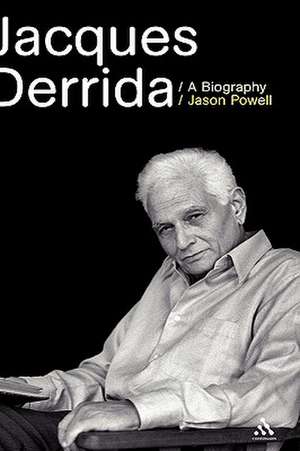
Jacques Derrida: A Biography
Autor Dr. Jason Powellen Limba Engleză Hardback – 24 mai 2006
Preț: 1089.15 lei
Preț vechi: 1444.15 lei
-25%
Puncte Express: 1634
Carte tipărită la comandă
Livrare economică 20 noiembrie-04 decembrie
Livrare prin curier în România Termenul estimat este afișat lângă disponibilitate.
Transport gratuit pentru acest produs Plată online sau ramburs, în funcție de opțiunile comenzii.
Retur gratuit în 14 zile Comandă securizată și suport în română.
Specificații
ISBN-13: 9780826490018
ISBN-10: 0826490018
Pagini: 264
Dimensiuni: 158 x 236 x 20 mm
Greutate: 0.52 kg
Editura: Bloomsbury Publishing
Colecția Continuum
Locul publicării:London, United Kingdom
ISBN-10: 0826490018
Pagini: 264
Dimensiuni: 158 x 236 x 20 mm
Greutate: 0.52 kg
Editura: Bloomsbury Publishing
Colecția Continuum
Locul publicării:London, United Kingdom
V-ar putea interesa
-
 Young EliotRobert CrawfordPreț: 125.81 lei
 -
 Selected LettersJohn KeatsPreț: 104.41 lei
 -
 Tove JanssonTuula Karjalainen-25%Preț: 105.17 lei139.77 lei
 -
 -33%Preț: 1348.39 lei2004.94 lei
 -
 What I Talk About When I Talk About RunningHaruki MurakamiPreț: 58.02 lei
 -
 The ApprenticeJacques PépinPreț: 123.14 lei
 -
 In Search of Anne BrontëNick HollandPreț: 150.96 lei
 -
 Dr. Seuss: American IconPhilip Nel-19%Preț: 329.83 lei407.46 lei
 -
 Truman Capote Enfant TerribleRobert Emmet LongPreț: 216.12 lei
 -
 Gentle RegretsRoger Scruton-45%Preț: 140.22 lei257.05 lei
 -
 Jean-Jacques RousseauJurgen Oelkers-39%Preț: 932.37 lei1526.94 lei
 -
 Harold PinterWilliam Baker-17%Preț: 179.19 lei216.57 lei
 -
 John le Carré: The BiographyAdam Sisman-25%Preț: 92.81 lei122.97 lei
 -
 Blackout: Remembering the things I drank to forgetSarah Hepola-28%Preț: 65.55 lei91.13 lei
 -
 CheeverBlake Bailey-13%Preț: 133.74 lei152.99 lei
 -
 Hospitals' Dirty Little SecretsJason Powell-5%Preț: 105.35 lei110.90 lei
Cuprins
Introduction
1. Algeria
2. Paris and ENS
3. After ENS
4. The First Book
5. Against Structuralism
6. 1967
7. Post-Structuralism
8. America: Derrida as Literature
9. Glas
10. Greph
11. Paul de Man
12. Nietzsche and Heidegger
13. The Post Card
14. The 1980s
15. 1987-90: Deconstruction and Germany
16. Autobiographical Years: 1990-91
17. The Future of Democracy: The Very Worst Moment of Capitalism
18. Derrida's World: Confronting Marx
19. The Politics of Friendship
20. Derrida's Religion
21. Thoughtful Welcoming of the Other
22. 2000 Onwards
23. Conclusion: On the Future of Thinking
Bibliography
1. Algeria
2. Paris and ENS
3. After ENS
4. The First Book
5. Against Structuralism
6. 1967
7. Post-Structuralism
8. America: Derrida as Literature
9. Glas
10. Greph
11. Paul de Man
12. Nietzsche and Heidegger
13. The Post Card
14. The 1980s
15. 1987-90: Deconstruction and Germany
16. Autobiographical Years: 1990-91
17. The Future of Democracy: The Very Worst Moment of Capitalism
18. Derrida's World: Confronting Marx
19. The Politics of Friendship
20. Derrida's Religion
21. Thoughtful Welcoming of the Other
22. 2000 Onwards
23. Conclusion: On the Future of Thinking
Bibliography
Recenzii
"...a strong overview of the work and placing it in a framework that illuminates the development of Derrida's thought over the forty years of his career."- Nancy J. Holland, Notre Dame Philosophical Review, June 27, 2007
This concise biography of Derrida encompasses his life and works. Beginning with Derrida's early years in Algeria, Powell quickly moves to Derrida's intellectual development and the range of philosophical thought to which he is responding. Powell explores Derrida's writings in the context of his life and times, showing the continuity without reducing Derrida's complexities to simplified method or doctrine. Powell draws evidence from Derrida's texts, comments from colleagues and friends, and Derrida's own descriptions of his life garnered from published interviews.Since personal correspondence is not yet available, the biography lacks a private look into Derrida and instead presents him as a mystery. Much more revealing is the commentary on Derrida's oeuvre, his philosophical positions, and his response to other philosophers, both predecessors and contemporaries. Those encountered range from Husserl and Althusser to Foucault and Lacan to Nietzsche and Heidegger. The clarity of discussion of Derrida's philosophy makes this work quite accessible. The book has an unnecessary apologetic tone that reveals more about the author's milieu than Derrida's recognized importance to the discipline of philosophy. Summing Up: Recommended. Lower-/upper-level undergraduates; general readers.
This concise biography of Derrida encompasses his life and works. Beginning with Derrida's early years in Algeria, Powell quickly moves to Derrida's intellectual development and the range of philosophical thought to which he is responding. Powell explores Derrida's writings in the context of his life and times, showing the continuity without reducing Derrida's complexities to simplified method or doctrine. Powell draws evidence from Derrida's texts, comments from colleagues and friends, and Derrida's own descriptions of his life garnered from published interviews.Since personal correspondence is not yet available, the biography lacks a private look into Derrida and instead presents him as a mystery. Much more revealing is the commentary on Derrida's oeuvre, his philosophical positions, and his response to other philosophers, both predecessors and contemporaries. Those encountered range from Husserl and Althusser to Foucault and Lacan to Nietzsche and Heidegger. The clarity of discussion of Derrida's philosophy makes this work quite accessible. The book has an unnecessary apologetic tone that reveals more about the author's milieu than Derrida's recognized importance to the discipline of philosophy. Summing Up: Recommended. Lower-/upper-level undergraduates; general readers.