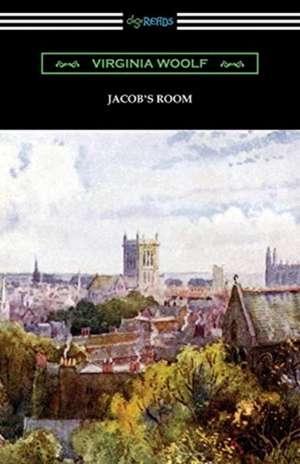
Jacob's Room
Autor Virginia Woolfen Limba Engleză Paperback – 28 aug 2019
Preț: 60.33 lei
Puncte Express: 90
Carte disponibilă
Livrare economică 19 octombrie-02 noiembrie
Livrare prin curier în România Termenul estimat este afișat lângă disponibilitate.
Transport gratuit de la 400.00 lei Plată online sau ramburs, în funcție de opțiunile comenzii.
Retur gratuit în 14 zile Comandă securizată și suport în română.
Specificații
ISBN-13: 9781420963885
ISBN-10: 1420963880
Pagini: 120
Dimensiuni: 140 x 216 x 7 mm
Greutate: 0.16 kg
Editura: Neeland Media
ISBN-10: 1420963880
Pagini: 120
Dimensiuni: 140 x 216 x 7 mm
Greutate: 0.16 kg
Editura: Neeland Media
V-ar putea interesa
-
 Room of One's Own and Three GuineasVirginia WoolfPreț: 28.01 lei
 -
 OrlandoVirginia WoolfPreț: 28.01 lei
 -
 CLASSICS THE VOYAGE OUTVirginia WoolfPreț: 28.01 lei
 -
 Mrs DallowayVirginia WoolfPreț: 28.01 lei
 -
 To the LighthouseVirginia WoolfPreț: 28.01 lei
 -
 The WavesVirginia WoolfPreț: 28.99 lei
 -
 EmmaJane Austen-25%Preț: 49.46 lei65.83 lei
 -
 The WavesVirginia WoolfPreț: 101.45 lei
 -
 Vilhelm's RoomTove DitlevsenPreț: 91.00 lei
 -
 -15%Preț: 419.92 lei494.03 lei
 -
 -15%Preț: 462.79 lei544.47 lei
 -
 The Life of VioletVirginia WoolfPreț: 107.77 lei
 -
 The Orwell Mystique: A Study in Male IdeologyDaphne PataiPreț: 281.55 lei
 -
 -14%Preț: 693.68 lei806.60 lei
 -
 -18%Preț: 1253.73 lei1528.95 lei
 -
 The Political in Margaret Atwood's Fiction: The Writing on the Wall of the TentTheodore F. Sheckels-18%Preț: 1114.04 lei1358.58 lei
 -
 -The Ethos of Britain-: Delderfieldʼs Swann TrilogyVictor J. Lams-23%Preț: 489.84 lei636.16 lei
 -
 One Man Zeitgeist: Dave Eggers, Publishing and PublicityDr Caroline D. Hamilton-25%Preț: 274.10 lei367.42 lei
 -
 Preț: 276.77 lei
 -
 Monday or TuesdayVirginia WoolfPreț: 35.19 lei
 -
 The Art of FictionVirginia WoolfPreț: 37.31 lei
 -
 Room of One''s Own & The Voyage OutVirginia WoolfPreț: 28.01 lei
 -
 Jacob's Room / Night and DayVirginia WoolfPreț: 38.82 lei
 -
 Preț: 52.08 lei
 -
 DublinersJames JoycePreț: 28.01 lei
 -
 Mrs. DallowayVirginia WoolfPreț: 29.91 lei
 -
 The Only Hope of the WorldOlga Soboleva-23%Preț: 446.26 lei579.56 lei
 -
 Forecasts of the PastDougal McNeill-23%Preț: 446.68 lei580.10 lei
Notă biografică
Virginia Woolf (1882-1941) was an English writer, born in South Kensington, London. Known for her feminist writings and pioneering work with the narrative style of stream of consciousness, Woolf is widely considered to be one of the most influential modernist writers of the 20th century. Some of her most famous works include Mrs. Dalloway, 1925, To the Lighthouse, 1927, and A Room of One's Own, 1929.
Descriere
Descriere de la o altă ediție sau format:
'What do we seek through millions of pages? Still hopefully turning the pages -- oh, here is Jacob's room.'Who is Jacob Flanders? Virginia Woolf's third novel, published in 1922 alongside James Joyce's Ulysses and T.S. Eliot's The Waste Land, follows this elusive title character from a sunlit childhood on the Cornwall coast to adventures in Cambridge, London, and Athens. Women fall in love with Jacob; young men desire his company and conversation. But Woolf keeps her scornful, charming protagonist at a distance, enveloping Jacob in mystery as he enters adulthood and the Great War thunders across Europe. A daring work that reimagines every element of the traditional novel, Jacob's Room tells a new story for a new century.In 1922, Lytton Strachey pronounced Jacob's Room 'a most wonderful achievement—more like poetry, it seems to me, than anything else, and as such I prophesy immortal.' One hundred years after its publication, Woolf's first full-length work of experimental fiction pulls us into the inexhaustible mysteries of intimacy and mortality.
'What do we seek through millions of pages? Still hopefully turning the pages -- oh, here is Jacob's room.'Who is Jacob Flanders? Virginia Woolf's third novel, published in 1922 alongside James Joyce's Ulysses and T.S. Eliot's The Waste Land, follows this elusive title character from a sunlit childhood on the Cornwall coast to adventures in Cambridge, London, and Athens. Women fall in love with Jacob; young men desire his company and conversation. But Woolf keeps her scornful, charming protagonist at a distance, enveloping Jacob in mystery as he enters adulthood and the Great War thunders across Europe. A daring work that reimagines every element of the traditional novel, Jacob's Room tells a new story for a new century.In 1922, Lytton Strachey pronounced Jacob's Room 'a most wonderful achievement—more like poetry, it seems to me, than anything else, and as such I prophesy immortal.' One hundred years after its publication, Woolf's first full-length work of experimental fiction pulls us into the inexhaustible mysteries of intimacy and mortality.
Recenzii
Jacob, of whom people speak, of whom they think, but who is never shown. And yet that denial of presence on the part of the author makes of him one of the most living presences in world literature.
She was doing with language something like what Jimi Hendrix does with a guitar.
She was doing with language something like what Jimi Hendrix does with a guitar.
Cuprins
List of illustrations and list of maps; General editors' preface; Notes on the edition; Acknowledgements; Chronology; List of abbreviations; List of archival sources for manuscript, typescript and proof material relating to Jacob's Room; List of editorial symbols; Introduction; Chronology of the composition of Jacob's Room; Maps; Jacob's Room; Explanatory notes; Textual apparatus; Textual notes; Appendix I; Appendix II; Bibliography.