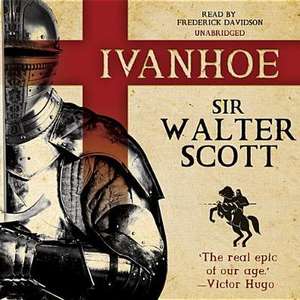
Ivanhoe
Autor Walter Scott Frederick Davidsonen Limba Engleză CD-Audio – 28 feb 2013 – vârsta de la 9 până la 12 ani
Set in England during Richard I s reign, Sir Walter Scott s fanciful, vivid reinterpretation of medieval life is a successful blend of fact, myth, and romance.
Upon returning from the Crusades, where he served with King Richard I, Wilfred of Ivanhoe is met with his father s disapproval, having fallen in love with Rowena, his father s ward. When his father disinherits him, Ivanhoe gets caught up in the power struggle between the king and his brother, Prince John, who is attempting to usurp the throne. Against the backdrop of a tournament of the Knights Templar, a series of adventures takes place. Ivanhoe catches the eye of Rebecca, a beautiful and courageous Jewess; he is taken prisoner, along with his father and hers, and Rowena as well; then they must rely upon one Locksley (Robin Hood) and his band of outlaws to set them free. When Rebecca is subsequently charged with witchcraft, she asks Ivanhoe to champion her in a trial by combat but have his affections shifted, or does he still love Rowena?"
Preț: 198.11 lei
Indisponibil temporar
Specificații
ISBN-10: 1441731695
Dimensiuni: 135 x 147 x 48 mm
Greutate: 0.43 kg
Editura: BLACKSTONE AUDIO BOOKS
V-ar putea interesa
-
 The Hobbit: Special collector's film tie-in editionJ. R. R. TolkienPreț: 122.91 lei
 -
 The Prison Doctor: Women InsideAmanda BrownPreț: 79.32 lei
 -
 Moby-DickHerman Melville-28%Preț: 59.35 lei82.58 lei
 -
 Sir Gawain and The Green KnightKeith Harrison-20%Preț: 51.23 lei63.87 lei
 -
 The SilmarillionJ. R. R. TolkienPreț: 65.60 lei
 -
 The Lord of the RingsJ. R. R. TolkienPreț: 325.69 lei
 -
 The HobbitJ. R. R. TolkienPreț: 274.76 lei
 -
 Perspective for ArtistsRex Vicat Cole-46%Preț: 66.24 lei121.90 lei
 -
 The Second Book Of LankhmarFritz Leiber-25%Preț: 92.85 lei124.08 lei
 -
 Dynamic AnatomyB. HogarthPreț: 195.45 lei
 -
 The Mothers: Five women. Five secrets. One missing husband.Sarah J Naughton-26%Preț: 59.24 lei79.63 lei
 -
 Atlas of Astronomical DiscoveriesGovert SchillingPreț: 368.43 lei
 -
 North and SouthElizabeth Gaskell-32%Preț: 59.42 lei87.61 lei
 -
 Twas The Nightshift Before ChristmasAdam Kay-35%Preț: 44.21 lei68.38 lei
 -
 The End of the StoryClark Ashton SmithPreț: 140.48 lei
 -
 Uncle Tom's CabinHarriet Beecher StowePreț: 38.73 lei
 -
 The Forsyte SagaJohn GalsworthyPreț: 39.80 lei
 -
 Collected Ghost StoriesM. R. JamesPreț: 31.75 lei
 -
 Three Men in a Boat & Three Men on the BummelJerome K. JeromePreț: 36.87 lei
 -
 Far from the Madding CrowdThomas HardyPreț: 28.01 lei
 -
 Bleak HouseCharles DickensPreț: 41.29 lei
 -
 Jude the ObscureThomas HardyPreț: 28.01 lei
 -
 The First Book of LankhmarFritz Leiber-24%Preț: 94.78 lei124.96 lei
Textul de pe ultima copertă
Notă biografică
Scott's literary career dates from 1802, when he published The Minstrelsy of the Scottish Border, a collection of ballads that had never before appeared in print. The book's popularity prompted him to attempt an original work based on Scottish themes, and in 1805 he brought out The Lay of the Last Minstrel, a narrative poem of love, war, and sorcery that, in his words, was 'intended to illustrate the customs and manners which anciently prevailed on the Borders of England and Scotland.' The Lay was an immediate success, and Scott secured fame with two more best-selling 'metrical romances': Marmion (1808) and The Lady of the Lake (1810). Yet in 1813 he declined the offer of Poet Laureatship. A versatile man of letters, Scott also edited The Works of John Dryden (1808) and The Works of Jonathan Swift (1814), two volumes that incorporated biography as a formal component of modern textual scholarship. He also contributed influential essays to the Edinburgh Review and helped found the Tory Quarterly Review.
As the vogue for his poetry waned, Scott turned to other literary forms. Eager to retain both his audience and large income, he hastily revised the draft of an abandoned prose romance and shaped it into the first historical novel. Waverley, Scott's tale of an Englishman who travels to the Scottish Highlands and becomes involved in the Jacobite rebellion of 1745, proved an overnight sensation when it was published anonymously in 1814. The success of Waverley was such that the author's identity soon became common knowledge. Its popularity in England prompted a humorous complaint from Jane Austen: 'Walter Scott has no business to write novels, especially good ones--It is not fair. He has fame and profit enough as a poet and should not be taking the bread out of other people's mouths. I do not mean to like Waverley if I can help it--but I fear I must.'
Over the next eighteen years Scott turned out some two dozen 'Waverley' novels. These so-called 'Scottish novels,' which are now widely considered to be his best work, deal with significant events in that nation's transition from feudalism to modern times. Among the most enduring are Guy Mannering (1815), The Antiquary (1816), The Black Dwarf (1816), Old Mortality (1816), Rob Roy (1818), The Heart of Midlothian (1818), The Bride of Lammermoor (1819), and Redgauntlet (1824). A second series of novels, including Ivanhoe (1819) and Quentin Durward (1823), are concerned with medieval history in England and Europe. A final group, notably Kenilworth (1821) and Woodstock (1826), focus on the Tudor - Stuart era in England.
In recognition of his literary achievements, Scott was awarded a baronetcy in 1818, and the enormous profits realized from his books enabled him to maintain a lavish country estate at Abbotsford. But the financial crash of 1826 forced Scott and his publishing partner James Ballantyne heavily into debt. Refusing to declare bankruptcy Scott labored endlessly to pay off creditors, though his personal liability was roughly ú130,000. He published The Life of Napoleon Buonaparte (1827), a nine-volume work that included a full history of the French Revolution; in 1828 he began preparing a 'Magnum Opus' edition of his works. In addition he turned out four last novels: The Fair Maid of Perth (1828), Anne of Geierstein (1829), Count Robert of Paris (1832), and Castle Dangerous (1832). Sir Walter Scott died at Abbotsford on September 21, 1832, and was buried at Dryburgh Abbey.
Cuprins
| Acknowledgements | vi | ||||
| The Waverley Novels in Penguin | viii | ||||
| Introduction | xi | ||||
| Chronology of Walter Scott | xxx | ||||
| Further Reading | xxxix | ||||
| A Note on the Text | xliii | ||||
| IVANHOE | |||||
| 1 | (132) | |||
| 133 | (126) | |||
| 259 | (144) | |||
| Historical note | 403 | (7) | |||
| Explanatory Notes | 410 | (77) | |||
| Glossary | 487 |
Descriere
More than a century after the Norman Conquest, England remains a colony of foreign warlords. The dissolute Prince John plots to seize his brother's crown, his barons terrorize the country, and the mysterious outlaw Robin Hood haunts the ancient greenwood. The secret return of King Richard and the disinherited Saxon knight, Ivanhoe, heralds the start of a splendid and tumultuous romance, featuring the tournament at Ashby-de-la-Zouche, the siege of Torquilstone, and the clash of wills between the wicked Templar Bois-Guilbert and the sublime Jewess Rebecca. In Ivanhoe Scott fashioned an imperial myth of national cultural identity that has shaped the popular imagination ever since its first appearance at the end of 1819. The most famous of Scottish novelists drew on the conventions of Gothic fiction, including its risky sexual and racial themes, to explore the violent origins and limits of English nationality. This edition uses the 1830 Magnum Opus text, corrected against the Interleaved Set, and incorporates readings from Scott's manuscript. The introduction examines the originality and cultural importance of Ivanhoe, and draws on current work by historians and cultural critics. ABOUT THE SERIES: For over 100 years Oxford World's Classics has made available the widest range of literature from around the globe. Each affordable volume reflects Oxford's commitment to scholarship, providing the most accurate text plus a wealth of other valuable features, including expert introductions by leading authorities, helpful notes to clarify the text, up-to-date bibliographies for further study, and much more.