
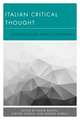
Italian Critical Thought: Genealogies and Categories: New Politics of Autonomy
Editat de Dario Gentili, Elettra Stimilli, Glenda Garellien Limba Engleză Hardback – 24 aug 2018
This book collects together leading names in Italian critical thought to examine the significant contributions that they are giving to contemporary political debates. The first part of the book draws a possible genealogy of the so-called 'Italian Theory', questioning the possibility of grouping together many authors, and political and theoretical approaches which are often reciprocally in conflict. The second part of the book presents certain categories that have become characteristic of Italian Thought for their original interpretation and use by some of the authors recognized as part of the Italian Theory tradition, from biopolitics and political theology to crisis and immanence.
| Toate formatele și edițiile | Preț | Express |
|---|---|---|
| Paperback (1) | 268.85 lei 6-8 săpt. | |
| Bloomsbury Publishing – 24 aug 2018 | 268.85 lei 6-8 săpt. | |
| Hardback (1) | 731.47 lei 6-8 săpt. | |
| Bloomsbury Publishing – 24 aug 2018 | 731.47 lei 6-8 săpt. |




Preț: 731.47 lei
Preț vechi: 1111.23 lei
-34%
Puncte Express: 1097
Preț estimativ în valută:
129.33€ • 152.43$ • 112.96£
129.33€ • 152.43$ • 112.96£
Carte tipărită la comandă
Livrare economică 09-23 aprilie
Specificații
ISBN-13: 9781786604507
ISBN-10: 1786604507
Pagini: 192
Dimensiuni: 154 x 230 x 16 mm
Greutate: 0.39 kg
Editura: Bloomsbury Publishing
Colecția Rowman & Littlefield
Seria New Politics of Autonomy
Locul publicării:New York, United States
ISBN-10: 1786604507
Pagini: 192
Dimensiuni: 154 x 230 x 16 mm
Greutate: 0.39 kg
Editura: Bloomsbury Publishing
Colecția Rowman & Littlefield
Seria New Politics of Autonomy
Locul publicării:New York, United States
Cuprins
Introduction: Alternative Narrative and Political Operation, Dario Gentili and Elettra Stimilli / Part One: Genealogies / Chapter 1: German Philosophy, French Theory, Italian Though, Roberto Esposito / Chapter 2: Post-operaism? No, Operaism, Toni Negri / Chapter 3: Italian Theory? Elements for a Genealogy, Sandro Chignola / Chapter 4: Italian Theory and its Differences: Subjectivation, Historicization, Conflict, Judith Revel / Chapter 5: Old Courses in New Countries, Mario Tronti / Part Two: Categories / Chapter 6: A World to Gain. On the Borders of Theory, Sandro Mezzadra / Chapter 7: Politics and Philosophy in Italian Radical Thought, Elettra Stimilli / Chapter 8: The Crisis Dispositive: Political Theology and Biopolitics, Dario Gentili / Chapter 9: Inhabiting Immanence. The Logic, History and Politics of an Italian Thought's Concept, Roberto Ciccarelli
Recenzii
Italian Critical Thought demonstrates that there are theoretical and political alternatives to the grand narratives of neoliberalism; that the vocabulary of globalization, free market, competition, and crisis can be displaced by critical imagination and militant philosophy. This volume provides a necessary toolbox for naming the excess of politics and mobilizing what resists against, or escapes from, the horizon of the nation-state and its categories.
What exactly is Italian thought and how might it help us respond to some of the political and ethical predicaments we face today? In this virtuous collection, Gentili, Stimilli and Garelli have arranged a number of incisive pieces that do justice to the broad and ecumenical perspectives that make up contemporary Italian thought. From autonomia to biopolitics to political theology and its critique, the snapshot that emerges of Italian thought is one of a powerful ontology and immanence able to enhance difference in a political moment that sorely needs it. It also happens to be a wonderful introduction for those new to Italian philosophy.
What exactly is Italian thought and how might it help us respond to some of the political and ethical predicaments we face today? In this virtuous collection, Gentili, Stimilli and Garelli have arranged a number of incisive pieces that do justice to the broad and ecumenical perspectives that make up contemporary Italian thought. From autonomia to biopolitics to political theology and its critique, the snapshot that emerges of Italian thought is one of a powerful ontology and immanence able to enhance difference in a political moment that sorely needs it. It also happens to be a wonderful introduction for those new to Italian philosophy.