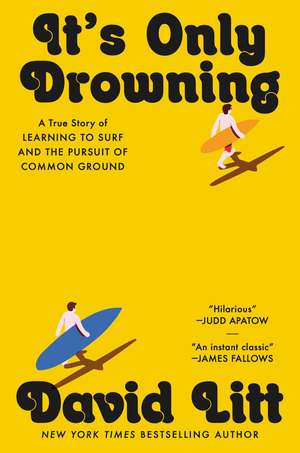
It's Only Drowning: A True Story of Learning to Surf and the Search for Common Ground
Autor David Litten Limba Engleză Hardback – 31 iul 2025
A former Obama speechwriter moves to the Jersey Shore and learns to surf with the help of his brother-in-law: a tattooed, truck-driving Joe Rogan superfan.
David, the Yale-educated writer with a fear of sharks, and Matt, the daredevil electrician with a shed full of surfboards, had never been close. But as America’s crises piled up and David spiraled into existential dread, he noticed that his brother-in-law was thriving. He began to suspect Matt’s favorite hobby had something to do with it.
David started taking surf lessons. For months, he wiped out on waves the height of daffodils. Yet, after realizing that surfing could change him both in and out of the water, he set an audacious goal: riding a big wave in Hawaii. He searched for an expert he could trust to guide and protect him—and when he couldn’t find one, he asked Matt. Together, they set out on a journey that spanned coasts, and even continents, before taking them to Oahu’s famously dangerous North Shore.
It’s Only Drowning is a laugh-out-loud love letter to surfing—and so much more. It’s an ode to embarking on adventures at any age. It’s a blueprint for becoming braver at a time when it takes courage just to read the news. Most of all, it’s the story of an unlikely friendship, one that crosses the fault lines of education, ideology, and culture tearing so many of us apart.
Preț: 118.47 lei
Preț vechi: 144.67 lei
-18%
Puncte Express: 178
Carte disponibilă
Livrare economică 20 noiembrie-02 decembrie
Livrare express 30 octombrie-05 noiembrie pentru 57.45 lei
Livrare prin curier în România Termenul estimat este afișat lângă disponibilitate.
Transport gratuit de la 400.00 lei Plată online sau ramburs, în funcție de opțiunile comenzii.
Retur gratuit în 14 zile Comandă securizată și suport în română.
Specificații
ISBN-13: 9781668035351
ISBN-10: 1668035359
Pagini: 304
Ilustrații: 2 photos t-o
Dimensiuni: 152 x 229 x 33 mm
Greutate: 0.46 kg
Editura: Gallery Books
Colecția Gallery Books
ISBN-10: 1668035359
Pagini: 304
Ilustrații: 2 photos t-o
Dimensiuni: 152 x 229 x 33 mm
Greutate: 0.46 kg
Editura: Gallery Books
Colecția Gallery Books
V-ar putea interesa
-
 Cold-Water EdenRichie FitzgeraldPreț: 93.38 lei
 -
 A Mile DownDavid VannPreț: 57.02 lei
 -
 I Could be Eaten by a SharkMarcela FerreiraPreț: 55.33 lei
 -
 Here for ItR. Eric ThomasPreț: 97.68 lei
 -
 Swimming with the Viking of SkyeRichard Waters-18%Preț: 105.92 lei129.50 lei
 -
 -24%Preț: 55.43 lei73.33 lei
 -
 -23%Preț: 61.80 lei80.45 lei
 -
 Preț: 71.85 lei
 -
 -19%Preț: 98.63 lei122.07 leiRecomandat
 -
 Swimmingly: Adventures in WaterVassos Alexander-26%Preț: 90.29 lei121.35 lei
 -
 -18%Preț: 53.19 lei65.06 lei
 -
 We Fell ApartE. LockhartPreț: 65.32 lei
 -
 Barbarian Days: A Surfing LifeWilliam Finnegan-25%Preț: 81.92 lei109.24 lei
 -
 All the Way to the RiverElizabeth GilbertPreț: 110.12 lei
 -
 -10%Preț: 141.81 lei157.21 lei
 -
 Stories From a Stranger: Every person has a story.Hunter Prosper-20%Preț: 158.89 lei198.80 leiRecomandat
 -
 Preț: 65.53 lei
 -
 -22%Preț: 111.78 lei144.06 leiRecomandat
 -
 The Only Way I KnowAndy FarrellPreț: 194.11 lei
 -
 -7%Preț: 117.98 lei127.23 lei
Notă biografică
David Litt is the New York Times bestselling author of Thanks, Obama; Democracy in One Book or Less; and It’s Only Drowning. A former senior speechwriter for Barack Obama, described as “the comic muse for the president” for his work on White House Correspondents’ Dinner monologues, he has also written for The New York Times, The Atlantic, The Washington Post, Los Angeles Times, Cosmopolitan, and more. Along with writing speeches and jokes for political figures, athletes, Fortune 500 CEOs, and philanthropists, David was the head writer/producer at Funny Or Die, DC, and has written and sold comedy pilots for Comedy Central, ABC, and NBC. He and his wife divide their time between Washington, DC, and Asbury Park, New Jersey. Find out more at DavidLittBooks.com.
Extras
Chapter One: Surfing Is for LunaticsCHAPTER ONE ![]() Surfing Is for Lunatics
Surfing Is for Lunatics
MATTHEW KAPPLER IS MY BROTHER-IN-LAW, and we’re very different, and one of the biggest differences between us is that if I lived like him I would die.
Matt owns two motorcycles. The first is a Kawasaki for racing, the second a Harley for roaring down the Garden State Parkway at speeds he once described as “only” a hundred miles per hour. He’s an electrician, and a good one, in part because of how seriously he takes his work, and in part because of how casually he takes the prospect of violent shocks. Matt once threw out his back training to be a mixed martial arts fighter. I once threw out my back lifting a bag of cat litter.
We met in the summer of 2012. I’d been dating his older sister, Jacqui, for about a year, and she and I had driven up from Washington, DC, to visit her parents in New Jersey. At the time I was a twenty-five-year-old speechwriter for Barack Obama, with sensibly parted hair, an ergonomic keyboard, and a strong preference for the half-Windsor tie knot over the more conventional four-in-hand. Matt was living at home. He was twenty-two years old, on the tail end of a rebel-without-a-cause phase that had begun, as far as I could tell, at birth.
Because I was busy trying to impress Jacqui’s parents during that initial visit, I didn’t pay much attention to her brother. Matt first appears in my memory not as a person but as a muscle shirt–wearing specter, floating silently to the kitchen to blend a protein shake before disappearing into the garage to jam on his electric guitar. But more trips followed; my future in-laws lived minutes from the Jersey Shore, so Jacqui and I started coming up for beach weekends each summer.
Matt and I thus got to know each other a little better, and the better we got to know each other, the clearer it became that we had absolutely nothing in common. My professional life revolved around politics; he had never registered to vote. Matt played in a locally famous ska band; I played in a co-ed recreational Ultimate Frisbee league. My idea of a perfect meal was a bowl of homemade knife-cut noodles, studded with bits of pork and drenched in chili oil, from a hole-in-the-wall restaurant near the university where I studied on a summer fellowship that sent Ivy League undergraduates to Beijing. His was chicken tenders.
I didn’t dislike Matt. I found him quite interesting, in the way all men who need two computer monitors for work find all men who need a pickup truck for work quite interesting. But we never became anything like friends.
The closest we got to bonding were the times when, in a spirit of anthropological curiosity, I asked him about small details of his life. The tattoo covering his left shoulder, for instance. It depicted a giant robotic claw reaching across his collarbone, slicing his flesh with metal talons, and ripping back his skin to reveal a bloody mess of muscle and machine parts.
“So, Matt,” I once asked, in my best NPR voice, “what made you decide to get that tattoo?”
He thought for a second, then shrugged contentedly.
“I dunno.”
I tried conjuring a follow-up and couldn’t. I’ve been told that one of my first words was ambivalent. To permanently brand oneself with any image, of any size, struck me as an inconceivably risky invitation to regret. And to pick an image that was huge, gruesome, and highly visible, for basically no reason? I was left gasping in confusion like a goldfish plucked from its bowl.
Which is all to say that when, five years after we met, Matt bought a beat-up used surfboard, I did not think, At last, a healthful pastime that might bring me closer to my future brother-in-law! I thought, Surfing is for lunatics.
Nothing in the years that followed changed my view. On one occasion, Matt arrived at a family gathering wild-eyed, his light-brown hair not so much tousled as beaten. He’d woken at dawn, he explained as though this were normal, and spent his morning being pummeled against rocks and slammed into the seabed. I would have found this alarming at any time of year, even summer, when the Jersey Shore is packed with beachgoers. But this was Christmas Day.
“Aren’t you worried about, you know, drowning?”
“Neh,” he replied, in his slightly pinched Jersey accent. I waited for him to elaborate. He didn’t.
“Okay. What about freezing to death?”
“The best waves are in winter,” he said, in what I could not help but notice was not an answer to my question. “You should try it.”
I declined his offer, not so much verbally as through my very existence. It was true that once, on a family trip to Mexico, I’d taken something described as a “surf lesson,” during which I knelt on a plank for an hour while a teenager rolled his eyes and pushed me toward a beach. But surfing—really surfing—was clearly different. Along with absurd levels of fitness and dexterity, it required a near-total lack of common sense.
It also seemed like a waste of time. My adult life had been defined by a line from Barack Obama’s first presidential campaign: “In the face of impossible odds, people who love this country can change it.” Even after leaving the White House, I’d remained a proudly earnest workaholic. I filled my days, along with most nights and weekends, with productivity. Writing books and TV pilots. Working on speeches for private clients. Volunteering for campaigns. While each project was different, when you zoomed out far enough the goal was always the same: to change the world.
Matt seemed to surf for no higher purpose whatsoever. He did it simply because he enjoyed it. That made no sense to me.
In 2018, Jacqui and I got married in Asbury Park, a Jersey Shore town best known as the spot where Bruce Springsteen got his start. The following year we bought a small vacation house there. It was listed, optimistically, as a “Victorian cottage,” and located a half mile from the beach. Sometimes while strolling the boardwalk, I’d see a gaggle of wetsuit-clad figures bobbing like apples in the sea. Every so often, one would turn, stand, and cruise toward shore.
It was noteworthy: these individuals were not my brother-in-law, yet they surfed. Still, nothing could change what was, in my opinion, the most relevant fact about Matt’s favorite hobby. If it was for people like him, it wasn’t for people like me.
Besides, I was an adult now, with a wife and a mortgage and two cats and intermittent back pain and a determination to make the most of my limited time on earth. To the extent I looked toward the ocean and thought, I wish I’d tried it, surfing was just another scribble on the map of roads not taken that people in their early thirties can’t help but draw. I should have seen Tom Petty in concert. I should have made out with Leah Franklin at that party freshman year. I should have learned to surf. Who cares?
The answer, as it turned out, was me. Enormously.
And all it took to realize it was the worst year of my life.
When I was four years old, I was terrified—absolutely terrified—that Saddam Hussein would emerge from my toilet and strangle me.
This was during the first Gulf War, so my fear was rational, assuming you knew, as I did, the rules governing Saddam’s behavior. First, he lurked in the pipes. Second, he could travel instantly between rooms and even buildings, so long as he remained submerged. Third, while Saddam could overpower any child whose bathroom he invaded, he couldn’t escape the plumbing on his own. Only the emptying of a toilet bowl would release him.
I never told an adult about the danger. Even at age four, I understood grown-ups were unlikely to believe me. Nor did I stop flushing; I gathered adults would frown upon that, too. Instead, for the duration of the war, and (to be on the safe side) for several months after it ended, I did what any reasonable person would do. I flushed and ran.
This all took place decades ago, but I bring it up now for context: I have always taken current events a bit personally.
For most of my childhood, that was a good thing. Born halfway through the 1980s, I formed my first memories as the Berlin Wall fell and spent my youth as a fortunate son of the world’s sole superpower. Growing up, I knew—and everyone I knew knew—that America was good and getting better and everywhere else was getting more like America. Demographers call us the millennials. In truth, I belong to the greatest-expectations generation. We flew closest to the sun.
And then? September 11th; the Great Recession; the Trump era; a million smaller yet previously unimaginable crises in between. A towering lasagna of calamity. As people my age entered our thirties, the problems we were supposed to be on our way to solving—mass shootings, income inequality, racial prejudice, climate change—all seemed to be getting worse instead of better. Rather than staying vanquished, the villains of the twentieth century, Nazis and white supremacists and Russian tyrants, returned with a vengeance.
As if this weren’t brutal enough, for us, young adulthood did not recede gradually, like a hairline. It was snatched away by the worst pandemic in one hundred years.
By the standards of people living through a global catastrophe, Jacqui and I were lucky when Covid hit. Health intact. Family safe. Jobs that could be done remotely. No children to enroll in Zoom school. We even had a refuge from the heat and humidity of DC, where we were living at the time. The first summer after buying our Asbury Park cottage, we’d rented it to vacationers from New York City for a small profit, but by the second summer the world was on fire and we rented it to ourselves for free. Jacqui gardened. I grilled. At first, I kind of liked it.
Then I fell apart. Despite my good fortune—and despite being from a generation accustomed to pinballing between crises—Covid felt different. Maybe it was the scale. Maybe it was the isolation, or the fact that the pandemic arrived as I approached my thirty-fifth birthday. Maybe it was the variants that pulled the rug of normalcy out from under us, even after the release of a vaccine.
It is said that Shakespeare wrote King Lear during a pandemic. Good for him. I bought a PlayStation and drank lots of wine. Every so often, in increasingly urgent tones, Jacqui would suggest I pick up a hobby. But I already had a hobby: reading the news and worrying. By the fall of 2021, a perfect storm of growing certainties—that Covid was not an event but an era, that Trumpism was not a blip but a spreading stain, that a world on fire was not a challenge to be overcome but a permanent condition to be endured for the rest of our lives—began howling in my head.
Psychologists call this “situational depression,” meaning that it was brought on by events, rather than purely by brain chemistry. But that was hardly comforting when the world had become one big situation. Night after night I lay awake, mind whirring like a washing machine on the fritz. Am I wasting my life? Is humanity hurtling toward extinction? Are Jacqui and I waiting too long to have kids? Am I doomed, if we do have kids, to be a sad dad who mopes around worrying he’s wasted his life and humanity is hurtling toward extinction?
I would say it was like running on a treadmill, but that would imply health and fitness. It was more like being a treadmill, spinning in circles while getting repeatedly stomped on. Regardless of the subject of my panic—the planet, the country, my life—I arrived at the same conclusion: The best was over. There was nowhere to go but down.
My spiral was privileged and high-functioning. Few of my friends knew what was happening below the surface, and I never stopped working weekends. But the faith that had lifted me out of previous low moments—that what I did mattered—now seemed totally naïve.
As far as I could tell, only three categories of people made it through Covid without succumbing to despair: happy warriors, pathological narcissists, and Taylor Swift. Many of my friends in DC fell into the first group. So did my wife. Jacqui was working as a legislative director for a congressman, and I admired her ability to fight the good fight. But the attitude displayed by her and my DC friends no longer made sense to me. The courage of the happy warriors struck me as a form of denial.
So did the narcissism of the narcissists. They seemed to experience the same crushing realization I did, that the world was full of chaos and time was running out. But instead of responding rationally, with depression, they tried to overturn elections or committed cryptocurrency fraud or purchased entire social networks just to maintain the illusion of control. They were hardly role models. Yet I was impressed by their relentlessness.
Why is it, I wondered, that so many of the world’s worst people have no trouble getting off the couch?
This was the kind of question I pondered while lying on my couch. It would be easy to say I was stuck in a rut. But that doesn’t capture the gravitational pull of hopelessness, the twisted comfort that comes from wrapping oneself in a blanket of bleakness. I felt stuck in a tar pit, at once static and frantic, sinking deeper into gloom.
I remained lucky in one crucial respect: I never seriously considered harming myself. But I came frighteningly close. One morning in early 2022, I left our Victorian cottage, stepped onto the tracks running through town, and saw, in the distance, an oncoming NJ Transit locomotive. For a moment, I paused and faced the train.
It’s not for me, I thought. But I get the appeal.
My brother-in-law, meanwhile, was thriving. I couldn’t understand it. He was neither a warrior, a narcissist, nor Taylor Swift. Yet the second year of the pandemic—the same year I slid deeper into depression—was the most successful of Matt’s life. As New Yorkers fled the city for the Shore, he made a killing fixing lights in their guest bedrooms and installing charging stations for their Teslas. Before long, he’d started his own company and bought a house in Brick, a blue-collar exurb in New Jersey’s small but passionate Trump Country.
Matt referred to his new hometown, affectionately, as “Bricktucky.” This was one of many things I might not have even noticed before the pandemic, and that now felt like an example of everything wrong with him and also the entire world. As recently as 2019, our differences in taste hadn’t meant much. He drove a Dodge Ram; I drove a Subaru. He lifted weights to death metal; I jogged to Lizzo. He was a Joe Rogan superfan; I was a Stephen Sondheim aficionado. So what? Now, though, our preferences were more than preferences. They were identifiers, declaring not just what we liked but who we were. Matt still wasn’t registered to vote, so the divide between us wasn’t technically partisan. But we’d been drafted into opposite sides of a cultural civil war.
The deepest fault line was, of course, vaccination. Had Matt been a friend rather than my wife’s younger brother, I probably would have cut off contact after learning he’d refused the Covid shot. As it was, Jacqui and I came up with excuses (“He’s an introvert”; “He works in empty houses”; “He doesn’t eat in restaurants anyway”) to justify not taking a stand. Afraid of the blow-up that would result, I never confronted him about his decision, and because failing to confront him felt like a betrayal of principles, I stopped speaking much to him at all. On the increasingly rare and always outdoor occasions when I saw him, we exchanged clipped, awkward snippets.
“Work’s been good?”
“Meh.”
“Mrmm.”
Yet the fact remained: at the moment I judged Matt more harshly than ever, he was doing better than ever. I wasn’t sure where his inner strength came from. But I couldn’t help wondering if what I’d dismissed as recklessness—the loose screw that compelled him to zoom down the Parkway on his Harley or handle live wires for a living or float on a fiberglass plank in a freezing wintry ocean—was in fact fearlessness, driving him forward when I was stuck.
The days got longer, which helped. I began seeing a therapist over Zoom. That helped, too. Still, as spring drew to a close and summer beckoned, Matt remained on track while I stayed stuck in my tar pit.
And then, on June 14, 2022, I opened the door to Glide, a surf shop in Asbury Park.
Looking back, it seems impossible that this was a coincidence. At a moment when Matt was blooming and I was wilting, was it really random chance that I decided to try his favorite hobby? Did it not occur to me, even subconsciously, that surfing was the one thing he enjoyed that I could, in the far reaches of my imagination, picture myself enjoying, too?
I dunno.
All I know is that it felt pretty random to me. I didn’t walk into Glide planning to one day surf with Matt. How could I have? We were barely speaking. I just wanted to do something new at a time when it took enormous effort to do anything at all. So I bought a wetsuit. I asked the young woman behind the counter, a curly-haired brunette named Katie, if she knew someone who could teach me to surf. And when she said, “I could?” I ignored the uncertainty in her voice and scheduled a lesson for later that week.
At the time, I imagined learning to surf would be a fun but manageable challenge, like learning a language. It was only later—after being stung by jellyfish and run over by ill-tempered youth; after being flung through the air by waves the size of shipping crates and paddling out in near-freezing winter swells; after, with my brother-in-law watching from the beach, executing what can only be described as a bellyflop but for testicles—that I revised my view.
Learning to surf is like learning a language that wants to kill you. With the sole exception of being a person in the world in the late-early twenty-first century, it’s the hardest thing I’ve ever tried to do.
MATTHEW KAPPLER IS MY BROTHER-IN-LAW, and we’re very different, and one of the biggest differences between us is that if I lived like him I would die.
Matt owns two motorcycles. The first is a Kawasaki for racing, the second a Harley for roaring down the Garden State Parkway at speeds he once described as “only” a hundred miles per hour. He’s an electrician, and a good one, in part because of how seriously he takes his work, and in part because of how casually he takes the prospect of violent shocks. Matt once threw out his back training to be a mixed martial arts fighter. I once threw out my back lifting a bag of cat litter.
We met in the summer of 2012. I’d been dating his older sister, Jacqui, for about a year, and she and I had driven up from Washington, DC, to visit her parents in New Jersey. At the time I was a twenty-five-year-old speechwriter for Barack Obama, with sensibly parted hair, an ergonomic keyboard, and a strong preference for the half-Windsor tie knot over the more conventional four-in-hand. Matt was living at home. He was twenty-two years old, on the tail end of a rebel-without-a-cause phase that had begun, as far as I could tell, at birth.
Because I was busy trying to impress Jacqui’s parents during that initial visit, I didn’t pay much attention to her brother. Matt first appears in my memory not as a person but as a muscle shirt–wearing specter, floating silently to the kitchen to blend a protein shake before disappearing into the garage to jam on his electric guitar. But more trips followed; my future in-laws lived minutes from the Jersey Shore, so Jacqui and I started coming up for beach weekends each summer.
Matt and I thus got to know each other a little better, and the better we got to know each other, the clearer it became that we had absolutely nothing in common. My professional life revolved around politics; he had never registered to vote. Matt played in a locally famous ska band; I played in a co-ed recreational Ultimate Frisbee league. My idea of a perfect meal was a bowl of homemade knife-cut noodles, studded with bits of pork and drenched in chili oil, from a hole-in-the-wall restaurant near the university where I studied on a summer fellowship that sent Ivy League undergraduates to Beijing. His was chicken tenders.
I didn’t dislike Matt. I found him quite interesting, in the way all men who need two computer monitors for work find all men who need a pickup truck for work quite interesting. But we never became anything like friends.
The closest we got to bonding were the times when, in a spirit of anthropological curiosity, I asked him about small details of his life. The tattoo covering his left shoulder, for instance. It depicted a giant robotic claw reaching across his collarbone, slicing his flesh with metal talons, and ripping back his skin to reveal a bloody mess of muscle and machine parts.
“So, Matt,” I once asked, in my best NPR voice, “what made you decide to get that tattoo?”
He thought for a second, then shrugged contentedly.
“I dunno.”
I tried conjuring a follow-up and couldn’t. I’ve been told that one of my first words was ambivalent. To permanently brand oneself with any image, of any size, struck me as an inconceivably risky invitation to regret. And to pick an image that was huge, gruesome, and highly visible, for basically no reason? I was left gasping in confusion like a goldfish plucked from its bowl.
Which is all to say that when, five years after we met, Matt bought a beat-up used surfboard, I did not think, At last, a healthful pastime that might bring me closer to my future brother-in-law! I thought, Surfing is for lunatics.
Nothing in the years that followed changed my view. On one occasion, Matt arrived at a family gathering wild-eyed, his light-brown hair not so much tousled as beaten. He’d woken at dawn, he explained as though this were normal, and spent his morning being pummeled against rocks and slammed into the seabed. I would have found this alarming at any time of year, even summer, when the Jersey Shore is packed with beachgoers. But this was Christmas Day.
“Aren’t you worried about, you know, drowning?”
“Neh,” he replied, in his slightly pinched Jersey accent. I waited for him to elaborate. He didn’t.
“Okay. What about freezing to death?”
“The best waves are in winter,” he said, in what I could not help but notice was not an answer to my question. “You should try it.”
I declined his offer, not so much verbally as through my very existence. It was true that once, on a family trip to Mexico, I’d taken something described as a “surf lesson,” during which I knelt on a plank for an hour while a teenager rolled his eyes and pushed me toward a beach. But surfing—really surfing—was clearly different. Along with absurd levels of fitness and dexterity, it required a near-total lack of common sense.
It also seemed like a waste of time. My adult life had been defined by a line from Barack Obama’s first presidential campaign: “In the face of impossible odds, people who love this country can change it.” Even after leaving the White House, I’d remained a proudly earnest workaholic. I filled my days, along with most nights and weekends, with productivity. Writing books and TV pilots. Working on speeches for private clients. Volunteering for campaigns. While each project was different, when you zoomed out far enough the goal was always the same: to change the world.
Matt seemed to surf for no higher purpose whatsoever. He did it simply because he enjoyed it. That made no sense to me.
In 2018, Jacqui and I got married in Asbury Park, a Jersey Shore town best known as the spot where Bruce Springsteen got his start. The following year we bought a small vacation house there. It was listed, optimistically, as a “Victorian cottage,” and located a half mile from the beach. Sometimes while strolling the boardwalk, I’d see a gaggle of wetsuit-clad figures bobbing like apples in the sea. Every so often, one would turn, stand, and cruise toward shore.
It was noteworthy: these individuals were not my brother-in-law, yet they surfed. Still, nothing could change what was, in my opinion, the most relevant fact about Matt’s favorite hobby. If it was for people like him, it wasn’t for people like me.
Besides, I was an adult now, with a wife and a mortgage and two cats and intermittent back pain and a determination to make the most of my limited time on earth. To the extent I looked toward the ocean and thought, I wish I’d tried it, surfing was just another scribble on the map of roads not taken that people in their early thirties can’t help but draw. I should have seen Tom Petty in concert. I should have made out with Leah Franklin at that party freshman year. I should have learned to surf. Who cares?
The answer, as it turned out, was me. Enormously.
And all it took to realize it was the worst year of my life.
When I was four years old, I was terrified—absolutely terrified—that Saddam Hussein would emerge from my toilet and strangle me.
This was during the first Gulf War, so my fear was rational, assuming you knew, as I did, the rules governing Saddam’s behavior. First, he lurked in the pipes. Second, he could travel instantly between rooms and even buildings, so long as he remained submerged. Third, while Saddam could overpower any child whose bathroom he invaded, he couldn’t escape the plumbing on his own. Only the emptying of a toilet bowl would release him.
I never told an adult about the danger. Even at age four, I understood grown-ups were unlikely to believe me. Nor did I stop flushing; I gathered adults would frown upon that, too. Instead, for the duration of the war, and (to be on the safe side) for several months after it ended, I did what any reasonable person would do. I flushed and ran.
This all took place decades ago, but I bring it up now for context: I have always taken current events a bit personally.
For most of my childhood, that was a good thing. Born halfway through the 1980s, I formed my first memories as the Berlin Wall fell and spent my youth as a fortunate son of the world’s sole superpower. Growing up, I knew—and everyone I knew knew—that America was good and getting better and everywhere else was getting more like America. Demographers call us the millennials. In truth, I belong to the greatest-expectations generation. We flew closest to the sun.
And then? September 11th; the Great Recession; the Trump era; a million smaller yet previously unimaginable crises in between. A towering lasagna of calamity. As people my age entered our thirties, the problems we were supposed to be on our way to solving—mass shootings, income inequality, racial prejudice, climate change—all seemed to be getting worse instead of better. Rather than staying vanquished, the villains of the twentieth century, Nazis and white supremacists and Russian tyrants, returned with a vengeance.
As if this weren’t brutal enough, for us, young adulthood did not recede gradually, like a hairline. It was snatched away by the worst pandemic in one hundred years.
By the standards of people living through a global catastrophe, Jacqui and I were lucky when Covid hit. Health intact. Family safe. Jobs that could be done remotely. No children to enroll in Zoom school. We even had a refuge from the heat and humidity of DC, where we were living at the time. The first summer after buying our Asbury Park cottage, we’d rented it to vacationers from New York City for a small profit, but by the second summer the world was on fire and we rented it to ourselves for free. Jacqui gardened. I grilled. At first, I kind of liked it.
Then I fell apart. Despite my good fortune—and despite being from a generation accustomed to pinballing between crises—Covid felt different. Maybe it was the scale. Maybe it was the isolation, or the fact that the pandemic arrived as I approached my thirty-fifth birthday. Maybe it was the variants that pulled the rug of normalcy out from under us, even after the release of a vaccine.
It is said that Shakespeare wrote King Lear during a pandemic. Good for him. I bought a PlayStation and drank lots of wine. Every so often, in increasingly urgent tones, Jacqui would suggest I pick up a hobby. But I already had a hobby: reading the news and worrying. By the fall of 2021, a perfect storm of growing certainties—that Covid was not an event but an era, that Trumpism was not a blip but a spreading stain, that a world on fire was not a challenge to be overcome but a permanent condition to be endured for the rest of our lives—began howling in my head.
Psychologists call this “situational depression,” meaning that it was brought on by events, rather than purely by brain chemistry. But that was hardly comforting when the world had become one big situation. Night after night I lay awake, mind whirring like a washing machine on the fritz. Am I wasting my life? Is humanity hurtling toward extinction? Are Jacqui and I waiting too long to have kids? Am I doomed, if we do have kids, to be a sad dad who mopes around worrying he’s wasted his life and humanity is hurtling toward extinction?
I would say it was like running on a treadmill, but that would imply health and fitness. It was more like being a treadmill, spinning in circles while getting repeatedly stomped on. Regardless of the subject of my panic—the planet, the country, my life—I arrived at the same conclusion: The best was over. There was nowhere to go but down.
My spiral was privileged and high-functioning. Few of my friends knew what was happening below the surface, and I never stopped working weekends. But the faith that had lifted me out of previous low moments—that what I did mattered—now seemed totally naïve.
As far as I could tell, only three categories of people made it through Covid without succumbing to despair: happy warriors, pathological narcissists, and Taylor Swift. Many of my friends in DC fell into the first group. So did my wife. Jacqui was working as a legislative director for a congressman, and I admired her ability to fight the good fight. But the attitude displayed by her and my DC friends no longer made sense to me. The courage of the happy warriors struck me as a form of denial.
So did the narcissism of the narcissists. They seemed to experience the same crushing realization I did, that the world was full of chaos and time was running out. But instead of responding rationally, with depression, they tried to overturn elections or committed cryptocurrency fraud or purchased entire social networks just to maintain the illusion of control. They were hardly role models. Yet I was impressed by their relentlessness.
Why is it, I wondered, that so many of the world’s worst people have no trouble getting off the couch?
This was the kind of question I pondered while lying on my couch. It would be easy to say I was stuck in a rut. But that doesn’t capture the gravitational pull of hopelessness, the twisted comfort that comes from wrapping oneself in a blanket of bleakness. I felt stuck in a tar pit, at once static and frantic, sinking deeper into gloom.
I remained lucky in one crucial respect: I never seriously considered harming myself. But I came frighteningly close. One morning in early 2022, I left our Victorian cottage, stepped onto the tracks running through town, and saw, in the distance, an oncoming NJ Transit locomotive. For a moment, I paused and faced the train.
It’s not for me, I thought. But I get the appeal.
My brother-in-law, meanwhile, was thriving. I couldn’t understand it. He was neither a warrior, a narcissist, nor Taylor Swift. Yet the second year of the pandemic—the same year I slid deeper into depression—was the most successful of Matt’s life. As New Yorkers fled the city for the Shore, he made a killing fixing lights in their guest bedrooms and installing charging stations for their Teslas. Before long, he’d started his own company and bought a house in Brick, a blue-collar exurb in New Jersey’s small but passionate Trump Country.
Matt referred to his new hometown, affectionately, as “Bricktucky.” This was one of many things I might not have even noticed before the pandemic, and that now felt like an example of everything wrong with him and also the entire world. As recently as 2019, our differences in taste hadn’t meant much. He drove a Dodge Ram; I drove a Subaru. He lifted weights to death metal; I jogged to Lizzo. He was a Joe Rogan superfan; I was a Stephen Sondheim aficionado. So what? Now, though, our preferences were more than preferences. They were identifiers, declaring not just what we liked but who we were. Matt still wasn’t registered to vote, so the divide between us wasn’t technically partisan. But we’d been drafted into opposite sides of a cultural civil war.
The deepest fault line was, of course, vaccination. Had Matt been a friend rather than my wife’s younger brother, I probably would have cut off contact after learning he’d refused the Covid shot. As it was, Jacqui and I came up with excuses (“He’s an introvert”; “He works in empty houses”; “He doesn’t eat in restaurants anyway”) to justify not taking a stand. Afraid of the blow-up that would result, I never confronted him about his decision, and because failing to confront him felt like a betrayal of principles, I stopped speaking much to him at all. On the increasingly rare and always outdoor occasions when I saw him, we exchanged clipped, awkward snippets.
“Work’s been good?”
“Meh.”
“Mrmm.”
Yet the fact remained: at the moment I judged Matt more harshly than ever, he was doing better than ever. I wasn’t sure where his inner strength came from. But I couldn’t help wondering if what I’d dismissed as recklessness—the loose screw that compelled him to zoom down the Parkway on his Harley or handle live wires for a living or float on a fiberglass plank in a freezing wintry ocean—was in fact fearlessness, driving him forward when I was stuck.
The days got longer, which helped. I began seeing a therapist over Zoom. That helped, too. Still, as spring drew to a close and summer beckoned, Matt remained on track while I stayed stuck in my tar pit.
And then, on June 14, 2022, I opened the door to Glide, a surf shop in Asbury Park.
Looking back, it seems impossible that this was a coincidence. At a moment when Matt was blooming and I was wilting, was it really random chance that I decided to try his favorite hobby? Did it not occur to me, even subconsciously, that surfing was the one thing he enjoyed that I could, in the far reaches of my imagination, picture myself enjoying, too?
I dunno.
All I know is that it felt pretty random to me. I didn’t walk into Glide planning to one day surf with Matt. How could I have? We were barely speaking. I just wanted to do something new at a time when it took enormous effort to do anything at all. So I bought a wetsuit. I asked the young woman behind the counter, a curly-haired brunette named Katie, if she knew someone who could teach me to surf. And when she said, “I could?” I ignored the uncertainty in her voice and scheduled a lesson for later that week.
At the time, I imagined learning to surf would be a fun but manageable challenge, like learning a language. It was only later—after being stung by jellyfish and run over by ill-tempered youth; after being flung through the air by waves the size of shipping crates and paddling out in near-freezing winter swells; after, with my brother-in-law watching from the beach, executing what can only be described as a bellyflop but for testicles—that I revised my view.
Learning to surf is like learning a language that wants to kill you. With the sole exception of being a person in the world in the late-early twenty-first century, it’s the hardest thing I’ve ever tried to do.
Recenzii
“Litt’s chronicle offers beautiful writing and laugh-out-loud humor and will engage anyone who has dreamed about learning to surf or undertaking any other seemingly improbable challenge. Litt also navigates the ebb and flow of familial relationships, sharing his own experience as an example of how to agree to disagree without demonizing one another. Timely and uplifting.”
—BOOKLIST (starred review)
"This memoir about finding yourself in unexpected places is inspiring, eye-opening, and very funny; it’s also much easier to hold onto than a surfboard."
—TOWN & COUNTRY, Must-Read Books of Summer 2025
"A raucous, insightful and timely memoir about human connection and the schisms that separate us from each other."
—BARNES & NOBLE, Best Books of June 2025
“This buddy adventure packs a surprisingly substantial punch.”
—PUBLISHERS WEEKLY
"The skills Litt honed by speech writing—especially being quick, clever, and funny while imbuing meaning—are on full display here. Though this book is nominally about learning to surf, at the heart of the tale is Litt’s learning to see beyond his assumptions."
—LIBRARY JOURNAL
“Despite delving into America’s partisanship, Litt’s story remains personal, irreverent, and hilarious. In fact, the choice to explore such a hot topic in a memoir is clever, because it reveals a successful language through which we might approach that same problem in our own lives.”
—AIRMAIL
“An amusing introduction to the craft and culture of surfing as seen through the eyes of a novice. Much of the book is backdropped by the Jersey Shore . . . [David and Matt] are fine company as we ride along with them from New Jersey to Hawaii.”
—THE WALL STREET JOURNAL
“Reading It’s Only Drowning feels like those early mornings paddling out into an unpredictable swell—you don’t know what’s coming, but you feel alive just being out there. David's book is not just a surfing memoir— it's about the connections that keep us going.”
—LAIRD HAMILTON, legendary big-wave surfer and author of Force of Nature
“I have no connection to surf culture and I loved this book! It's witty, insightful, and will leave you feeling surprisingly optimistic about the future.”
—SAMI SAGE, New York Times bestselling coauthor of Democracy in Retrograde
“It's Only Drowning is delightful and an instant classic. David Litt has given us a coming-of-age story in the best sense—about a person, a passion, a friendship, and a moment in history. And the book is wickedly funny from beginning to end."
—JAMES FALLOWS, New York Times bestselling author of Our Towns
“David Litt has written a surfing memoir that’s about so much more than surfing. It's an insightful, hilarious, surprisingly moving story about the nature of friendship and the search for common ground, and I loved it.”
—JUDD APATOW, New York Times bestselling author of Sick in the Head
"I will be honest—I did not intend to read beyond the first chapter of this book. New Jersey? Surfing? Crazy brother-in-law? Come on! How wrong I was. One chapter led to the next which led to me setting my alarm for 5 a.m. so I could get up early and finish It's Only Drowning, which is funny and wise and needed for our time on more levels than I can describe. Everybody should read this book which is, in the end, a treatise on humans and humanity."
—CYNTHIA MCFADDEN, Peabody Award-winning investigative journalist
“So funny. So smart. If you’re a millennial panicking about middle age, read this book!”
—ILANA GLAZER, cocreator of Broad City
"It's Only Drowning is captivating and engaging, witty and funny, and the deeper issues it raises—about living with uncertainty, the importance of stepping outside one's comfort zone, and the value in spending time with those who see the world differently—stuck with me long after I put it down. This book is easy to read and hard to forget."
—ROBERT RUBIN, former U.S. Treasury Secretary and New York Times bestselling author of In an Uncertain World
—BOOKLIST (starred review)
"This memoir about finding yourself in unexpected places is inspiring, eye-opening, and very funny; it’s also much easier to hold onto than a surfboard."
—TOWN & COUNTRY, Must-Read Books of Summer 2025
"A raucous, insightful and timely memoir about human connection and the schisms that separate us from each other."
—BARNES & NOBLE, Best Books of June 2025
“This buddy adventure packs a surprisingly substantial punch.”
—PUBLISHERS WEEKLY
"The skills Litt honed by speech writing—especially being quick, clever, and funny while imbuing meaning—are on full display here. Though this book is nominally about learning to surf, at the heart of the tale is Litt’s learning to see beyond his assumptions."
—LIBRARY JOURNAL
“Despite delving into America’s partisanship, Litt’s story remains personal, irreverent, and hilarious. In fact, the choice to explore such a hot topic in a memoir is clever, because it reveals a successful language through which we might approach that same problem in our own lives.”
—AIRMAIL
“An amusing introduction to the craft and culture of surfing as seen through the eyes of a novice. Much of the book is backdropped by the Jersey Shore . . . [David and Matt] are fine company as we ride along with them from New Jersey to Hawaii.”
—THE WALL STREET JOURNAL
“Reading It’s Only Drowning feels like those early mornings paddling out into an unpredictable swell—you don’t know what’s coming, but you feel alive just being out there. David's book is not just a surfing memoir— it's about the connections that keep us going.”
—LAIRD HAMILTON, legendary big-wave surfer and author of Force of Nature
“I have no connection to surf culture and I loved this book! It's witty, insightful, and will leave you feeling surprisingly optimistic about the future.”
—SAMI SAGE, New York Times bestselling coauthor of Democracy in Retrograde
“It's Only Drowning is delightful and an instant classic. David Litt has given us a coming-of-age story in the best sense—about a person, a passion, a friendship, and a moment in history. And the book is wickedly funny from beginning to end."
—JAMES FALLOWS, New York Times bestselling author of Our Towns
“David Litt has written a surfing memoir that’s about so much more than surfing. It's an insightful, hilarious, surprisingly moving story about the nature of friendship and the search for common ground, and I loved it.”
—JUDD APATOW, New York Times bestselling author of Sick in the Head
"I will be honest—I did not intend to read beyond the first chapter of this book. New Jersey? Surfing? Crazy brother-in-law? Come on! How wrong I was. One chapter led to the next which led to me setting my alarm for 5 a.m. so I could get up early and finish It's Only Drowning, which is funny and wise and needed for our time on more levels than I can describe. Everybody should read this book which is, in the end, a treatise on humans and humanity."
—CYNTHIA MCFADDEN, Peabody Award-winning investigative journalist
“So funny. So smart. If you’re a millennial panicking about middle age, read this book!”
—ILANA GLAZER, cocreator of Broad City
"It's Only Drowning is captivating and engaging, witty and funny, and the deeper issues it raises—about living with uncertainty, the importance of stepping outside one's comfort zone, and the value in spending time with those who see the world differently—stuck with me long after I put it down. This book is easy to read and hard to forget."
—ROBERT RUBIN, former U.S. Treasury Secretary and New York Times bestselling author of In an Uncertain World
Descriere
A former Obama speechwriter moves to the Jersey Shore and learns to surf with the help of his brother-in-law: a tattooed, truck-driving Joe Rogan superfan.