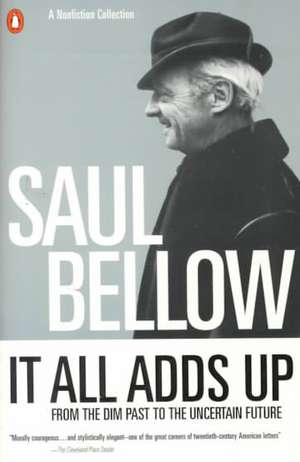
It All Adds Up
Autor Saul Bellowen Limba Engleză Paperback – iun 1995
Considerăm It All Adds Up o piesă centrală în studiul literaturii americane contemporane, volumul integrându-se în curriculumul de critică literară și eseistică ca o cronică a vieții intelectuale din a doua jumătate a secolului XX. Această ediție publicată de Penguin Books nu este doar o antologie de articole, ci o hartă a convingerilor unui laureat al Premiului Nobel, oferind contextul ideatic din spatele marilor sale romane. Structura este riguroasă, evoluând de la analize politice despre epoca lui Roosevelt și Hrușciov în primele părți, către reflecții profunde despre condiția artistului în raport cu statul și societatea publică „distrasă”. Volumul culminează cu impresii de călătorie din Paris, Chicago sau Toscana și o serie de „rămas-bun-uri” emoționante dedicate unor contemporani precum John Cheever. Această lucrare completează perspectiva biografică oferită de Bellow de James Atlas, adăugând vocea directă a autorului acolo unde biograful se oprește la fapte; dacă Atlas analizează viața, Bellow își analizează aici propria arhitectură a gândirii. În contextul operei sale, eseistica din acest volum servește drept fundament teoretic pentru personajele sale cerebrale din Herzog sau Humboldt's Gift. Dacă în ficțiune Bellow explorează „insanitățile la scară mare” ale secolului prin intermediul personajelor, în It All Adds Up el abordează aceste teme frontal, prin argumente critice și observații directe. Este o tranziție de la picarescul narativ la precizia eseului, păstrând însă același spirit interogativ.
Preț: 152.23 lei
Carte disponibilă
Livrare economică 31 octombrie-14 noiembrie
Specificații
ISBN-10: 0140233652
Pagini: 352
Dimensiuni: 129 x 197 x 21 mm
Greutate: 0.42 kg
Editura: PENGUIN RANDOM HOUSE LLC
V-ar putea interesa
-
 Time BitesDoris LessingPreț: 57.68 lei
 -
 Let Me Tell You What I MeanJoan DidionPreț: 78.57 lei
 -
 Notes to JohnJoan DidionPreț: 123.21 lei
 -
 The Life of Saul BellowZachary Leader-14%Preț: 128.12 lei149.66 lei
 -
 Changing My MindZadie Smith-25%Preț: 64.55 lei86.27 lei
 -
 An Apology for IdlersRobert Louis Stevenson-21%Preț: 44.19 lei55.69 lei
 -
 Franny and ZooeyJ. D. SalingerPreț: 63.57 lei
 -
 HerzogSaul Bellow-25%Preț: 59.98 lei79.75 lei
 -
 To Jerusalem and BackSaul Bellow-20%Preț: 62.46 lei78.18 lei
 -
 Preț: 143.39 lei
 -
 A Life in LettersJohn UpdikePreț: 318.14 lei
 -
 The Silvae of StatiusBetty Rose NaglePreț: 123.01 lei
 -
 PulpheadJohn Jeremiah SullivanPreț: 111.83 lei
 -
 CityBrian LennonPreț: 119.72 lei
 -
 Still Life with a BridleZbigniew HerbertPreț: 90.89 lei
 -
 Architecture of DefeatKengo KumaPreț: 353.66 lei
 -
 The ProphetKahlil GibranPreț: 27.21 lei
 -
 The Land of Sweet ForeverHarper LeePreț: 157.03 leiRecomandat
 -
 History MattersDavid McCullough-19%Preț: 115.34 lei142.92 leiRecomandat
 -
 Beautiful and Impossible ThingsOscar WildePreț: 113.65 lei
De ce să citești această carte
Recomandăm această carte cititorilor care doresc să înțeleagă mecanismele din spatele marii literaturi. It All Adds Up oferă acces direct la laboratorul mental al lui Saul Bellow, transformând observația cotidiană în analiză culturală profundă. Este un câștig esențial pentru cei interesați de relația dintre politică, artă și identitate, oferind claritate asupra modului în care un scriitor de calibru procesează istoria în timp ce o trăiește.
Despre autor
Saul Bellow (1915–2005) a fost unul dintre cei mai influenți scriitori americani, singurul autor care a câștigat National Book Award for Fiction de trei ori. Distins cu Premiul Pulitzer și Premiul Nobel pentru Literatură, Bellow este recunoscut pentru capacitatea sa unică de a îmbina aventura picarescă cu analiza subtilă a culturii moderne. Născut în Canada într-o familie de imigranți evrei și stabilit ulterior la Chicago, el a explorat în opere precum The Adventures of Augie March și Ravelstein tensiunea dintre condiția socială și dorința de transcendență spirituală, devenind vocea definitorie a dilemelor intelectuale ale secolului XX.
Descriere scurtă
Cuprins
Mozart: An Overture
Part One: Riding Off in All Directions
In the Days of Mr. Roosevelt
Literary Notes on Khrushchev
The French as Dostoyevsky Saw Them
A Talk with the Yellow Kid
Part Two: Writers, Intellectuals, Politics
The Sealed Treasure
Facts That Put Fancy to Flight
White House and Artists
A Matter of the Soul
An Interview with Myself
Nobel Lecture
Writers, Intellectuals, Politics: Mainly Reminiscence
Part Three: The Distracted Public
The Jefferson Lectures
The Distracted Public
There Is Simply Too Much to Think About
Part Four: Thoughts in Transition
Spanish Letter
Illinois Journey
Israel: The Six-Day War
New York: World-Famous Impossibility
The Day They Signed the Treaty
My Paris
Chicago: The City That Was, the City That Is
Vermont: The Good Place
Winter in Tuscany
Part Five: A Few Farewells
Isaac Rosenfeld
John Berryman
John Cheever
Allan Bloom
William Arrowsmith
Part Six: Impressions and Notions
A Half Life
A Second Half Life
Descriere
Notă biografică
Bellow published his first novel, The Dangling Man, in 1944; this was followed, in 1947, by The Victim. In 1948 a Guggenheim Fellowship enabled Bellow to travel to Paris, where he wrote The Adventures of Augie March, published in 1953. Henderson The Rain King (1959) brought Bellow worldwide fame, and in 1964, his best-known novel, Herzog, was published and immediately lauded as a masterpiece, 'a well-nigh faultless novel' (New Yorker).
Saul Bellow's dazzling career as a novelist was celebrated during his lifetime with an unprecedented array of literary prizes and awards, including the Pulitzer Prize, three National Book Awards, and the Gold Medal for the Novel. In 1976 he was awarded a Nobel Prize 'for the human understanding and subtle analysis of contemporary culture that are combined in his work'.
Bellow's death in 2005 was met with tribute from writers and critics around the world, including James Wood, who praised 'the beauty of this writing, its music, its high lyricism, its firm but luxurious pleasure in language itself'.