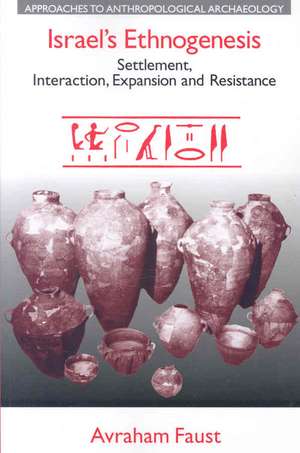
Israel's Ethnogenesis: Settlement, Interaction, Expansion and Resistance
Autor Avraham Fausten Limba Engleză Paperback – 23 iun 2008
| Toate formatele și edițiile | Preț | Express |
|---|---|---|
| Paperback (1) | 266.33 lei 3-5 săpt. | |
| Taylor & Francis – 23 iun 2008 | 266.33 lei 3-5 săpt. | |
| Hardback (1) | 765.93 lei 3-5 săpt. | |
| Taylor & Francis – dec 2006 | 765.93 lei 3-5 săpt. |
Preț: 266.33 lei
Preț vechi: 336.63 lei
-21%
Puncte Express: 399
Preț estimativ în valută:
47.13€ • 55.09$ • 40.92£
47.13€ • 55.09$ • 40.92£
Carte disponibilă
Livrare economică 29 ianuarie-12 februarie
Preluare comenzi: 021 569.72.76
Specificații
ISBN-13: 9781845534561
ISBN-10: 1845534565
Pagini: 306
Dimensiuni: 156 x 234 x 13 mm
Greutate: 0.43 kg
Ediția:1
Editura: Taylor & Francis
Colecția Routledge
Locul publicării:Oxford, United Kingdom
ISBN-10: 1845534565
Pagini: 306
Dimensiuni: 156 x 234 x 13 mm
Greutate: 0.43 kg
Ediția:1
Editura: Taylor & Francis
Colecția Routledge
Locul publicării:Oxford, United Kingdom
V-ar putea interesa
-
 The Rise of the Roman EmpirePolybe-20%Preț: 83.69 lei103.97 lei
 -
 Law and Family in Late Antiquity: The Emperor Constantine's Marriage LegislationJudith Evans Grubbs-37%Preț: 597.69 lei950.87 lei
 -
 Rethinking the MediterraneanW. V. Harris-23%Preț: 427.45 lei556.10 lei
 -
 -24%Preț: 462.22 lei607.17 lei
 -
 -20%Preț: 516.21 lei644.74 lei
 -
 Pyrrho, his Antecedents, and his LegacyRichard Bett-11%Preț: 449.25 lei504.77 lei
 -
 -37%Preț: 574.36 lei913.49 lei
 -
 The Trojans & Their NeighboursTrevor Bryce-23%Preț: 256.30 lei334.69 lei
 -
 -28%Preț: 256.85 lei355.37 lei
 -
 -8%Preț: 540.79 lei587.82 lei
 -
 The New Complete Works of JosephusJosephus FlaviusPreț: 266.69 lei
 -
 Attila The HunChristopher KellyPreț: 110.41 lei
Descriere
This study of ethnicity in the emergence of Israel in Canaan, is wholeheartedly archaeological in scope, using the Bible only as a secondary source of information.