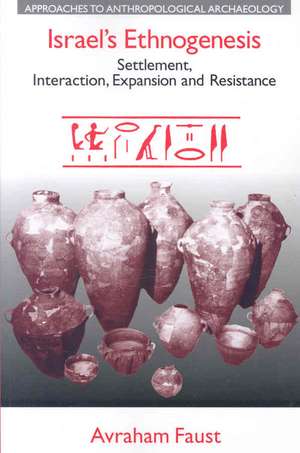
Israel's Ethnogenesis: Settlement, Interaction, Expansion and Resistance
Autor Avraham Fausten Limba Engleză Paperback – 23 iun 2008
Preț: 419.00 lei
Puncte Express: 629
Carte tipărită la comandă
Livrare economică 04-18 decembrie
Livrare prin curier în România Termenul estimat este afișat lângă disponibilitate.
Transport gratuit pentru acest produs Plată online sau ramburs, în funcție de opțiunile comenzii.
Retur gratuit în 14 zile Comandă securizată și suport în română.
Specificații
ISBN-13: 9781845534561
ISBN-10: 1845534565
Pagini: 306
Dimensiuni: 156 x 234 x 13 mm
Greutate: 0.57 kg
Ediția:1
Editura: Taylor & Francis
Colecția Routledge
Locul publicării:Oxford, United Kingdom
ISBN-10: 1845534565
Pagini: 306
Dimensiuni: 156 x 234 x 13 mm
Greutate: 0.57 kg
Ediția:1
Editura: Taylor & Francis
Colecția Routledge
Locul publicării:Oxford, United Kingdom
V-ar putea interesa
-
 The Rise of the Roman EmpirePolybe-18%Preț: 87.82 lei107.65 lei
 -
 Law and Family in Late Antiquity: The Emperor Constantine's Marriage LegislationJudith Evans Grubbs-34%Preț: 653.32 lei983.97 lei
 -
 Rethinking the MediterraneanW. V. Harris-28%Preț: 474.50 lei660.84 lei
 -
 -29%Preț: 511.04 lei714.82 lei
 -
 -31%Preț: 548.52 lei791.43 lei
 -
 Pyrrho, his Antecedents, and his LegacyRichard Bett-27%Preț: 513.25 lei707.75 lei
 -
 -32%Preț: 635.94 lei941.10 lei
 -
 The Trojans & Their NeighboursTrevor BrycePreț: 378.93 lei
 -
 Preț: 403.11 lei
 -
 -8%Preț: 583.42 lei634.14 lei
 -
 The New Complete Works of JosephusFlavius JosephusPreț: 287.89 lei
 -
 Attila The HunChristopher KellyPreț: 115.96 lei
Descriere
This study of ethnicity in the emergence of Israel in Canaan, is wholeheartedly archaeological in scope, using the Bible only as a secondary source of information.