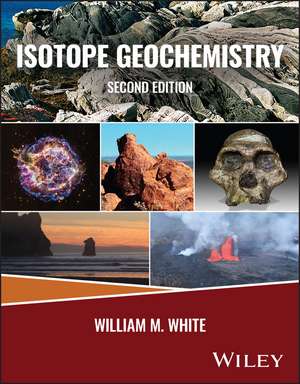
Isotope Geochemistry
Autor William M. Whiteen Limba Engleză Paperback – 6 mar 2023
Cea de-a doua ediție a lucrării Isotope Geochemistry reprezintă o actualizare substanțială a resurselor educaționale dedicate geochimiei, aducând în prim-plan o disciplină care a devenit esențială pentru aproape toate ramurile științelor pământului. Notăm cu interes că această versiune extinde aria de aplicabilitate a izotopilor dincolo de geologia tradițională, introducând un capitol nou dedicat paleontologiei și arheologiei. Această adăugire reflectă tendința modernă de interdisciplinaritate, oferind instrumente analitice precise pentru datarea și interpretarea resturilor biologice și culturale. Suntem de părere că rigoarea structurii sale — de la fundamentele fizicii nucleare și nucleosinteză, până la fracționarea izotopilor stabili — face din acest manual o resursă indispensabilă. William M. White reușește să sintetizeze procese complexe precum evoluția mantalei și a scoarței terestre sau dinamica sistemului hidrologic, menținând un echilibru între teorie și observația empirică. Lucrarea se poziționează ca o continuare firească a expertizei autorului, cunoscut pentru coordonarea Encyclopedia of Geochemistry, însă aici abordarea este mult mai pedagogică și focalizată pe mecanismele de transformare izotopică. Ne-a atras atenția prezentarea grafică integral color, care facilitează înțelegerea modelelor de geocronologie și a hărților de distribuție izotopică. Ca alternativă la Geochemistry de Francis Albarède pentru cursurile de geochimie generală, volumul lui White vine cu avantajul unei specializări profunde în domeniul izotopilor radiogeni și stabili, oferind o perspectivă mai tehnică asupra proceselor de fracționare. În comparație cu Radiogenic Isotope Geology de Alan P. Dickin, care se concentrează preponderent pe izotopii radiogeni, acest manual oferă o viziune unitară, integrând ambele ramuri ale geochimiei izotopice într-un singur volum de referință.
Preț: 596.78 lei
Preț vechi: 775.05 lei
-23%
Carte disponibilă
Livrare economică 30 octombrie-13 noiembrie
Livrare express 16-22 octombrie pentru 91.71 lei
Specificații
ISBN-10: 1119729939
Pagini: 722
Dimensiuni: 216 x 278 x 36 mm
Greutate: 2.04 kg
Ediția:2. Auflage
Editura: Wiley
Locul publicării:Chichester, United Kingdom
V-ar putea interesa
-
 -9%Preț: 911.80 lei1001.97 lei
 -
 -9%Preț: 3554.26 lei3905.79 lei
 -
 Advanced Inorganic Chemistry 6eCarlos A. Murillo-14%Preț: 957.94 lei1113.89 lei
 -
 Cases in BiochemistryKathleen CornelyPreț: 520.85 lei
 -
 Advances Chem Physics V108Prigogine-9%Preț: 2987.60 lei3283.07 lei
 -
 Advances Chem Physics V109Prigogine-9%Preț: 3195.85 lei3511.92 lei
 -
 -23%Preț: 1434.76 lei1863.32 lei
 -
 Modern Techniques for Polymer CharacterisationR A Pethrick-9%Preț: 4506.43 lei4952.12 lei
 -
 Polymer Surfaces Interfaces IIIRichards-9%Preț: 2855.81 lei3138.25 lei
 -
 Disabled ChildrenLaura Middleton-23%Preț: 463.39 lei601.81 lei
 -
 Analytical Applications of RamanPelletier-9%Preț: 1712.37 lei1881.73 lei
 -
 Advances in Electron Transfer ChemistryP.S. Mariano-27%Preț: 838.58 lei1148.74 lei
 -
 Thermodynamics: Processes and ApplicationsEarl Logan Jr.-18%Preț: 1422.30 lei1734.51 lei
 -
 Nanomaterials in Drug Delivery, Imaging, and Tissue EngineeringAshutosh Tiwari-5%Preț: 1850.37 lei1947.76 lei
 -
 -23%Preț: 608.16 lei789.82 lei
 -
 Dictionary of DNA and Genome TechnologyPaul Singleton-23%Preț: 841.19 lei1092.46 lei
 -
 GeochemistryWilliam M. White-19%Preț: 594.57 lei734.04 lei
 -
 Spectral Properties of LipiosHamilton-9%Preț: 1488.48 lei1635.68 lei
 -
 NUCLEAR POWER, ENERGY & THE ENVIRONMENTHodgson Peter E-15%Preț: 565.21 lei664.96 lei
De ce să citești această carte
Recomandăm această carte studenților de la geologie și cercetătorilor care au nevoie de un fundament solid în utilizarea izotopilor ca trasori și cronometre. Cititorul câștigă acces la cele mai noi metode de datare și analiză a sistemului terestru, beneficiind de un capitol inedit despre aplicațiile în arheologie. Este o investiție în înțelegerea cantitativă a evoluției planetei, de la formarea sistemului solar până la schimbările climatice actuale.
Descriere scurtă
ISOTOPE GEOCHEMISTRY Provides a thorough and up-to-date overview of radiogenic and stable isotope geochemistry Now in its second edition, Isotope Geochemistry presents a comprehensive introduction to radiogenic and stable isotope geochemistry. The first five chapters cover fundamentals including the physics of nuclei, radioactive decay, nucleosynthesis, geochronology, and the theory of stable isotope fractionation. The next chapter focuses on the isotope geochemistry of meteorites and their constraints on the formation of the solar system and the Earth. The subsequent three chapters cover radiogenic and stable isotope geochemistry evolution of the Earth's mantle and crust. Three more chapters are devoted to the Earth's surface, the exogene, including the hydrologic system, the biosphere, and climate. A new chapter in this edition focuses on the use of isotopes in paleontology and archeology. The final chapter is devoted to the isotope geochemistry of the noble gases. Illustrated in full color throughout, Isotope Geochemistry is intended primarily as a textbook for advanced undergraduate and graduate students. It is also intended as a reference for earth science professionals, reflecting the impact that isotope geochemistry has on virtually every aspect of the earth sciences, from climate change and geomorphology to geodynamics.
Notă biografică
Cuprins
2: Decay Systems and Geochronology I 2.1 Basics of Radioactive Isotope Geochemistry 2.2 Fundamentals of Geochronology 2.3 The K-Ar-Ca system 2.4 The Rb-Sr System 2.5 Rare Earth Decay Systems 2.6 The Re-Os-Pt System
3: Decay Systems and Geochronology II: U and Th 3.1 Introduction 3.2 Pb-Pb Ages and Isochrons 3.3 Zircon Dating 3.4 U-Decay Series Dating
4: Geochronology III: Other Dating Methods 4.1 Introduction 4.2 Cosmogenic Nuclides 4.3 Thermochronology
5: Fractionation of isotopes 5.1 Introduction 5.2 Notation, definitions, and standards 5.3 Theory of Equilibrium isotopic fractionations 5.4 Kinetic fractionation 5.5 Mass dependent versus mass dependent fractionation
6: Isotope Cosmochemistry 6.1 Introduction 6.2 Star Birth 6.3 Meteorites 6.4 Cosmochronology 6.5 Stardust 6.6 Isotopic variations in bulk meteorites 6.7 Cosmic ray exposure ages of meteorites
7: Isotope Geochemistry of the Mantle 7.1 Introduction 7.2 Composition of the Earth's Mantle 7.3 Radiogenic isotopes in oceanic basalts 7.4 Inferences on mantle structure and evolution 7.5 The Subcontinental Lithosphere 7.6 U-Series Isotopes and Melt Generation
8: Isotope geochemistry of the continental crust 8.1 Introduction 8.2 Mechanisms of crustal growth 8.3 The earliest continental crust 8.4 The continental crust through time 8.5 Isotopic composition of the continental crust 8.6 Subduction Zones
9: Stable Isotopes in the solid Earth 9.1 Introduction 9.2 Equilibrium Fractionations Among Minerals 9.3 Geothermometry 9.4 Stable Isotope Composition of the Mantle 9.5 Oxygen Isotopes in Hydrothermal Systems 9.6 Sulfur Isotopes in magmatic and hydrothermal systems 9.7 Copper isotopes in ore deposits
10: Light Stable Isotopes in the exogene 10.1 Introduction 10.2 The hydrologic system 10.3 isotope ratios in the biosphere 10.4 isotope ratios in the atmosphere
11: Non-traditional stable and radiogenic isotopes in the exogene 11.1 Introduction 11.2 Radiogenic isotopes in the modern ocean 11.3 Stable isotope ratios of conservative elements 11.4 Stable isotope ratios of nutrient elements 11.5 Stable isotope ratios of transition metals
12: Paleoclimate, paleoceanography, and atmospheric history 12.1 Introduction 12.2 The Pleistocene Climate Record in Deep Sea Sediments 12.3 Isotopes in paleoceanography 12.4 Climate in the Cenozoic 12.5 Carbon isotopes, atmospheric carbon dioxide, and climate 12.6 Tracing the evolution of atmospheric oxygen
13: Life, Paleoecology, and Human History 13.1 Introduction 13.2 Isotopes in evolution 13.3 Isotopes and diet: you are what you eat 13.4 Paleoecology of grasslands 13.5 Paleoecology of the Pleistocene Tundra Steppe 13.6.1 Domestication of maize 13.7 The metallurgical revolution
14: Noble Gas Isotope Geochemistry 14.1 Introduction 14.1.1 Noble Gas Chemistry 14.2 Noble Gases in the Solar System 14.3 Helium 14.4 Neon 14.5 Argon 14.6 Krypton 14.7 Xenon 14.8 Implications of Noble Gas Isotope Ratios for the Origin and Evolution of the Earth 14.9 Noble gas constraints on formation and evolution of the Earth