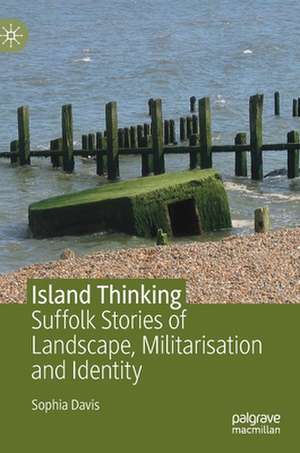
Island Thinking
Autor Sophia Davisen Limba Engleză Hardback – 15 aug 2019
Preț: 405.63 lei
Puncte Express: 608
Carte tipărită la comandă
Livrare economică 28 noiembrie-12 decembrie
Livrare prin curier în România Termenul estimat este afișat lângă disponibilitate.
Transport gratuit pentru acest produs Plată online sau ramburs, în funcție de opțiunile comenzii.
Retur gratuit în 14 zile Comandă securizată și suport în română.
Specificații
ISBN-13: 9789811396755
ISBN-10: 9811396752
Pagini: 316
Ilustrații: XIII, 302 p. 32 illus., 17 illus. in color.
Dimensiuni: 153 x 216 x 22 mm
Greutate: 0.48 kg
Ediția:1st ed. 2020
Editura: Springer
Locul publicării:Singapore, Singapore
ISBN-10: 9811396752
Pagini: 316
Ilustrații: XIII, 302 p. 32 illus., 17 illus. in color.
Dimensiuni: 153 x 216 x 22 mm
Greutate: 0.48 kg
Ediția:1st ed. 2020
Editura: Springer
Locul publicării:Singapore, Singapore
Cuprins
1. Island Stories.- 2. Secluded Suffolk: Countryside Writing, c.1930–1960.- 3. Invaded Island: Wartime Enclosures and Postwar Memories.- 4. Looking to the Skies: Postwar Radar Stories.- 5. Birds and Belonging: The Return of the Avocet, 1947–1969.- 6. Nature Set in Reserve: 1950s–60s Nature Conservation.- 7. Rewilding and War Monuments: Orford Ness, c.1995 to the Present.- 8. Conclusion.
Recenzii
“Davis offers a good account of how Britain was affected by preparations for war (and defence) through the case study of Suffolk. The writing is enlightening and perceptive … .” (Gary Willis, Agricultural History Review, Vol. 69 (1), 2021)
Notă biografică
Sophia Danielle Davis completed her Ph.D. at the University of Cambridge in the History and Philosophy of Science, and was subsequently a research scholar at the Max Planck Institute for the History of Science, Berlin.
Textul de pe ultima copertă
Island Thinking is a cultural historical and geographical study of Englishness in a key period of cultural transformation in mid-twentieth century Britain as the empire shrank back to its insular core. The book uses a highly regional focus to investigate the imaginative appeal of islands and boundedness, interweaving twentieth-century histories of militarisation, countryside, nature conservation and national heritage to create a thickly textured picture of landscape and history. Referred to as an ‘island within an island’, Suffolk's corner of England provides fascinating stories displaying a preoccupation with vulnerability and threat, refuge and safety. The book explores the portrayal of the region in mid-century rural writing that ‘rediscovered’ the countryside, as well as the area’s extensive militarisation during the Second World War. It examines various enclosures, from the wartime radar project to ‘make Britain an island again’ to the postwar establishment of secludednature reserves protecting British birds.
Caracteristici
Explores the imaginative appeal of Britain as an island, feeding narratives of isolation and separation Focusing on coastal Suffolk, the book uses a regional study to unravel the motif of the island, alternately zooming in to Suffolk and out to the nation Creates a thickly textured picture of landscape and history, through interweaving natural history, literary history, and military history Connecting local issues to broader themes, the author takes the reader on a tour through the history of English countryside, nature conservation, and national heritage, as well as episodes connecting science and warfare, and the militarization of landscape Draws on a wide range of rare source material, including countryside guides, fiction, local oral histories, archive material in natural history, memoirs, interviews, and the author’s own impressions of the landscapes