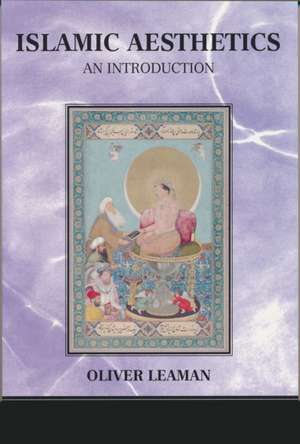
Islamic Aesthetics – An Introduction
Autor Oliver Leamanen Limba Engleză Paperback – 11 sep 2023
Leaman criticizes the influence of Sufism on Islamic aesthetics and contends that it is generally misleading regarding both the nature of Islam and artistic expression. He discusses issues arising in painting, calligraphy, architecture, gardens, literature, films, and music and pays close attention to the teachings of the Qur'an. In particular he asks what it would mean for the Qur'an to be a miraculous literary creation, and he analyzes two passages in the Qur'an--those of Yusuf and Zulaykha (Joseph and Zuleika) and King Sullayman (Solomon) and the Queen of Sheba. His arguments draw on examples from history, art, philosophy, theology, and the artefacts of the Islamic world, and raise a large number of difficulties in the accepted paradigms for analyzing Islamic art.
Preț: 191.30 lei
Puncte Express: 287
Carte tipărită la comandă
Livrare economică 05-19 iunie
Specificații
ISBN-13: 9780268033705
ISBN-10: 0268033706
Pagini: 256
Dimensiuni: 152 x 228 x 11 mm
Greutate: 0.35 kg
Ediția:1
Editura: MR – University of Notre Dame Press
ISBN-10: 0268033706
Pagini: 256
Dimensiuni: 152 x 228 x 11 mm
Greutate: 0.35 kg
Ediția:1
Editura: MR – University of Notre Dame Press
V-ar putea interesa
-
 Art in ChinaCraig Clunas-24%Preț: 137.92 lei181.61 lei
 -
 Vanished SmileR. A. ScottiPreț: 104.28 lei
 -
 Islam: The Key ConceptsKecia AliPreț: 283.07 lei
 -
 World PhilosophiesNinian SmartPreț: 437.80 lei
 -
 Symbolist Art in ContextMichelle FacosPreț: 281.03 lei
 -
 The Biographical Encyclopedia of Islamic PhilosophyOliver Leaman-38%Preț: 364.39 lei586.06 lei
 -
 The Qur'an: A Philosophical GuideOliver Leaman-26%Preț: 173.98 lei233.71 lei
 -
 The Art of the Body: Antiquity and its LegacyMichael Squire-22%Preț: 172.16 lei220.91 lei
 -
 A Closer Look: Conservation of PaintingsDavid BomfordPreț: 84.15 lei
Recenzii
"This is certainly an important and thought-provoking work, one of the few that is willing to treat seriously the topic of aesthetics in Islam. As such, this book provides an important corrective to much of what has been written about art in various Islamic contexts over the past century."—The Journal of Religion
Notă biografică
OLIVER LEAMAN is professor of philosophy at the University of Kentucky.
Descriere
Descriere de la o altă ediție sau format:
“This is a useful and imaginative project . . . Leaman is an accomplished and productive author and the book will be of genuine and considerable interest.” —Lenn E. Goodman, Vanderbilt University
It is often argued that a very special sort of consciousness went into creating Islamic art, that Islamic art is very different from other forms of art, that Muslims are not allowed to portray human beings in their art, and that calligraphy is the supreme Islamic art form. Oliver Leaman challenges all of these ideas, and argues that they are misguided. Instead, he suggests that the criteria we should apply to Islamic art are identical to the criteria applicable to art in general, and that the attempt to put Islamic art into a special category is a result of orientalism.
Leaman criticizes the influence of Sufism on Islamic aesthetics and contends that it is generally misleading regarding both the nature of Islam and artistic expression. He discusses issues arising in painting, calligraphy, architecture, gardens, literature, films, and music and pays close attention to the teachings of the Qur’an. In particular he asks what it would mean for the Qur’an to be a miraculous literary creation, and he analyzes two passages in the Qur’an—those of Yusuf and Zulaykha (Joseph and Zuleika) and King Sullayman (Solomon) and the Queen of Sheba. His arguments draw on examples from history, art, philosophy, theology, and the artefacts of the Islamic world, and raise a large number of difficulties in the accepted paradigms for analyzing Islamic art.