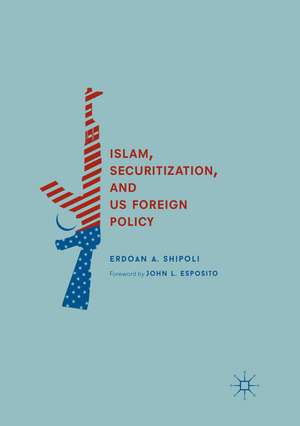
Islam, Securitization, and US Foreign Policy
Autor Erdoan A. Shipolien Limba Engleză Paperback – 22 dec 2018
Preț: 510.36 lei
Preț vechi: 600.42 lei
-15%
Puncte Express: 766
Carte tipărită la comandă
Livrare economică 18 noiembrie-02 decembrie
Livrare prin curier în România Termenul estimat este afișat lângă disponibilitate.
Transport gratuit pentru acest produs Plată online sau ramburs, în funcție de opțiunile comenzii.
Retur gratuit în 14 zile Comandă securizată și suport în română.
Specificații
ISBN-13: 9783030100155
ISBN-10: 3030100154
Pagini: 348
Ilustrații: XVII, 327 p.
Dimensiuni: 148 x 210 x 19 mm
Greutate: 0.45 kg
Ediția:Softcover reprint of the original 1st ed. 2018
Editura: Springer
Locul publicării:Cham, Switzerland
ISBN-10: 3030100154
Pagini: 348
Ilustrații: XVII, 327 p.
Dimensiuni: 148 x 210 x 19 mm
Greutate: 0.45 kg
Ediția:Softcover reprint of the original 1st ed. 2018
Editura: Springer
Locul publicării:Cham, Switzerland
Cuprins
1. Introduction.- 2. A Theoretical Approach to US Foreign Policy.- 3. Islam in US Politics.- 4. Securitization of Islam in US Foreign Policy.- 5. US Democracy Promotion.- 6. Levels of Securitization.- 7. Conclusion: What's Next?.
Textul de pe ultima copertă
This book argues that Islam has been securitized in US foreign policy, especially during the W. Bush administration when it was increasingly portrayed as the ultimate “other.” This securitization was realized through the association of Islam with unique security threats in speeches of foreign policy and national security. By analyzing the four recent US presidents’ discourses on Islam, this work sheds light on how they viewed Islam and addresses the following questions: How do we talk about Islam, its place and relationship within the context of US security? How does the language we use to describe Islam influence the way we imagine it? How is Islam constructed as a security issue?
Erdoan A. Shipoli is Visiting Scholar at the Center for Muslim-Christian Understanding at Georgetown University, USA. He is also a social entrepreneur and has established numerous international organizations to advance dialogue, leadership, and youth development.
Caracteristici
Analyzes how Islam has been securitized in the US on a state level Details how US foreign policy makers have securitized Islam first in policy discourses, and then globally as part of a systemic securitization process Further develops securitization theory by using Islam as an example